


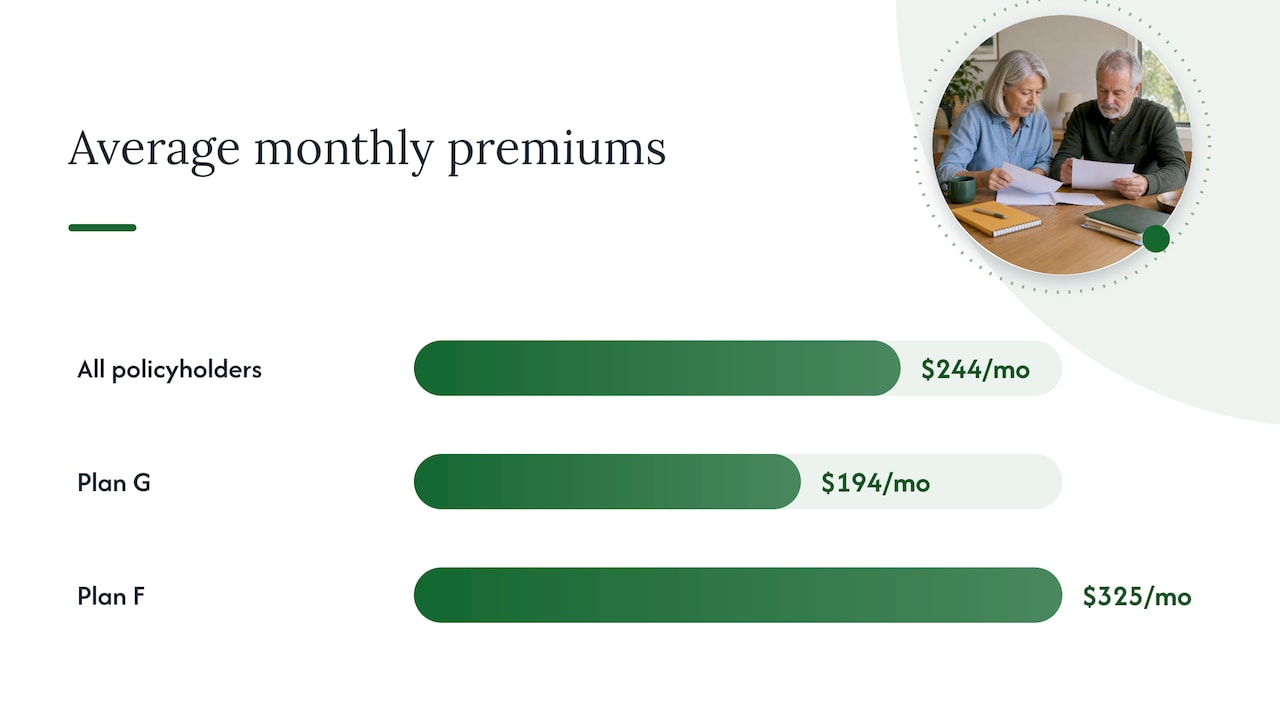
Medigap (Medicare Supplement) premiums averaged $244 a month across all policyholders in 2025, and Plan G averaged $194, according to KFF’s analysis of national insurance data. Your own price depends on the plan letter, your ZIP code, your age, and how the insurer sets rates. Because every company must offer identical benefits for a given letter, the price is the only thing that separates one Plan G from another. That is where a licensed local planner earns their keep: comparing the same plan across carriers, explaining how each one raises rates, and doing it at no cost to you.
TL;DR
- The 2025 average Medigap premium was $244 a month ($2,926 a year). Plan G averaged $194 a month and Plan F $325, per KFF.
- Your premium depends on plan letter, location, age, tobacco use, discounts, and the insurer.
- How a policy is rated (community, issue-age or attained-age) decides how fast your premium climbs. Florida bans attained-age rating.
- Medigap premiums are separate from, and on top of, your Medicare Part B premium.
- Compare the same plan letter across several companies, and ask each how it has raised rates in recent years.
Table of Contents
- What Medigap premiums look like nationally
- What sets your Medigap premium
- Why your premium can rise: three ways insurers price
- Medigap is only part of your monthly Medicare bill
- How to compare Medigap premiums step by step
- Perspective
- Get a Medigap comparison from a local planner
- FAQ
- Sources
What Medigap premiums look like nationally
Medigap is private insurance that helps pay the costs Original Medicare leaves behind, such as deductibles and coinsurance. You pay the premium directly to the insurance company each month.
KFF’s October 2026 analysis of 2025 data from the National Association of Insurance Commissioners gives the clearest benchmark. The numbers describe people who already hold policies, so they include long-time holders who bought years ago.
| Measure (2025 average) | Monthly premium | Range across states |
|---|---|---|
| All Medigap policyholders | $244 ($2,926 a year) | $214 in Hawaii to $306 in New York |
| Plan G | $194 ($2,323 a year) | $164 in New Mexico to $257 in New York |
| Plan F | $325 | $243 in Vermont to $378 in Nebraska |
Source: KFF, Key Facts About Medigap Enrollment and Premiums.
Two things stand out. First, the spread between states is large even for the same plan. Second, Plan F averages more than Plan G, partly because Plan F is closed to anyone who became eligible for Medicare on or after January 1, 2020, so its pool is older. Plan G is the most popular comprehensive plan for newly eligible beneficiaries. If you want a closer look at that plan’s pricing, our page on Medicare Supplement Plan G cost walks through it.
These are averages across everyone who holds a policy, not quotes. Your quote is the only number that matters for your budget, and it can land well above or below the average.
What sets your Medigap premium
Medicare.gov says Medigap premiums vary by insurance company, plan, and where you live. They can also depend on several other things.
Plan letter
Plans A through N differ in how much of your cost-sharing they cover. Broader coverage generally means a higher premium. The benefits in each lettered plan are the same no matter which company sells it, so a Plan G from one insurer covers exactly what a Plan G from another does.
Location
Medicare is federal, but Medigap is regulated state by state. KFF reports that 37 states and D.C. allow any rating system. Nine states (Arkansas, Connecticut, Idaho, Massachusetts, Maine, Minnesota, New York, Vermont and Washington) require community rating for people 65 and older. Four states (Arizona, Florida, Georgia and Missouri) allow issue-age rating but prohibit attained-age rating. Within a state, premiums can also vary by ZIP code.
Age, sex and tobacco use
State consumer guides, such as Missouri’s 2025 Medigap Shopping Guide, note that charges can vary with your age when you apply, where you live, the company, and often your gender and smoking status.
Discounts and underwriting
Medicare.gov lists discounts that insurers may offer for women, non-smokers, married people, paying yearly, paying by electronic funds transfer, or holding multiple policies. Premiums may also reflect medical underwriting. That is a health review the insurer may require if you apply outside your guaranteed-issue rights, such as after your initial Medigap open enrollment window.
Plan design options
Two designs lower the premium in exchange for a trade-off in how you use care:
- High-deductible Plan F or G. In 2026 you pay the first $2,950 of costs Medicare doesn’t cover before the policy pays anything, per the CMS guide to choosing a Medigap policy.
- Medicare SELECT. Oregon’s 2026 SHIBA guide explains that these plans offer the same basic benefits and usually cost less because routine care is limited to a provider network. Emergency care is covered like a standard plan.
Why your premium can rise: three ways insurers price
The sticker price at 65 tells you little about what you will pay at 75. Each company chooses how to rate its policies, and the CMS guide describes three methods:
- Community-rated. Generally the same premium regardless of age.
- Issue-age-rated. The premium is based on your age when you buy and does not rise because you get older.
- Attained-age-rated. The premium rises as you age. It may be the cheapest at first and eventually the most expensive.
Arizona’s insurance department gives a plain example: a 72-year-old paying $165 under attained-age pricing would see $171 at 73 and $177 at 74 (Arizona DIFI, 2020 guide). The figures are from an older guide, but the mechanics are the same today.
If you live in Florida, as many of our clients in Orange Park, Fleming Island and Jacksonville do, attained-age rating is prohibited, per KFF’s state breakdown. That doesn’t make every Florida quote equal, because insurers still raise rates for all policyholders over time.
Rate increases hit every rating type
Premiums may also rise because of inflation and other factors, according to the CMS guide. The Nevada Division of Insurance adds that rates can change when companies file new rates and because of an insurer’s rising claims for similar policyholders (Nevada DOI, 2026 guide).
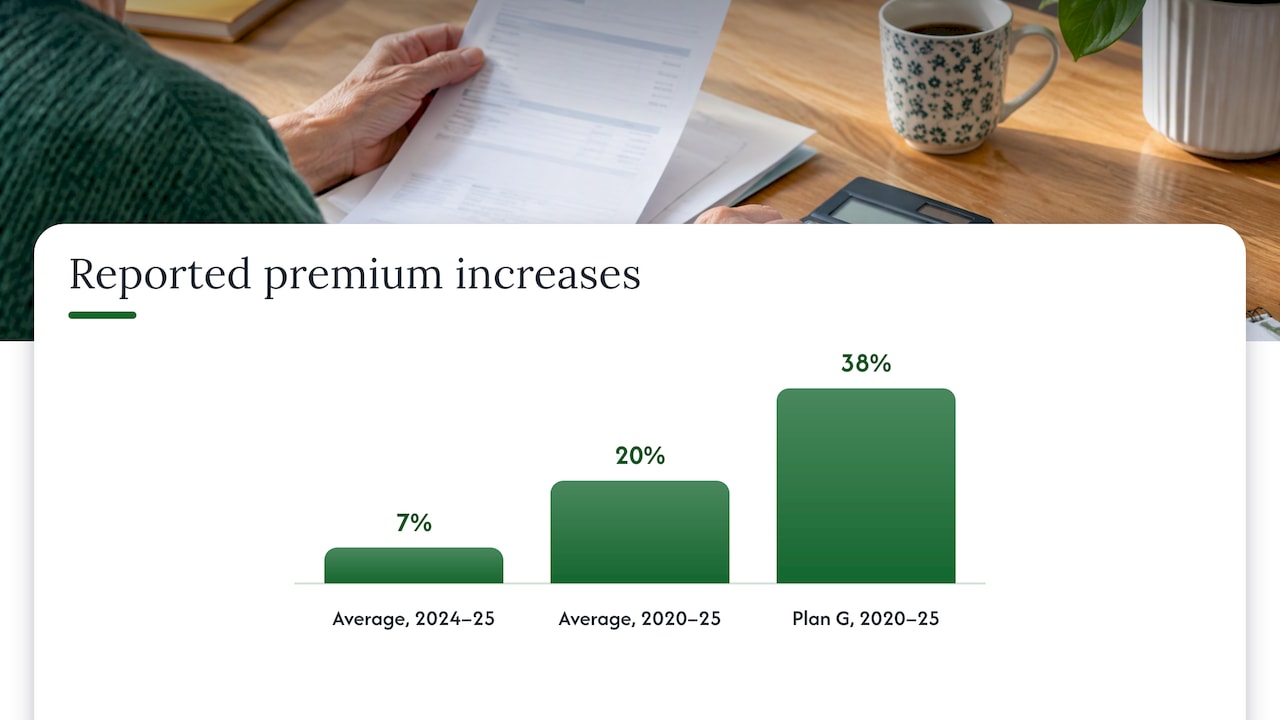
The scale is worth knowing. KFF found average premiums rose 7% between 2024 and 2025, and 20% between 2020 and 2025. Plan G premiums rose 38% over the five-year period. We explain how those increases happen and what you can do in our guide to Medigap rate increases.
Medigap is only part of your monthly Medicare bill
When you buy Medigap, you pay the insurer a monthly premium and you still pay your Part B premium. Medicare doesn’t pay Medigap premiums, per Medicare.gov.
For 2026, CMS lists the standard Part B premium at $202.90 a month, with a $283 annual deductible. Part B is set annually, and some people pay more based on income. Our page on what Medicare Part B costs per month covers the details.
A worked example using national averages: a Plan G premium of $194 plus the 2026 Part B premium of $202.90 comes to about $397 a month before any drug plan. Budget the Medigap premium alongside everything else you pay for your health, from a Part D drug plan to wellness spending such as compression therapy costs. A stand-alone Part D plan has its own premium, which we cover on our Part D prescription drug plans page.
How to compare Medigap premiums step by step
The CMS guidance is consistent: compare like with like. Here is the routine, and where it tends to go wrong.
Step 1: Pick the plan letter first
Decide which letter fits your health and budget before looking at prices. Comparing a Plan N quote to a Plan G quote tells you nothing about which company is cheaper. If you are weighing the two most common choices, see Plan G vs Plan F. Plan F is only open to people eligible for Medicare before 2020.
Step 2: Get quotes for that one letter from several companies
Medicare.gov and CMS both advise contacting more than one insurer. Where it goes wrong: a single online quote form shows one company’s price and often leaves out its rating method and rate history. At Greenins, our Medicare Insurance Planners compare plans across top carriers for you, which saves you from calling each insurer and re-explaining your situation.
Step 3: Ask how the price is set
The CMS guide suggests asking each insurer:
- Is the policy community-, issue-age- or attained-age-rated?
- What would the premium be at my age?
- How often does an attained-age premium rise because of age?
- Has the premium gone up in the last three years because of inflation or other reasons?
The last question matters most. Two quotes that look identical today can diverge sharply after a few years of increases.
Step 4: Check for discounts and design options
Ask about the discounts listed above (non-smoker, married, annual payment, electronic payment, multiple policies). Ask whether a Medicare SELECT or high-deductible version exists, and what trade-off comes with it.
Step 5: Use official state tools
Many states publish rate comparison tables. New York’s Department of Financial Services, for example, posts Medicare Supplement rate tables by insurer, plan letter and region. A premium shown for a region may be offered in only part of it, so exact rates come from the state’s lookup tool. Your State Health Insurance Assistance Program (SHIP) is a federally funded counseling resource that can also point you to your state’s guide.
Step 6: Revisit it every year
Premiums typically rise each year, so a plan that was competitive at enrollment may not be later. Our annual coverage review looks at whether your current premium still makes sense against what’s on the market.
Perspective
Most people who call us about Medigap premiums ask the same thing: “What is the cheapest Plan G?” It is a fair question, but it is only half the question. A low price at 65 means little if the company’s rate history is steep, or if the rating method means your cost climbs every birthday.
We built our approach around education first. Our certified Medicare Insurance Planners® compare plans across top carriers, explain how each one prices, and make sure you understand what you are choosing before you enroll. Our consultations are free to you, and we are paid by the carrier if you enroll, so there is no reason to rush you.
What separates us from a call center is what happens afterward. We offer ongoing in-person support for claims, appeals and annual reviews, so when a rate notice arrives in the mail you have someone local to ask.
Zach
Get a Medigap comparison from a local planner
If you are turning 65 or reviewing a policy whose premium keeps climbing, our Insurance Plan Comparison and Annual Medicare Coverage Review services are built for exactly this. We compare the same plan letter across carriers, explain the rating method behind each quote, and stay available for questions long after you enroll.

See how our Medicare Supplement (Medigap) plans work, or start with our services to book a consultation.
FAQ
How much do Medigap plans cost per month?
KFF’s 2025 data puts the average across all policyholders at $244 a month, with Plan G averaging $194. State averages ranged from $214 in Hawaii to $306 in New York. Your own quote depends on your plan, ZIP code, age and the insurer.
Are Medicare Supplement premiums the same as Medigap premiums?
Yes. Medicare Supplement insurance and Medigap are two names for the same private policies that fill gaps in Original Medicare. You pay the premium to the insurance company, and it is separate from your Part B premium.
Why did my Medigap premium go up?
Insurers can raise rates when they file new rates with the state, when claims rise for similar policyholders, and because of inflation. If your policy is attained-age-rated, age also pushes it up. Florida prohibits attained-age rating, but increases still happen. A planner can compare your current premium against other carriers’ prices for the same letter.
Does Medicare pay my Medigap premium?
No. Per Medicare.gov, you pay the insurer a monthly premium and you must also keep paying your Part B premium. Premium amounts typically increase each year.
Sources
- KFF: Key Facts About Medigap Enrollment and Premiums for Medicare Beneficiaries
- Medicare.gov: Get Medigap costs
- Medicare.gov: Choosing a Medigap Policy
- CMS: Medicare Deductible, Coinsurance and Premium Rates, CY 2026 Update
- Missouri Department of Insurance: 2025 Medigap Shopping Guide
- Oregon SHIBA: 2026 Guide to Medicare Insurance Plans
- Arizona DIFI: 2020 Guide to Health Insurance
- Nevada Division of Insurance: Medicare Supplement Insurance Premium Comparison Guide
- New York DFS: Medicare Supplement plans and rates