


Original Medicare covers a wide range of telehealth services right now, including visits delivered to you at home, and that access is locked in through December 31, 2027. Behavioral health telehealth, including audio-only sessions, is permanent. Most other flexibilities are not, and unless Congress acts again, they revert to stricter, pre-pandemic rules on January 1, 2028. Expect the usual Part B deductible and 20% coinsurance, and confirm details with your specific plan.
TL;DR:
- Telehealth services delivered at home remain covered through December 31, 2027, including audio-only behavioral health visits, which will stay permanent regardless of future legislation.
- Most outpatient, specialist, and therapy telehealth services are set to revert to stricter, pre-pandemic rules starting January 1, 2028, unless Congress intervenes.
- Telehealth billing depends on specific codes and location, with providers using POS 10 for home visits, and patients should verify if facility fees or in-person requirements will apply later.
- A broad range of practitioners, including nurse practitioners and social workers, can bill Medicare for telehealth until the end of 2027, especially in underserved and rural areas.
- Beneficiaries relying on ongoing telehealth care should confirm with their providers now whether their services will require an in-person visit after 2027, and document any current arrangements.
Table of Contents
- What Does Telehealth Medicare Coverage Actually Include Right Now?
- Which Telehealth Services Have Special Rules or Exceptions?
- How Much Will a Telehealth Visit With Medicare Cost You?
- Who Can Provide Telehealth Care Under Medicare Right Now?
- What Happens to Telehealth Coverage on January 1, 2028?
- How Do You Confirm Your Own Telehealth Coverage?
- A Straight Take on the Telehealth Cliff
- Get Help Reviewing Your Medicare Coverage Before the Rules Change
- Where to Verify Telehealth Rules Yourself
- Sources
- FAQ
What Does Telehealth Medicare Coverage Actually Include Right Now?
Medicare defines a covered telehealth visit as a real-time, interactive audio-video substitute for an in-person appointment, not a one-way text message or a portal note from your doctor. The exception is behavioral health care, where audio-only calls qualify when video isn’t practical, a rule the Centers for Medicare & Medicaid Services (CMS) has kept in place because it recognizes that not every beneficiary has reliable video access.
Through 2027, Original Medicare beneficiaries can generally use telehealth for:
- Office and outpatient visits with a physician or qualified practitioner
- Individual and group psychotherapy
- Specialist consultations, including many follow-up appointments
- Diabetes self-management training
- Cognitive assessments and care planning
- Speech, occupational, and physical therapy services
CMS maintains an official telehealth services list that gets updated periodically, and it’s worth checking before assuming a specific service qualifies. Some services fall outside these telehealth rules entirely and get covered under different Medicare categories, like remote patient monitoring or chronic care management. Those aren’t restricted to the temporary flexibilities the same way, so they aren’t at risk in the 2028 changes discussed below.
Which Telehealth Services Have Special Rules or Exceptions?
Not every telehealth category works the same way, and the differences matter if you’re trying to figure out whether a visit will actually get paid.
Behavioral health stands apart. Congress made home access and audio-only allowances permanent for mental health care, so a beneficiary getting therapy by phone from their kitchen table isn’t affected by anything happening in 2027 or 2028.
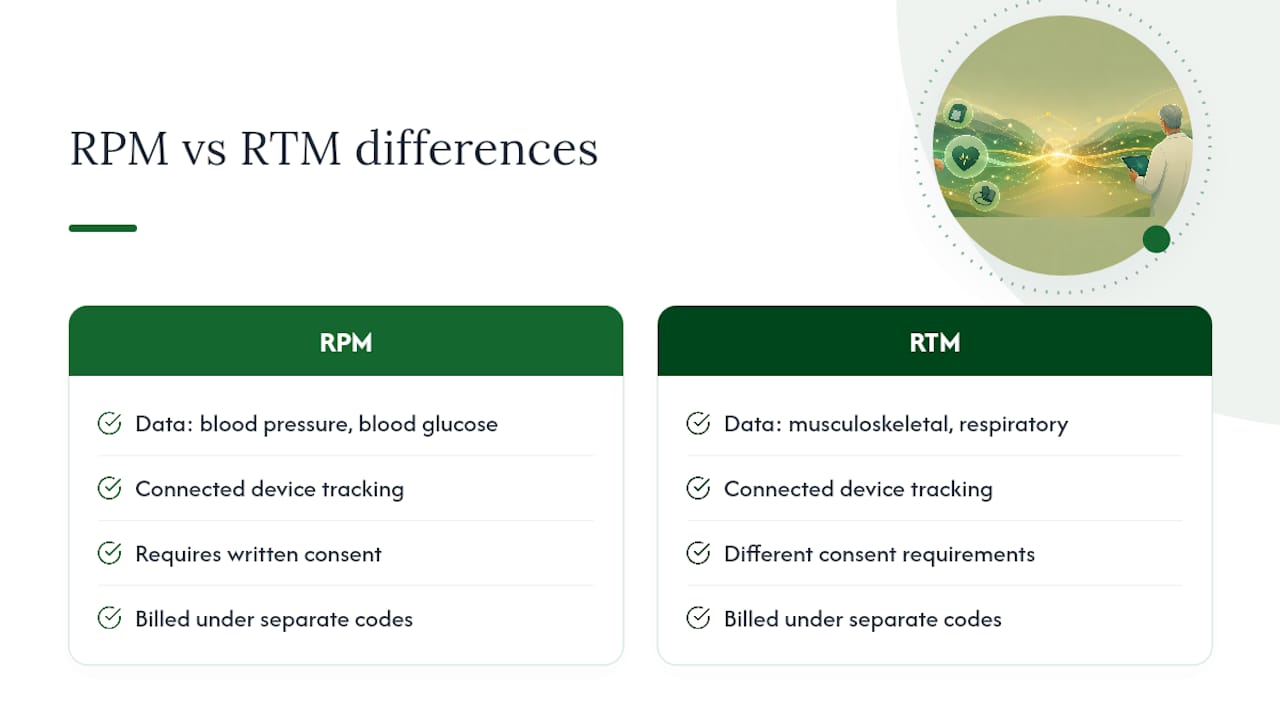
Remote physiologic monitoring (RPM) is different from a telehealth visit. It tracks things like blood pressure or blood glucose through a connected device, requires your written consent, and bills under separate codes. Remote therapeutic monitoring (RTM), a newer cousin, covers musculoskeletal and respiratory data instead of vital signs; the two get confused constantly, but they’re billed differently and have different consent requirements.
Therapy and rehab services delivered by telehealth are allowed through 2027, but some therapist types could lose telehealth billing rights in 2028 depending on how the rules settle. Hospital outpatient services delivered into a patient’s home also run on the same 2027 clock.
Pro Tip: If you’re mid-treatment with a therapist or specialist through telehealth, ask now whether that specific service is expected to require an in-person switch after 2027. Don’t wait for a surprise denial.
How Much Will a Telehealth Visit With Medicare Cost You?
Telehealth visits generally cost the same as an in-person appointment. You pay your Part B deductible first, then 20% coinsurance on the Medicare-approved amount, with Medicare covering the rest.
Billing codes matter more than most beneficiaries realize. Providers use POS 10 when you’re receiving telehealth at home, and that visit gets paid at the nonfacility Physician Fee Schedule rate under the CY 2026 Medicare Physician Fee Schedule final rule (MM14315). POS 02 applies when you’re at a location other than home, such as a clinic serving as your connection point.
If you’re physically sitting in a qualifying facility for your telehealth appointment rather than home, that facility may bill an originating site facility fee, HCPCS code Q3014. You could owe coinsurance on that fee separately from the visit itself.
- Ask your provider’s billing office which POS code they plan to use
- Confirm the provider accepts Medicare assignment before the appointment
- Request a written cost estimate if you’re unsure about facility fees
Who Can Provide Telehealth Care Under Medicare Right Now?
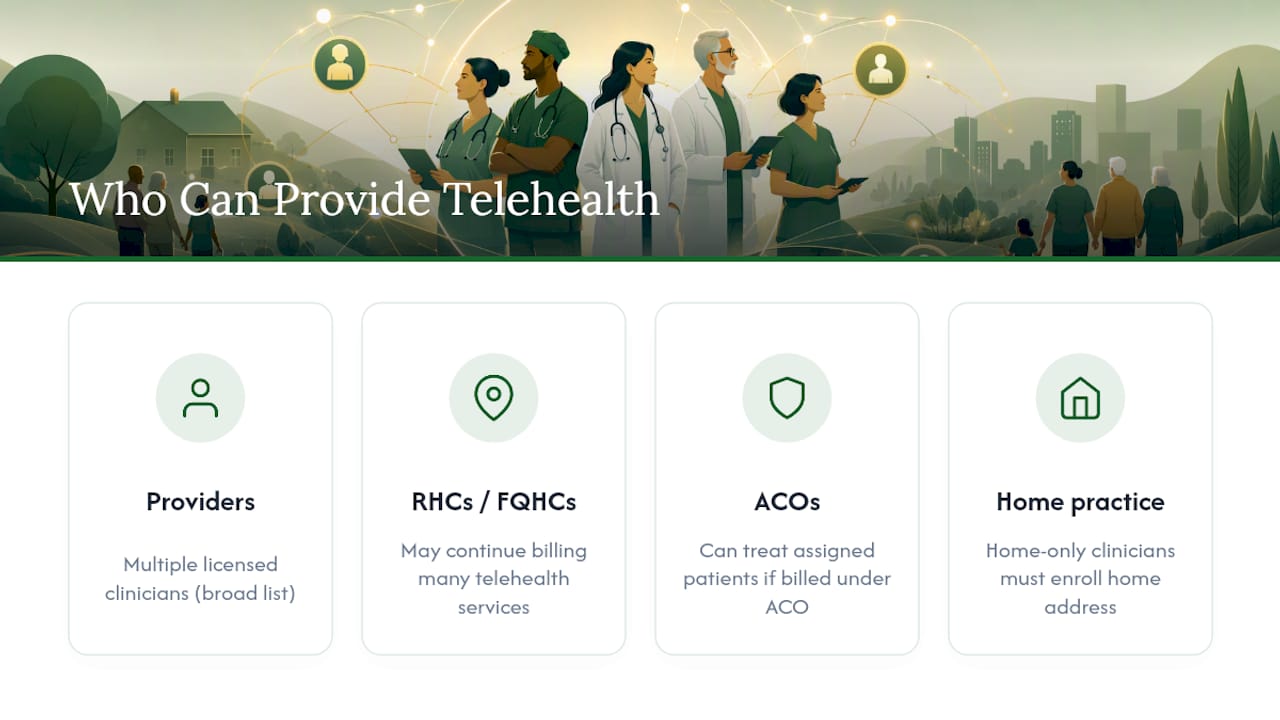
Through the end of 2027, an expanded roster of practitioners can bill Medicare for telehealth: physicians, nurse practitioners, physician assistants, clinical psychologists, clinical social workers, and several other licensed professionals. That’s a much broader list than the pre-pandemic rules allowed, which limited telehealth largely to physicians in rural areas.
Rural Health Clinics (RHCs) and Federally Qualified Health Centers (FQHCs) can continue billing for many telehealth services through the extension, a lifeline for beneficiaries in underserved areas. Accountable Care Organization (ACO) participants in certain Medicare Shared Savings Program tracks get their own flexibility: clinicians can deliver telehealth to assigned beneficiaries without the usual geographic restrictions, as long as billing routes through the ACO participant’s tax ID.
One detail catches new virtual practitioners off guard. A doctor who also runs a physical office generally doesn’t have to report their home address as a separate practice location when they see patients by telehealth from home. Someone who practices virtually only, with no brick-and-mortar office, does need to enroll that home address.
What Happens to Telehealth Coverage on January 1, 2028?
The current extension isn’t a permanent fix. It’s a bridge, and the Kaiser Family Foundation (KFF) has flagged the pattern of repeated short-term extensions as a real source of instability for patients and providers alike.
Here’s the practical breakdown:
- What stays through December 31, 2027: home-based telehealth access for most services, audio-only allowances in specific situations, and the expanded list of eligible practitioners.
- What reverts January 1, 2028, absent new legislation: geographic and originating-site restrictions return for most non-behavioral care, meaning many rural-only limits come back; the practitioner list shrinks; some hospital-to-home services lose coverage.
- What’s permanent regardless of what Congress does: behavioral health telehealth flexibilities, including audio-only mental health visits.
Industry coverage has already called this a temporary patch rather than a lasting solution. If you rely on telehealth for an ongoing condition, ask your provider now whether an in-person visit might become necessary after 2027, and keep documentation of when your telehealth care started in case coverage disputes come up later.
How Do You Confirm Your Own Telehealth Coverage?
Coverage rules differ depending on whether you’re on Original Medicare or a Medicare Advantage plan, so don’t assume parity between the two.
- Check whether you have Original Medicare or Medicare Advantage. Medicare Advantage plans often add telehealth perks beyond what Original Medicare covers, but the details vary by plan.
- Pull your Evidence of Coverage (EOC) if you’re on Medicare Advantage. That document spells out any extra virtual-care benefits and their limits.
- Call your provider’s office before the visit. Ask which billing codes and place-of-service designation they’ll use, and whether prior authorization applies.
- Test your technology beforehand. Confirm your device has working audio and video, have your Medicare card number ready, and jot down the date, provider name, and service type for your own records.
- If you get an unexpected bill, contact the provider’s billing office first, then your Medicare Administrative Contractor, then 1-800-MEDICARE if the issue isn’t resolved.
Pro Tip: Keep a simple log, even a notes app entry, of every telehealth visit: date, provider, and what was discussed. It sounds unnecessary until you’re disputing a bill six months later with no record of what happened.
A Straight Take on the Telehealth Cliff
The 2027 extension gets treated like good news, and it is, but it’s also a countdown clock disguised as a policy win. Every short-term extension since the pandemic has followed the same script: relief, then renewed uncertainty a year or two later. Beneficiaries who assume today’s rules are permanent are the ones most likely to get blind sided by a denied claim in 2028.
The real fix isn’t hoping Congress acts again. It’s reviewing your coverage every year, tracking how much telehealth you actually use, and knowing whether your Medicare Advantage plan offers virtual benefits that Original Medicare doesn’t guarantee. If you’re not sure where you stand, get a second set of eyes on it before a rule change catches you off guard.
— Zach
Get Help Reviewing Your Medicare Coverage Before the Rules Change
Green Insurance Agency is the alternative to guessing your way through telehealth rules on your own: our certified Medicare Insurance Planners® walk through your Evidence of Coverage line by line, so you know exactly what your plan pays for virtual visits and what disappears if the 2028 rollback happens.

If you’re on Medicare Advantage, we can compare your current plan’s telehealth extras against other carriers during your Annual Coverage Review, at no cost to you since our services are carrier-paid. If you’re staring down a confusing telehealth bill right now, our Claims Support & Appeals team can help sort out whether it was billed correctly. And if you’re newly turning 65 and trying to figure out Original Medicare versus Medicare Advantage Plans from scratch, guidance is available for families navigating these choices. Schedule a consultation through our services page and get a straight answer about your actual coverage, not a guess.
Where to Verify Telehealth Rules Yourself
Policy details shift, so it pays to check primary sources rather than relying on secondhand summaries. Bookmark these:
- Medicare for beneficiary-facing basics
- CMS’s Telehealth FAQ, updated February 26, 2026, for practitioner and billing detail
- The CY 2026 Medicare Physician Fee Schedule final rule summary (MM14315) for payment policy specifics
- KFF’s telehealth explainer for policy analysis and the 2028 outlook
This article is general information, not a substitute for advice from a qualified doctor. Consult a qualified healthcare professional about your own circumstances before acting on anything here.
Sources
- Telehealth Insurance Coverage
- Telehealth Frequently Asked Questions (updated 02/26/2026)
- MM14315 - Medicare Physician Fee Schedule Final Rule Summary: CY 2026
- What to know about Medicare coverage of telehealth
- How to use Medicare’s new telehealth coverage
FAQ
Will Medicare Still Cover Telehealth in 2026?
Yes. Original Medicare covers telehealth services delivered anywhere in the U.S., including your home, through December 31, 2027. Behavioral health telehealth, including audio-only visits, is covered permanently regardless of what happens after that date.
Did Congress Pass a Telehealth Extension?
Yes, recent legislation and CMS rulemaking extended most pandemic-era telehealth flexibilities through the end of 2027. Policy analysts at KFF describe it as a temporary bridge rather than a permanent fix, since most nonbehavioral flexibilities are set to revert on January 1, 2028 without further action.
Are Telehealth Visits Covered by Medicare the Same as In-Person Visits?
Mostly, yes. The main difference shows up in billing codes, since providers use place-of-service code 10 for telehealth delivered to your home under the CY 2026 fee schedule rules.
What Are the CMS Guidelines for Telehealth Billing in 2026?
CMS requires interactive two-way audio-video for most telehealth services, with an audio-only exception for behavioral health care. Providers use POS 10 for home-based telehealth and POS 02 otherwise, and facilities hosting a beneficiary for a telehealth visit may bill an originating site fee under code Q3014, according to CMS’s updated Telehealth FAQ.
How Can I Get Help Understanding My Telehealth Benefits?
Green Insurance Agency offers free Annual Medicare Coverage Reviews and claims support to help you understand exactly what your plan covers for virtual visits. There’s no published fee for these services since they’re funded through carrier commissions, not client charges.