

Find Your U.S. Medicare Special Needs Plan: Eligibility and Free Review

A Special Needs Plan (SNP) is a Medicare Advantage plan built for a specific group: people with certain chronic conditions, people who qualify for both Medicare and Medicaid, or people who need institutional-level care. If you fall into one of those groups, an SNP can mean lower costs and more coordinated care than Original Medicare offers. SNPs are Medicare Advantage (Part C) plans, and every one of them includes Part D drug coverage.
TL;DR:
- SNPs typically include formularies tailored to specific chronic conditions, making medication coverage highly condition-dependent and requiring verification of diagnoses.
- Dual Eligible SNPs often offer significantly lower out-of-pocket costs since Medicaid covers copays and deductibles based on state-specific rules.
- In-network provider verification is crucial for SNPs because their tight referral networks mean out-of-network care may be full price or not covered at all.
- Eligibility can be lost if a person’s qualifying condition, Medicaid status, or institutional care needs change, but a Special Enrollment Period usually allows for a quick plan switch.
- Additional benefits like OTC cards, transportation, and home-delivered assistance vary widely between plans and should be confirmed through official Evidence of Coverage before enrolling.
Table of Contents
- What Makes a Special Needs Plan Different From Other Medicare Plans?
- What Are the Three Types of Special Needs Plans?
- Who Qualifies for a Special Needs Medicare Plan?
- What Benefits Do Special Needs Plans Actually Cover?
- How Do You Enroll in a Special Needs Plan?
- Which Questions Should You Ask Before Choosing an SNP?
- Who’s Behind This Guide and How Green Insurance Agency Can Help
- When Should You Use a Plan Finder Versus Call for Help?
- Get a Free Special Needs Plan Eligibility Review
- Where to Verify Plan Details and Get Free Counseling
- Sources
- FAQ
What Makes a Special Needs Plan Different From Other Medicare Plans?
An SNP is a Medicare Advantage plan sold by a private insurer, but it’s built around one population instead of the general Medicare crowd. It has to cover everything Original Medicare covers under Parts A and B, and it must bundle in Part D prescription drug coverage automatically, according to Medicare. You won’t find a standalone SNP without drug coverage.
Most SNPs run as HMOs, though PPO versions exist in some markets. What sets them apart isn’t the network structure, it’s the customization underneath it:
- Formularies tuned to the conditions the plan is designed for (diabetes drugs, heart medications, and so on)
- Care coordination teams that track appointments, labs, and specialist referrals
- A required Model of Care (MOC), reviewed and approved by the National Committee for Quality Assurance (NCQA), that spells out exactly how the plan manages your specific needs
Because SNPs lean on tighter networks to deliver that coordination, checking which doctors and hospitals are actually in-network matters more here than with a broader Medicare Advantage plan.
What Are the Three Types of Special Needs Plans?
CMS recognizes three SNP categories, and each one solves a different problem. Knowing which bucket you fall into is the fastest way to narrow your options.
- Chronic Condition SNP (C-SNP). Built around clinical management of a specific illness. CMS keeps an approved list of chronic conditions that qualify, including diabetes, chronic heart failure, and certain lung conditions. A diabetes SNP in Florida, for instance, might load its formulary with insulin and glucose-monitoring supplies and pair you with a care team that specializes in diabetes management. You can only enroll if you have one of the CMS-approved conditions, and the plan verifies that diagnosis before and after enrollment.
- Dual Eligible SNP (D-SNP). Designed for people enrolled in both Medicare and Medicaid. These plans coordinate benefits between the two programs, which often shrinks out-of-pocket costs significantly. D-SNPs require the insurer to hold a State Medicaid Agency Contract (SMAC), so the exact structure varies by state.
- Institutional SNP (I-SNP). For people living in a long-term care facility, or who need that level of care at home. CMS typically applies a 90-day rule: you need to have lived in (or be expected to need) an institutional setting for at least 90 days, verified through a CMS-approved needs assessment.
Someone managing diabetes alone usually fits a C-SNP. Someone on both Medicare and Medicaid trying to cut monthly costs usually fits a D-SNP. Someone in a nursing facility fits an I-SNP.
Who Qualifies for a Special Needs Medicare Plan?
Every SNP applicant starts from the same baseline: you need Medicare Part A and Part B, and you need to live in the plan’s service area. From there, eligibility for special needs Medicare plans splits by type.
- C-SNP: You must have a diagnosed chronic condition on the CMS-approved list, and the plan will usually ask a doctor to confirm it, either at enrollment or shortly after through a health risk assessment.
- D-SNP: You must qualify for full or partial Medicaid benefits in your state. Medicaid eligibility categories vary widely, so what qualifies someone in Ohio might not match California’s rules. Always confirm directly with your state Medicaid office.
If you lose the qualifying status, whether that’s a Medicaid category change, a condition going into remission in a way CMS no longer recognizes, or leaving institutional care, the plan can disenroll you. That’s not automatic punishment. It triggers a Special Enrollment Period so you can move to a plan that fits your new situation.
What Benefits Do Special Needs Plans Actually Cover?
Every SNP includes Part D prescription coverage on top of standard Part A and B benefits, so there’s no separate drug plan to shop for. Beyond that baseline, most SNPs layer in extras that Original Medicare doesn’t touch at all.
- Over-the-counter allowance cards for things like vitamins and first-aid supplies
- Non-emergency medical transportation to appointments
- Supplemental Special Benefits for the Chronically Ill (SSBCI) items, which can include produce cards or home-delivered meals for qualifying members
Pro Tip: Don’t assume every SNP in your area covers the same extras. Two D-SNPs from different insurers in the same county can offer very different transportation or OTC benefits, so ask for the Evidence of Coverage before you compare anything else.
Network restrictions are where SNPs bite the hardest if you don’t check first. Because plans build tight referral networks around their care model, going out-of-network for a specialist can mean paying full price or getting no coverage at all.
D-SNPs generally offer stronger financial protection than C-SNPs because Medicaid coordination often covers copays and deductibles that Medicare alone would leave to you. NCOA notes that dual-eligible enrollees frequently see meaningfully lower out-of-pocket exposure once Medicaid picks up the cost-sharing gap, though the exact amount depends entirely on your state’s Medicaid rules.
How Do You Enroll in a Special Needs Plan?
Enrollment mechanics for SNPs follow the general Medicare Advantage calendar, with a few extra doors that don’t exist for standard plans.
- Standard windows apply. You can enroll during the Annual Enrollment Period (October 15 to December 7) or during your Initial Enrollment Period when you first become eligible for Medicare.
- SNP-specific Special Enrollment Periods exist. If you develop a qualifying chronic condition, become dual-eligible, or move into institutional care, you typically get a one-time SEP to enroll outside the standard windows. Some integrated D-SNPs also offer an ongoing monthly SEP for dual-eligible individuals.
- Verification happens before coverage starts. Some insurers accept online applications for C-SNPs and D-SNPs; others require a phone or paper application specifically to confirm chronic condition or Medicaid status before approving enrollment.
- Continuity protections kick in if you’re mid-treatment. Many plans temporarily waive new prior authorization requirements for members actively receiving treatment when they switch plans, so care doesn’t get interrupted while paperwork catches up.
If you lose eligibility down the road, Medicare grants a Special Enrollment Period so you’re never stuck in a plan that no longer fits, according to Medicare.gov.
Which Questions Should You Ask Before Choosing an SNP?
Before you sign anything, run through this short list. It’s the same set of questions a good agent walks through with clients every enrollment season.
- What’s your primary need: managing one chronic condition, coordinating Medicaid and Medicare, or covering institutional care?
- Are your current primary care doctor, specialists, and preferred hospital actually in the plan’s network?
- Does the formulary cover every medication you’re currently taking, at a copay you can live with?
- If you’re dual-eligible, what exactly does Medicaid pay for under this specific plan in your state?
- Do you have your Medicare and Medicaid cards, a list of current prescriptions, and your providers’ names ready before you call?
Pro Tip: Call the plan’s member services line and ask them to confirm, in writing, that your specific doctors are in-network before you enroll. Provider directories go stale fast, and a phone confirmation protects you if the online list is wrong.
Who’s Behind This Guide and How Green Insurance Agency Can Help
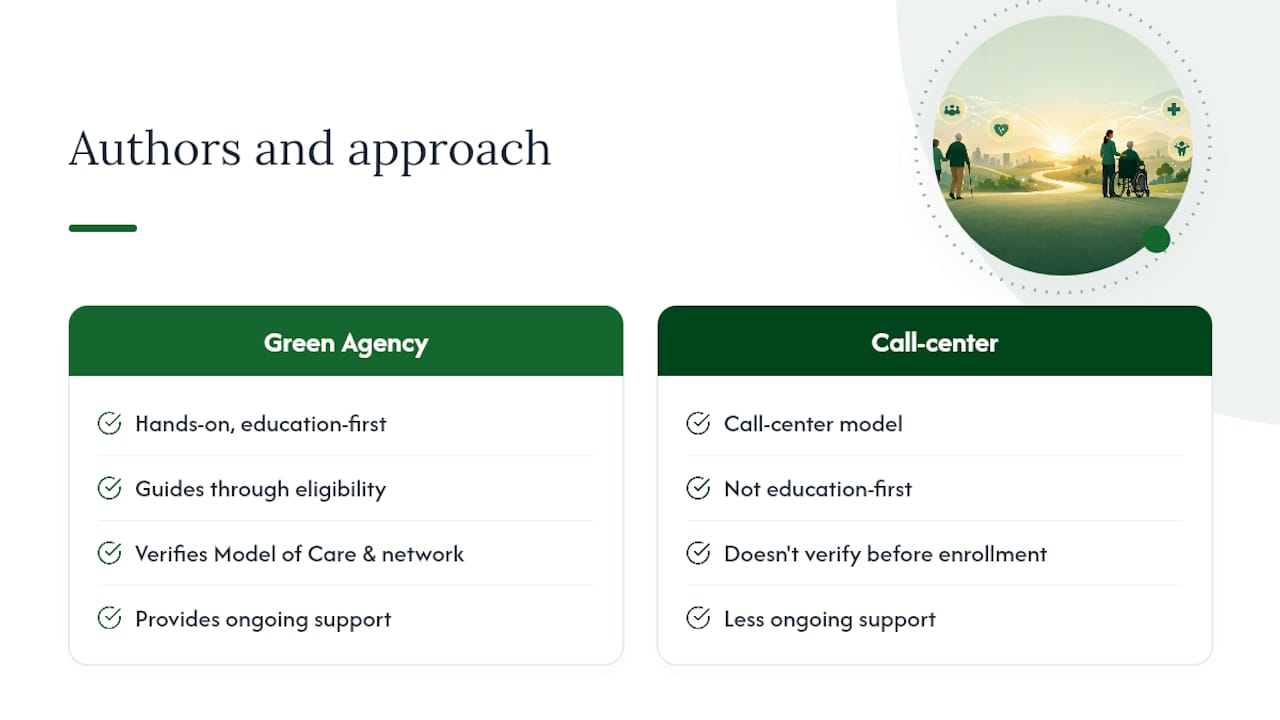
This guide was written by a certified Medicare Insurance Planner® with Green Insurance Agency, which takes a hands-on, education-first approach rather than a call-center model, guiding clients through eligibility, Model of Care details, and provider-network verification before enrollment, and offering ongoing support after enrollment.
When Should You Use a Plan Finder Versus Call for Help?
Online plan finders are fine for a first pass: comparing premiums and confirming a plan is sold in your county. Where they fall short is interpreting Model of Care language, untangling state-specific Medicaid rules, or confirming a provider is truly in-network. If you’re unsure which SNP type fits, a free State Health Insurance Assistance Program (SHIP) counselor is a solid neutral first stop. For hands-on enrollment help, a certified planner does the legwork instead of you.
— Zach
Get a Free Special Needs Plan Eligibility Review
Sorting through C-SNP condition lists, D-SNP Medicaid rules, and I-SNP assessments by yourself is a lot to manage on top of everything else Medicare throws at you. Eligibility reviews, plan comparisons, enrollment assistance, and appeals support are offered for beneficiaries in certain Florida areas, with no direct cost to clients as commissions are paid by carriers.

Bring your Medicare and Medicaid cards, prescription list, and provider information to your consultation, where eligibility against CMS rules and local plan options can be reviewed. Schedule your free review on the Green Insurance Agency site and find out which SNP, if any, actually fits your situation before the next enrollment deadline.
Where to Verify Plan Details and Get Free Counseling
- Medicare for local SNP availability
- CMS’s Managed Care Manual, Chapter 16-B for regulatory detail
- Your state Medicaid office and a local SHIP counselor for personalized guidance
This article is general information, not a substitute for advice from a qualified doctor. Consult a qualified healthcare professional about your own circumstances before acting on anything here.
Sources
- Special Needs Plans (SNP) | Medicare
- Medicare Managed Care Manual Chapter 16-B: Special Needs Plans | CMS
- Medicare Advantage Special Needs Plans: Types, Benefits, and Eligibility | NCOA
- Medicare Special Needs Plans | HHS
FAQ
What are the three types of Special Needs Plans in Medicare?
The three types are Chronic Condition SNPs (C-SNP), Dual Eligible SNPs (D-SNP), and Institutional SNPs (I-SNP), each built for a different qualifying group under CMS rules.
Does UnitedHealthcare offer a special needs plan?
Several major national insurers, including large Medicare Advantage carriers, sell SNPs, but availability depends entirely on your county and changes every year. Check Medicare.gov’s plan finder or ask a certified planner at Green Insurance Agency to confirm what’s actually sold near you.
Who qualifies for Medicare Special Needs Plans for seniors?
Anyone who has a CMS-approved chronic condition, qualifies for both Medicare and Medicaid, or needs institutional-level care can qualify, provided they also have Medicare Parts A and B and live in the plan’s service area.
Which Medicare Part D plan is the best?
There’s no single best Part D plan. Since SNPs include Part D coverage, the important question is whether the plan’s formulary covers your medications at a reasonable copay. A consultation can help check this against your prescriptions.
What happens if I lose my SNP eligibility?
Losing your qualifying condition, Medicaid status, or institutional care status triggers a Special Enrollment Period, giving you time to switch to a plan that matches your current situation without waiting for the next enrollment season.