


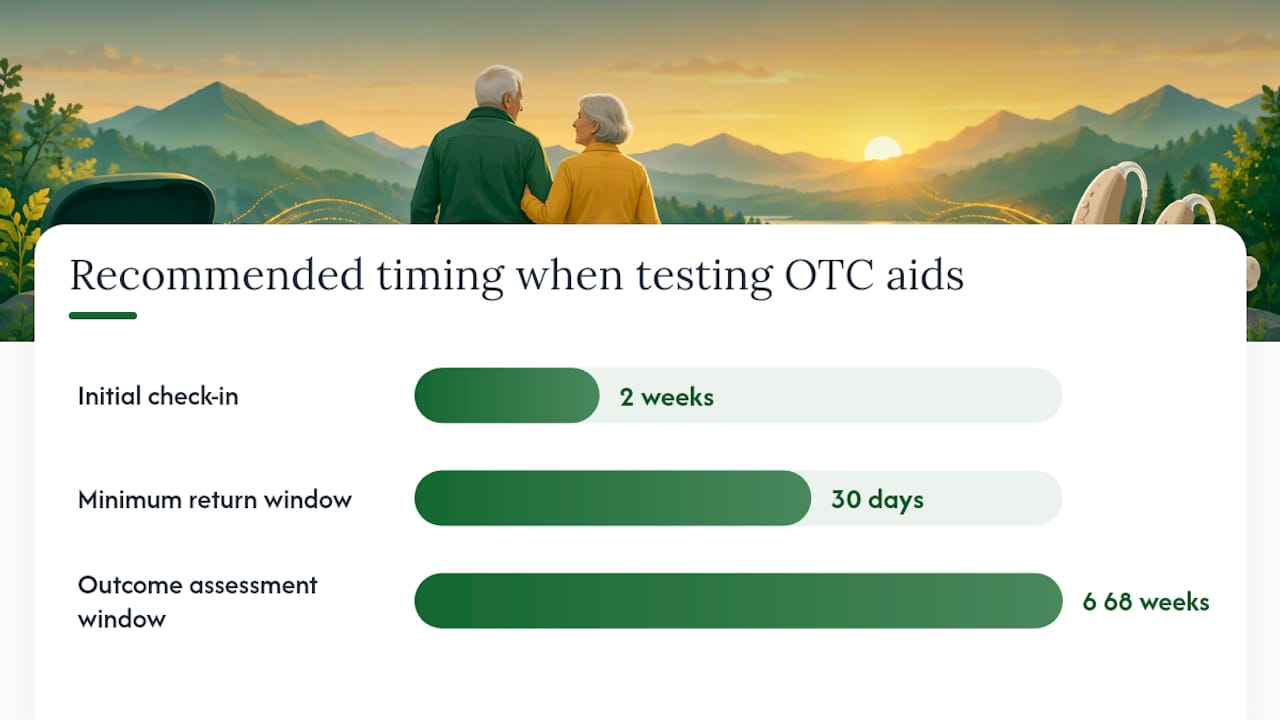
If you’re a senior who suspects mild to moderate hearing loss, trying an FDA-cleared OTC hearing aid first is a reasonable move. If your hearing loss came on suddenly, affects one ear more than the other, or comes with pain or dizziness, skip the OTC aisle and get a medical evaluation instead. Give any device six to eight weeks before judging whether it’s working.
TL;DR:
- OTC hearing aids are FDA-regulated for mild to moderate hearing loss, but sudden, asymmetric, or severe symptoms require immediate medical evaluation.
- Self-fitting OTC devices can perform comparably to audiologist-fitted aids in the short term for mild to moderate loss, especially with remote support.
- Devices with a built-in hearing test and a extended trial period of at least 30 days tend to be more reliable and easier to fine-tune at home.
- Cost differences are significant, with OTC devices ranging from $200 to $1,000 per pair, while prescription aids often cost several thousand dollars with professional services bundled in.
- Checking Medicare and plan benefits beforehand can potentially offset the cost of hearing aids, especially through Medicare Advantage plans with hearing benefits.
Table of Contents
- OTC vs Prescription Hearing Aids: The Quick Comparison
- Which Signs Point You Toward OTC and Which Point You Toward a Prescription
- How to Shop for an OTC Hearing Aid and Test It Properly
- What Hearing Aids Cost and How Medicare Usually Handles Them
- What to Do Next, Step by Step
- Why Checking Your Medicare Plan Should Come Before You Buy Anything
- Let Green Insurance Check What Your Plan Actually Covers
- Sources
- FAQ
OTC vs Prescription Hearing Aids: The Quick Comparison
The core difference comes down to who each category is built for and how much hand-holding you get along the way. OTC hearing aids are federally regulated for adults 18 and older who perceive their hearing loss as mild to moderate. Prescription hearing aids have no such ceiling. They’re built and fitted for every severity, including profound loss, and they usually involve a licensed audiologist from the first appointment to the last adjustment.
The buying process looks almost nothing alike. OTC devices are self-fit: you take a hearing check through an app, or you pick a preset program, and you walk away with the device the same day, often for less than the cost of a used bicycle. Prescription aids go through real-ear verification, a technique where an audiologist measures the actual sound reaching your eardrum and fine-tunes the device against prescriptive targets like NAL-NL2 or DSL v5. That precision costs money and time, but it also catches problems a phone app simply can’t detect.
Here’s what separates the two paths in practice:
- Regulation: OTC covers perceived mild to moderate loss only; prescription aids cover any severity.
- Fitting: OTC relies on self-fit apps or presets; prescription aids use audiologist-led real-ear verification.
- Price: OTC devices are generally less expensive per pair; prescription aids typically cost more and often include bundled services.
- Short-term outcomes: A randomized trial published in JAMA Otolaryngology found that self-fitting OTC aids with remote support performed comparably to audiologist-fitted devices on patient-reported outcomes at six weeks.
That last point surprises a lot of people, including some clinicians. It doesn’t mean OTC is equal to prescription care across the board. It means that for the mild to moderate range the FDA built this category around, a well-designed self-fitting device can hold its own, at least in the short run.
Which Signs Point You Toward OTC and Which Point You Toward a Prescription
Start with how the trouble actually shows up. If you’re straining to follow conversation in a noisy restaurant but doing fine one-on-one in a quiet room, that pattern usually fits mild to moderate loss, the exact zone OTC devices were designed for. If you can’t make out speech even in a silent room, or one ear feels noticeably worse than the other, that’s a different problem entirely.
Certain symptoms should send you to a doctor before you buy anything, OTC or otherwise:
- Hearing loss that appeared suddenly, over hours or a few days.
- A clear difference in hearing between your left and right ear.
- Ear pain, drainage, or a feeling of pressure or fullness.
- Dizziness, vertigo, or balance problems alongside the hearing change.
- Ringing (tinnitus) that started abruptly or has gotten sharply worse.
Any one of these warrants a visit to an audiologist or an ear, nose, and throat doctor. Johns Hopkins Medicine notes that sudden or asymmetric loss can point to something treatable, or something that needs immediate attention, and an OTC device won’t fix or diagnose the underlying cause.
Beyond the medical signs, personal preference matters more than most guides admit. Some people genuinely enjoy tinkering with an app and adjusting settings themselves. Others want a professional to handle the fitting, answer questions in person, and fine-tune the device over follow-up visits.
Pro Tip: Write down specific situations where you struggle to hear, like “can’t hear my grandkids at the dinner table” or “miss half of what the pharmacist says.” Bring that list to any hearing evaluation. It gives a professional far more to work with than “my hearing seems off.”
How to Shop for an OTC Hearing Aid and Test It Properly
Not every device on the shelf deserves your money, and the FDA clearance itself is your first filter. Confirm the box or listing states the device is FDA-regulated for OTC sale. Some cheaper “hearing amplifiers” sold online skip that clearance entirely and offer none of the same safety review.
Beyond that baseline, a few checklist items separate the devices worth trying from the ones you’ll return within a week:
- Trial period: Look for a return window of at least 30 days. Consumer protection guidance treats this as a baseline expectation, not a bonus feature.
- Self-fit method: A device with a built-in hearing test and app-guided calibration tends to fit better than a simple preset with one or two volume levels.
- Remote support: Some brands offer phone or video access to an audiologist for a fee even on OTC devices. That safety net matters more than people expect.
- Battery and charging: Rechargeable models save money over time but leave you stuck if you forget to charge overnight. Disposable batteries cost more long term but never leave you without backup.
- Warranty and repair: Confirm what’s covered and for how long before you buy, not after something breaks.
Consumer Reports has found that self-fitting models with validated hearing tests and remote support tend to perform more reliably than bare-bones preset devices, which tracks with what the clinical data shows.
Once you’ve bought a device, give it a real trial. Jot down baseline notes on your specific hearing struggles before you start wearing it. Check in with yourself at the two-week mark. By six to eight weeks, the window the JAMA trial used to measure outcomes, you should have a clear sense of whether it’s helping. If it isn’t, that’s your signal to book an audiologist visit rather than buy a second OTC device and hope for a different result.
What Hearing Aids Cost and How Medicare Usually Handles Them
Price is where the two categories diverge most sharply. OTC devices commonly run from around $200 to $1,000 per pair, while prescription hearing aids, bundled with fitting, adjustments, and follow-up care, often land in the thousands. Some government estimates cited by AARP project substantial average savings from choosing OTC over older prescription pricing models, though actual savings vary by device and provider.
Where Medicare fits into this is often the part people get wrong:
- Original Medicare generally does not cover hearing aids or fittings for either category.
- Some Medicare Advantage plans include hearing benefits, but the details, from allowance amounts to which devices qualify, vary enormously by plan and carrier.
- Keep every receipt. If you later pursue reimbursement or need documentation for a supplemental policy, having dated records of purchase and any professional visits saves headaches.
Checking your specific plan’s benefits before you buy, rather than after, can change which option makes financial sense.
What to Do Next, Step by Step
Get a baseline diagnostic hearing test even if you’re leaning toward OTC. It documents your actual severity and rules out medical causes like earwax buildup or fluid, something an app-based hearing check can’t do. Ask the audiologist’s office for a written copy of your results and keep it with your other health records.
If you go the prescription route, expect an initial fitting appointment followed by one or two follow-up visits within the first few months to adjust settings. Bring a list of specific listening situations that give you trouble. Many audiologists will also program or fine-tune an OTC device for a set fee if you’d rather buy off the shelf but still want a professional’s input on the settings.
Why Checking Your Medicare Plan Should Come Before You Buy Anything
Hearing loss decisions rarely happen in isolation from the rest of a senior’s health coverage, which is where Green Insurance’s Medicare planning work intersects with this topic more than people expect. A Medicare Advantage plan with a hearing benefit can shift the math entirely, sometimes making a prescription aid more affordable than the OTC option once you factor in what the plan actually covers.
The mistake we see constantly: people assume Original Medicare will help, discover it won’t, and never check whether a supplemental plan or Advantage plan would have. That’s a five-minute conversation, not a research project.
— Zach
Let Green Insurance Check What Your Plan Actually Covers
Before you spend a dollar on either kind of hearing aid, it’s worth finding out whether your current Medicare plan already helps pay for one. There are alternatives to guessing at your own benefits or calling a carrier hotline and getting a scripted answer. Some agencies review your actual plan documents, in person, to determine whether a Medicare Advantage plan with hearing benefits, or a supplemental policy, could offset the cost of either an OTC or prescription device.

This isn’t a sales pitch dressed up as advice. It’s a free coverage check that takes the guessing out of a decision that already involves enough unknowns. If you’re turning 65, already enrolled, or just unsure what your current plan includes, schedule a Medicare consultation and find out what you’re actually working with before you buy anything.
This article is general information, not a substitute for advice from a qualified doctor. Consult a qualified healthcare professional about your own circumstances before acting on anything here.
Sources
- OTC hearing aids: What you should know | FDA
- Effectiveness of an Over‑the‑Counter Self‑fitting Hearing Aid Compared With an Audiologist‑Fitted Hearing Aid | JAMA Otolaryngology
- Over‑the‑counter (OTC) hearing aids | NIDCD
- A complete guide to over‑the‑counter hearing aids | Consumer Reports
FAQ
Do I need a prescription to buy a hearing aid?
No. Adults 18 and older can buy FDA-regulated OTC hearing aids without a prescription or hearing exam, as long as the hearing loss is perceived as mild to moderate. Severe or complicated hearing loss still calls for a licensed audiologist and a fitted prescription device.
Are OTC hearing aids as good as prescription hearing aids?
For mild to moderate hearing loss, a randomized trial in JAMA Otolaryngology found self-fitting OTC devices with remote support produced outcomes comparable to audiologist-fitted aids at six weeks. Longer-term evidence is still limited, and prescription aids remain the better fit for severe or complex hearing loss.
Will Medicare pay for hearing aids?
Original Medicare generally does not cover hearing aids or fittings. Some Medicare Advantage plans include hearing benefits, and Green Insurance can review your specific plan options to check what, if anything, is covered.
How much do OTC hearing aids typically cost compared to prescription aids?
OTC devices often run from around $200 to $1,000 per pair, while prescription hearing aids, which bundle in professional fitting and follow-up care, typically cost several thousand dollars. Some estimates cited by AARP put average per-pair savings from choosing OTC at roughly $2,800 compared with older prescription pricing models.
How long should I try an OTC hearing aid before deciding it isn’t working?
Give it six to eight weeks, the same window used in the clinical trials comparing OTC and prescription outcomes. If you’re not noticing improvement by then, or you experience new symptoms like pain or dizziness, book an appointment with an audiologist rather than switching to a different OTC device.