


If you missed a Medicare deadline, you can usually still enroll. Which window you missed decides when, and what it costs. Most people who miss their first window can sign up during the General Enrollment Period each January through March, or sooner if they qualify for a Special Enrollment Period. The sooner you find out which one applies to you, the less a late penalty can add up. Our Medicare Insurance Planners® walk people through this every day, and a free consultation is the fastest way to learn which window you are in.
TL;DR
- Missing your age-65 Initial Enrollment Period usually means waiting for the General Enrollment Period (January 1 to March 31) unless a Special Enrollment Period applies.
- Coverage from a General Enrollment Period sign-up starts the first day of the month after you enroll.
- Late penalties differ by part: Part A can rise 10% for twice the years you delayed, Part B 10% per full 12 months, Part D 1% of a national base amount per uncovered month.
- Coverage through your own or a spouse’s current job may mean you never missed anything. That is the most common reason a penalty does not apply.
- Missing the fall Annual Enrollment Period generally means keeping your current plan for the year, though a few later options exist.
Table of Contents
- First, work out which deadline you missed
- You missed your Initial Enrollment Period
- When your coverage starts after a late sign-up
- What late penalties can cost
- Working past 65: you may not have missed anything
- If you missed the Annual Enrollment Period
- What to do this week
- Where we come in
- Our perspective
- FAQ
- Sources
First, work out which deadline you missed
“Medicare deadline” can mean three different things, and each has different consequences.
| Window | Who it is for | When it runs | If you miss it |
|---|---|---|---|
| Initial Enrollment Period (IEP) | Everyone first becoming eligible at 65 | 7 months: 3 months before your birthday month, the month itself, 3 months after | General Enrollment Period, or a Special Enrollment Period if you qualify |
| General Enrollment Period (GEP) | People who missed the IEP with no special circumstance | January 1 to March 31 every year | Wait for next year’s window |
| Annual Enrollment Period (AEP) | Current members who want to change Advantage or drug plans | October 15 to December 7 | Generally keep your plan until the next year |
If you are turning 65 and already receive Social Security or Railroad Retirement benefits, CMS says you generally get Parts A and B automatically. If you do not receive those benefits, you generally have to sign up yourself. That second group is where most missed deadlines happen, because nothing arrives telling you to act. People with a disability may be enrolled automatically after 24 months of disability benefits, according to the 2027 Medicare and You handbook.
Our guide to Medicare enrollment periods lays out the key dates side by side if you want a reference to keep.
You missed your Initial Enrollment Period
There are two ways back in.
A Special Enrollment Period, if you qualify
A Special Enrollment Period (SEP) is a window outside the normal dates, triggered by a life event. Medicare.gov lists qualifying group coverage through current employment as the most common, plus circumstances such as losing Medicaid, a disaster, being given incorrect information, incarceration, volunteer service abroad, or TRICARE coverage.
CMS also has an “other exceptional conditions” route, but it is narrow. Its guidance says it is for truly exceptional events, not simply forgetting, not knowing the rules or failing to pay premiums. If you were told something wrong by a federal representative, or you had a real obstacle, it is worth documenting and asking.
The General Enrollment Period
Without an SEP, you can enroll in Part B and any premium Part A from January 1 through March 31. Our page on the General Enrollment Period covers the dates and the penalty effects in more detail.
To apply for Part B, Social Security says you can apply online, mail or fax form CMS-40B, or visit a local Social Security office. If you are using the current-employment SEP, form CMS-L564, the Request for Employment Information, is also part of the process.
When your coverage starts after a late sign-up
The old rule had General Enrollment Period coverage beginning July 1. That changed. Medicare.gov now says coverage starts the first day of the month after you enroll, and CMS describes this as applying to GEP enrollments beginning January 1, 2023. So if you sign up in January, you are covered from February 1, not months later.
If you are eligible for premium-free Part A, there is no deadline pressure in the same way. You can sign up any time after turning 65, and coverage can be retroactive up to 6 months, though never earlier than the month you turned 65.
Between the missed window and the start date you may have no Medicare and possibly no other coverage. Plan for that gap: keep any existing coverage until Medicare begins, and do not schedule non-urgent care you expect Medicare to pay for before the start date.
What late penalties can cost
Penalties are not one rule. Medicare.gov explains each part separately:
- Part A (only for people who must buy it): premium may rise 10%, for twice the number of years you could have had it but did not sign up.
- Part B: premium generally rises 10% of the standard premium for each full 12-month period you could have had Part B but did not. It lasts as long as you have Part B.
- Part D: generally 1% of the national base beneficiary premium for each month you went without Part D or other creditable coverage after a continuous 63-day gap, usually for as long as you have drug coverage.
Two details change the math. First, the Part B penalty generally does not apply if you qualified for a Special Enrollment Period or were enrolled in a Medicare Savings Program. Second, most people do not owe the Part A penalty, because it applies only to those who buy Part A.
A worked example
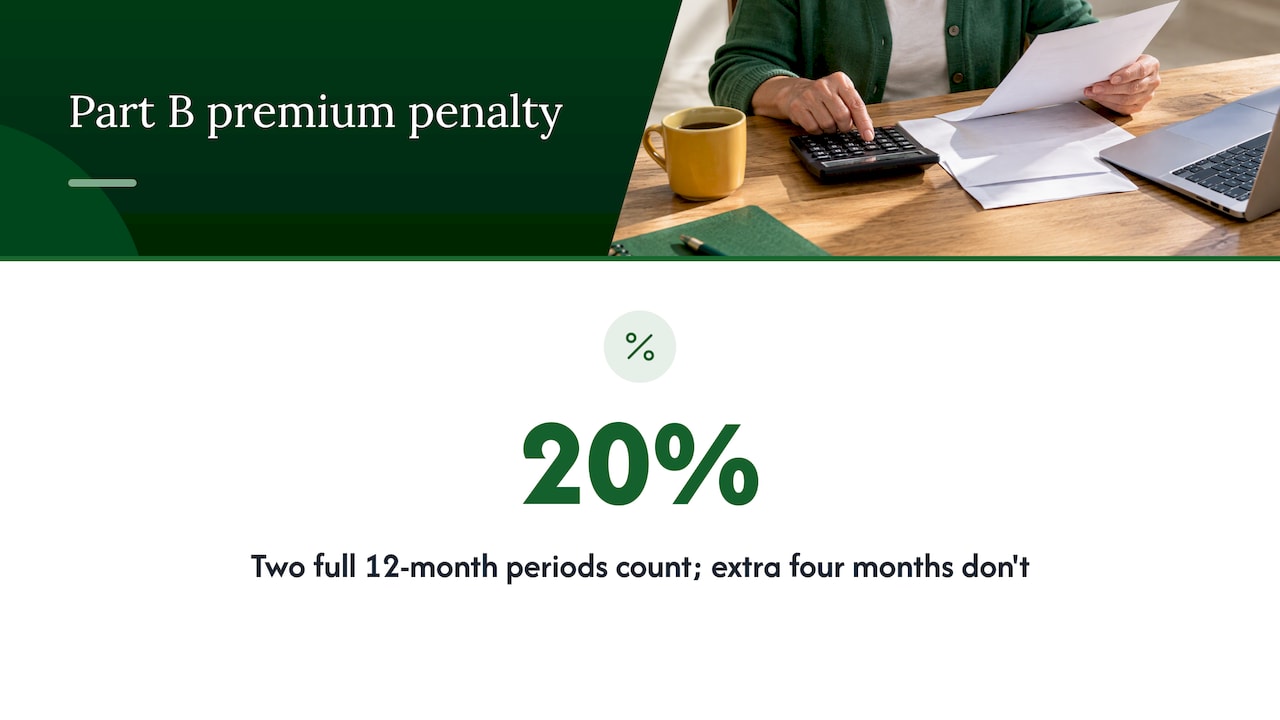
Say you turned 65, had no employer coverage, and signed up for Part B two years and four months later. You have two full 12-month periods of delay. That is a 20% increase on the standard Part B premium for as long as you keep Part B. The extra four months do not count, because only full 12-month periods do. The standard premium is set each year, so check the current figure on Medicare.gov, then add the percentage. You can also try our Part B penalty calculator, and read more on penalties for signing up late.
Drug coverage counts too
Part D penalties catch people who think they never needed drug coverage. CMS says coverage counts as creditable if it is expected to pay on average at least as much as standard Medicare drug coverage. Examples include some employer coverage, qualified state pharmaceutical assistance programs, VA, TRICARE and certain Medigap policies. If you had drug coverage before Medicare, ask the plan whether it was creditable and keep the notice. Our overview of Part D prescription drug plans shows what to compare.
Working past 65: you may not have missed anything
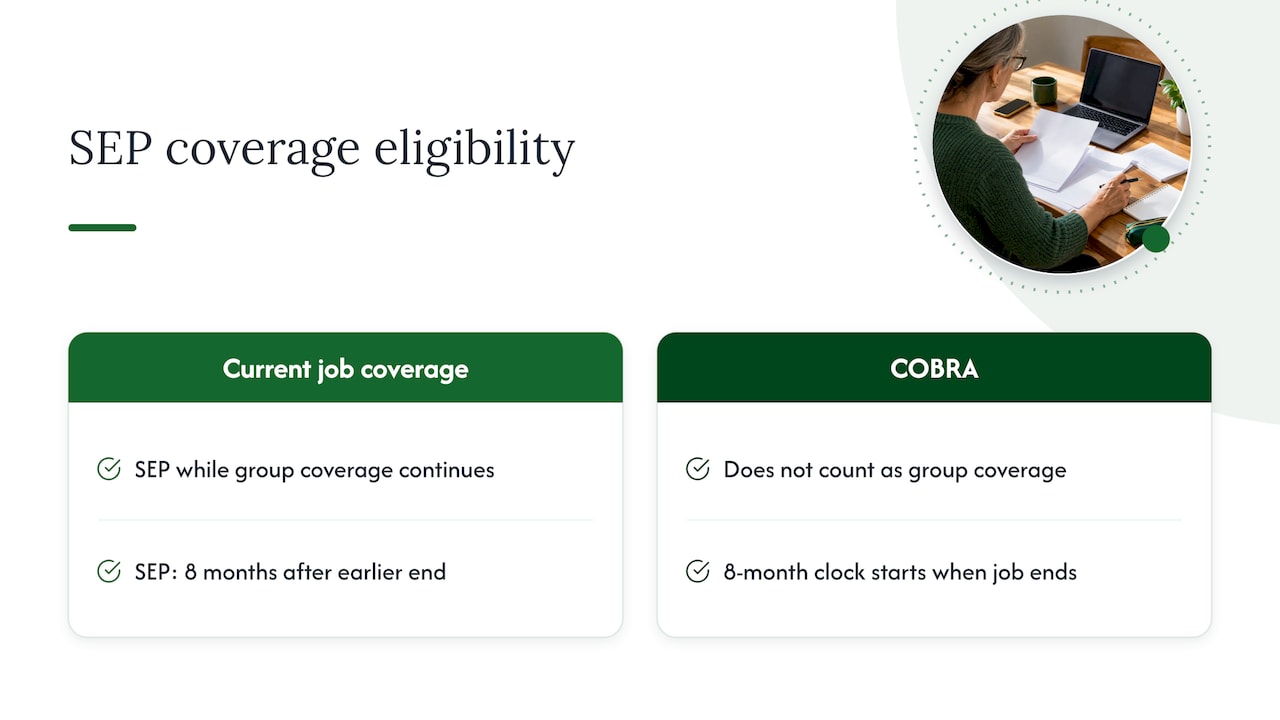
If you or your spouse kept working and had group health coverage through that current job, you may have an SEP. Medicare.gov says you can enroll in Part B and premium Part A while that coverage continues, or during the 8 months after the job or coverage ends, whichever comes first.
COBRA does not count as group health coverage for this purpose. People often assume COBRA protects them, then find the 8-month clock started when the job ended. If you sign up while working, or in the first full month after employer coverage ends, you can ask to delay your Part B start date by up to 3 months.
This is the one scenario where checking before you act matters most. If you are leaving a job soon, map out your dates before your last day.
If you missed the Annual Enrollment Period
The fall window, October 15 to December 7, is for people already on Medicare. The 2026 handbook says you can join, switch or drop a Medicare Advantage or drug plan, or return to Original Medicare, with changes effective January 1 when the request is received by December 7. Because that window repeats every fall, check the official page for each year’s schedule.
Missing it does not close every door:
- Medicare Advantage Open Enrollment (January 1 to March 31): if you are in an Advantage plan, you can switch to another Advantage plan or return to Original Medicare and add a standalone Part D plan, once. It is not a general drug plan switching period for people in Original Medicare.
- Plan-level SEPs: events such as moving outside your plan’s service area, losing Medicaid or involuntarily losing creditable drug coverage can allow midyear changes. The actions available and the deadline depend on the event.
- After a late Part B sign-up: if you have Part A and first get Part B during the General Enrollment Period, you may have 2 months after adding Part B to join a Medicare Advantage plan. If you must buy Part A and sign up for Part B in the General Enrollment Period, you may join a drug plan within 2 months.
If you want to compare options for next year, our pages on Medicare Advantage and Medicare Supplement plans are the place to start.
What to do this week
- Identify the window. Pull out your birthday, your retirement or coverage end date, and any notices. Decide whether you are dealing with a missed IEP, a missed AEP or both.
- List every health and drug coverage you had since 65. Include employer plans, retiree plans, VA, TRICARE and Medicaid, with start and end dates. This is your evidence for an SEP or for creditable coverage.
- Ask for written proof. Get a statement from the employer or plan showing coverage dates. Form CMS-L564 is how employment coverage is confirmed for Part B.
- Apply for Part B if an SEP or the GEP applies. Use the Social Security options above. Do not wait for the perfect plan decision; the start date depends on when you enroll.
- Pick supplementary coverage inside its window. After Part B begins, the 2-month plan windows above can be short. Our Medicare enrollment checklist helps you keep the order straight.
- Revisit every year. Plans and drug lists change, so an annual look keeps you from missing the next deadline.
Steps 1 to 3 are where people get stuck, because the rules interact. An employer plan with 20 employees, for example, can behave differently from one with 200, and the paperwork for an SEP request has to say the right thing.
Where we come in
Our Medicare Insurance Planners® help you sort out which enrollment period applies, compare Medicare Advantage, Supplement and Part D plans, and enroll once you know your dates. The consultation is free to you. Carriers pay us a commission when you enroll, so you do not pay for our time. If you are in Orange Park, Fleming Island or Jacksonville, we can meet you in person, and we stay available for claims, appeals and annual reviews after you enroll.

Start with our Medicare enrollment help page, or see everything under our services.
Our perspective
Missing a deadline feels like failure, but it is almost always a process gap. Medicare mails nothing to people who are not yet receiving Social Security, and employer coverage makes the dates look like someone else’s job.
The people we see in the best position are the ones who find out early which window they are in. A few weeks of clarity can be the difference between a penalty and none, or between a gap in coverage and a smooth start.
That is why we teach before we sell. A Medicare Insurance Planner® explains the rule, shows the dates on your own timeline, then compares plans across top carriers so the choice is yours. We keep supporting clients years after enrollment, because the next deadline is always coming.
Zach
FAQ
Can I still sign up for Medicare if I missed my Initial Enrollment Period?
Yes. If you do not qualify for a Special Enrollment Period, you can enroll in Part B and any premium Part A from January 1 to March 31. Coverage then starts the first day of the month after you sign up. Premium-free Part A can be requested any time after 65.
Will I automatically owe a penalty?
Not necessarily. The Part B penalty generally does not apply if you qualified for a Special Enrollment Period, such as coverage through current employment. Part A penalties apply only to people who must buy Part A. Part D penalties depend on whether you had creditable drug coverage.
Does COBRA protect me from the Part B penalty?
No. COBRA is not treated as current-employment group coverage for the Part B Special Enrollment Period. The 8-month window after your job or coverage ends is the one that counts, so start counting from the earlier of those two dates.
What if I missed the fall Annual Enrollment Period?
You generally keep your current plan for the year. If you are in a Medicare Advantage plan, you can use the January 1 to March 31 Advantage Open Enrollment Period once to switch plans or return to Original Medicare. Certain life events also open midyear changes.
Sources
- When does Medicare coverage start? | Medicare.gov
- Large Print Medicare and You Handbook 2027
- Original Medicare (Part A and B) Eligibility and Enrollment | CMS
- Sign up for Part B only | Social Security Administration
- Avoid late enrollment penalties | Medicare.gov
- Creditable Coverage and Late Enrollment Penalty | CMS
- Medicare and You Handbook 2026
- Special Enrollment Periods | Medicare.gov