


Short answer: Original Medicare generally does not pay for routine eye exams, eyeglasses, or contact lenses. It does cover specific medical eye care, like diabetic retinopathy exams, glaucoma screening for high-risk patients, and one pair of glasses or contacts after cataract surgery. If you want routine vision benefits, your best move is comparing Medicare Advantage plans or looking into supplemental options built for that gap.
TL;DR:
- Medicare generally does not cover routine eye exams, eyeglasses, or contact lenses, unless they are required for specific medical conditions.
- Medicare covers medical eye care like diabetic retinopathy exams, glaucoma screening for high-risk groups, and one pair of glasses after cataract surgery.
- Most routine vision benefits are available through Medicare Advantage plans, which may include coverage for exams and eyewear allowances.
- Medigap policies typically do not cover routine eye care unless already included in a Medicare Advantage plan, and community programs can provide additional assistance.
- It is crucial to compare annual plan benefits, network restrictions, and prior authorization rules to avoid unexpected out-of-pocket costs for routine vision care.
Table of Contents
- What Original Medicare (Parts A & B) Actually Covers
- When Medicare Pays for Eye Care: Diabetes, Glaucoma, and Cataracts
- Getting Routine Vision Benefits Through Medicare Advantage or Medigap
- Understanding Your Costs: Deductibles, Coinsurance, and ABNs
- How To Get Routine Vision Benefits: A Step-by-Step Checklist
- Does the ACA Add Any Free Vision Screenings Under Part B?
- Where Part D and Standalone Vision Plans Fit In
- What Medicare Vision Coverage Won’t Do for You
- A Publisher’s Take: Why Vision Coverage Deserves an Annual Look
- Get Help Comparing Your Medicare Vision Options
- Sources
What Original Medicare (Parts A & B) Actually Covers
The line between “routine” and “medical” vision care trips up more beneficiaries than almost any other Medicare gray area. Routine care means a standard vision checkup to update your eyeglass prescription. Medical care means treating or monitoring an eye disease or condition, like glaucoma, cataracts, or diabetic eye damage. Original Medicare draws a hard line between the two.
According to CMS, Medicare Fee-for-Service usually doesn’t cover routine vision items like eyeglasses, contacts, and standard eye exams. Medicare.gov confirms the same rule for routine eye exams, sometimes called eye refractions.
Here’s what falls on each side of that line:
- Not covered: routine eye exams, refractions for glasses, eyeglasses (with one exception below), contact lenses, and vision therapy for general vision correction.
- Covered when medically necessary: exams and treatment for eye diseases, diabetic retinopathy screening, glaucoma testing for high-risk patients, and cataract-related care.
Pro Tip: If your appointment is scheduled to update your prescription, plan to pay out of pocket unless a Medicare Advantage plan or other vision benefit covers it. Ask the front desk how the visit is being billed before you sit in the chair.
When Medicare Pays for Eye Care: Diabetes, Glaucoma, and Cataracts
Three situations reliably trigger Medicare payment for eye care, and knowing them can save you real money.
Diabetic retinopathy. If you have diabetes, Part B covers one dilated eye exam per year to check for retinopathy damage. The exam has to come from an eligible provider, and standard Part B cost sharing applies.
Glaucoma screening. Medicare covers annual glaucoma screening only for beneficiaries at high risk: people with diabetes, a family history of glaucoma, African American beneficiaries age 50 and older, and Hispanic beneficiaries age 65 and older.
Cataract surgery and lenses. This is the one place Original Medicare pays for eyewear. Medicare covers a conventional intraocular lens (IOL) during cataract surgery, plus one pair of prosthetic eyeglasses or contact lenses afterward. It won’t cover premium upgraded lenses like multifocal or toric IOLs beyond the conventional lens cost.
A few practical notes worth acting on:
- The supplier providing your post-surgery glasses or contacts must be enrolled in Medicare, or the claim gets denied outright.
- Claims for prosthetic lenses route through a specific Medicare Administrative Contractor, and coding errors are a common reason claims stall.
- Ask your surgeon’s office to confirm the DME supplier’s enrollment status before you order anything.
Getting Routine Vision Benefits Through Medicare Advantage or Medigap
Since Original Medicare leaves routine vision largely uncovered, most people fill that gap through Medicare Advantage. Many Medicare Advantage plans include vision benefits that pay for a routine exam plus an allowance toward glasses or contacts. But “many” isn’t “all,” and the details shift from plan to plan and year to year.
Medigap policies work differently, and this trips people up. Medigap fills cost-sharing gaps in Original Medicare, like the Part B coinsurance, but it doesn’t typically add new benefit categories. If Original Medicare doesn’t cover a routine exam, a Medigap policy generally won’t cover it either.
For beneficiaries who can’t find affordable vision coverage through a plan, community resources fill part of the gap. EyeCare America, a program of the Foundation of the American Academy of Ophthalmology, connects qualifying seniors with volunteer ophthalmologists for reduced-cost or no-cost exams.
When you compare Medicare Advantage plans for vision benefits, check these four things every time:
- How often the plan pays for a routine exam (once a year is standard, but not universal).
- The dollar allowance for glasses or contacts, and whether it’s annual or every two years.
- Whether the eye doctor is in-network, since out-of-network vision visits often cost far more.
- Whether prior authorization is required before certain services or higher-cost frames.
Pro Tip: Pull up two or three plans’ Summary of Benefits side by side before open enrollment ends. The vision allowance line item is usually buried on page three, not the marketing page.
Understanding Your Costs: Deductibles, Coinsurance, and ABNs
Routine services are a different story entirely. If a visit isn’t medically covered, you’re billed the full charge unless a Medicare Advantage plan or another benefit steps in.
Providers sometimes issue an Advance Beneficiary Notice (ABN) when they expect Medicare might deny a service. Signing an ABN means you agree to pay if Medicare refuses the claim. A common mix-up happens when patients assume “medical” and “routine” exams are interchangeable, which leads directly to surprise bills when a refraction gets billed as non-covered.
Before your appointment:
- Ask directly whether the visit is billed as medical or routine.
- Request the billing codes in advance if you’re unsure.
- Confirm any equipment supplier is Medicare-enrolled before you order glasses or contacts.
How To Get Routine Vision Benefits: A Step-by-Step Checklist
- Identify what you actually need. Gather your current prescription, any recent diagnosis (diabetes, glaucoma risk factors), and your last exam date.
- Check your current coverage first. Pull your plan’s Summary of Benefits or call member services to confirm exam frequency, allowance amounts, and network rules.
- Compare Medicare Advantage plans during open enrollment. Use Medicare.gov’s Plan Finder and filter specifically for vision benefits, then compare real out-of-pocket cost examples, not just headline allowances.
- If switching plans isn’t an option right now, contact a community program like EyeCare America, or ask local providers about cash-pay pricing for routine exams. Some accept payment plans that beat the sticker price on eyewear.
Following this order matters. Beneficiaries who shop for a new plan before confirming what they already have often switch unnecessarily, sometimes losing a doctor relationship they liked for a vision benefit they already qualified for.
Does the ACA Add Any Free Vision Screenings Under Part B?
The Affordable Care Act requires Medicare to cover many preventive services at no cost when you meet frequency and eligibility rules, but vision is one of the thinner categories on that list. Diabetic retinopathy exams and glaucoma screening for high-risk patients are covered Part B services, though they still carry standard Part B cost sharing rather than $0 preventive-service treatment.
There’s no ACA-mandated, zero-cost routine eye exam or vision screening built into Original Medicare the way there is for an annual wellness visit or a mammogram. That’s a common point of confusion, since many private ACA marketplace plans for adults do include a baseline vision screening as a preventive benefit. Medicare’s structure doesn’t extend that same protection to vision care outside the diabetic and glaucoma exceptions already covered.
If you’re hoping for a truly cost-free routine eye exam, Original Medicare isn’t going to deliver it. The closest thing to “free” vision care within the Medicare system comes from a Medicare Advantage plan with a $0 copay vision benefit, or from a community program covering the cost entirely. Neither of those is the ACA at work. They’re separate benefit structures layered on top of a baseline that simply doesn’t include routine vision as a no-cost preventive service.
Where Part D and Standalone Vision Plans Fit In
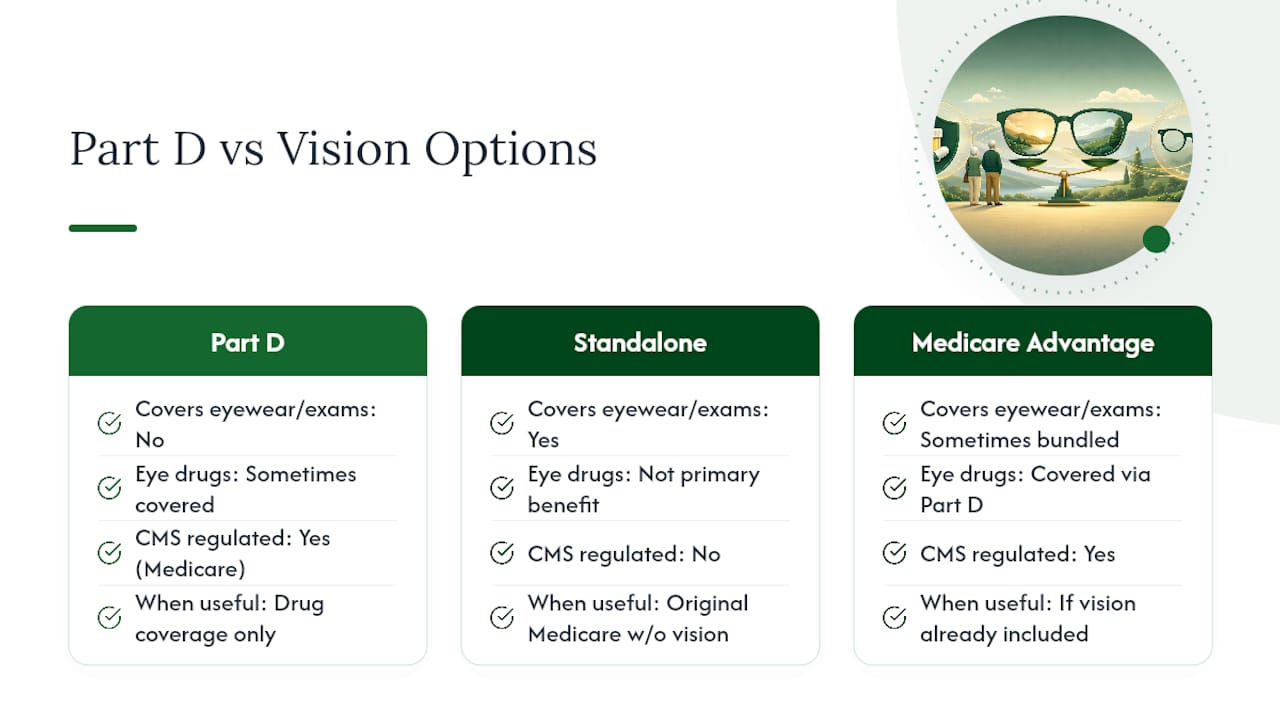
Medicare Part D covers prescription drugs, not eyewear or eye exams, so it plays no direct role in vision benefits. Some Part D plans cover eye drops or oral medications prescribed for conditions like glaucoma or dry eye, but that’s a drug benefit, not a vision benefit in the way most people mean the phrase.
Standalone vision insurance, sold separately from Medicare, is where many beneficiaries end up filling the routine care gap. These plans work like dental discount plans: a monthly premium in exchange for exam coverage and an eyewear allowance, often through a specific network of optometrists. They’re not part of Medicare at all, and CMS doesn’t regulate them the way it regulates Medicare Advantage or Medigap.
The tradeoff is worth thinking through carefully. A standalone vision plan can be cheaper than switching your entire Medicare Advantage plan just for the vision perk, but you’re managing another premium, another card, and another network to check. For beneficiaries who already get decent vision coverage bundled into their Medicare Advantage plan, adding a standalone policy is usually redundant money spent. For beneficiaries on Original Medicare with no supplemental vision benefit at all, a standalone plan (or an annual review to see if a bundled Medicare Advantage option beats it) is worth the ten minutes it takes to compare.
What Medicare Vision Coverage Won’t Do for You
Setting realistic expectations up front saves a lot of frustration later. Medicare vision coverage was never designed to function like a full-service vision insurance benefit, and it shows in several consistent limitations.
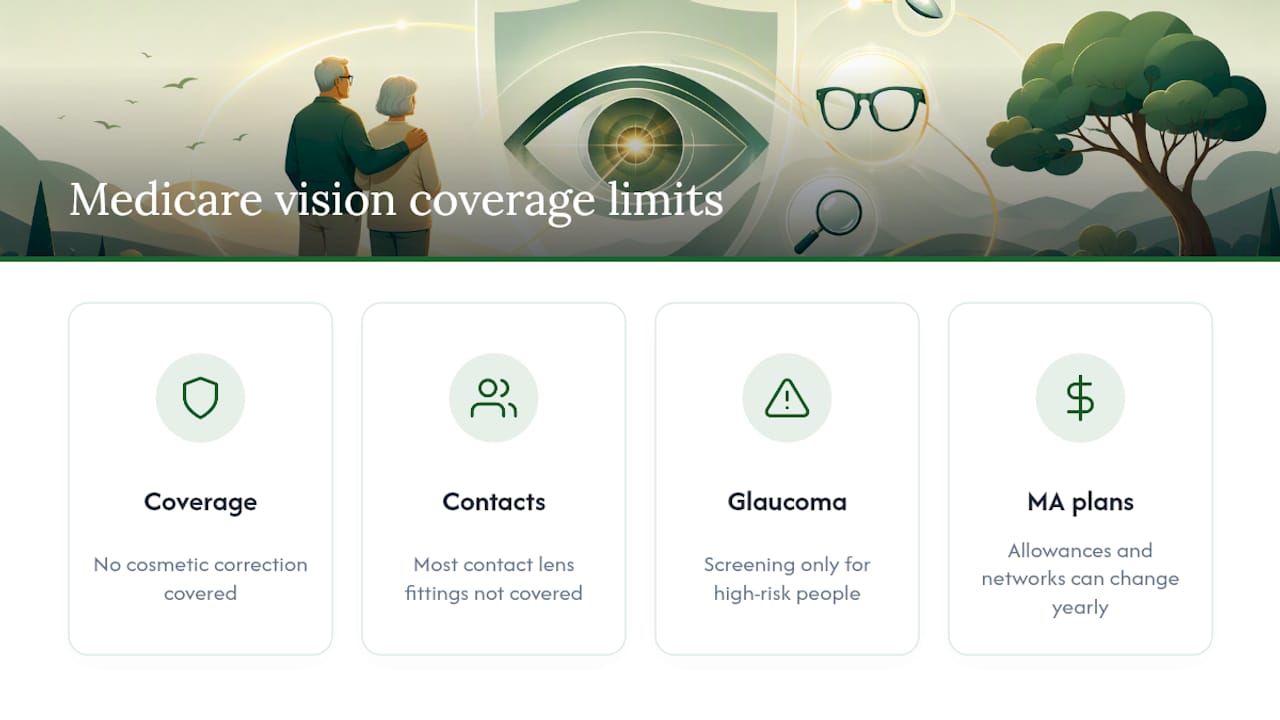
Original Medicare won’t pay for cosmetic vision correction, won’t cover most contact lens fittings, and won’t cover annual eyeglass replacement even for people with progressive eye conditions that genuinely need frequent prescription updates. The one-pair-after-cataract-surgery rule is a hard limit. If your glasses break the following year, or your prescription shifts again eighteen months later, Medicare isn’t paying for the replacement.
Screening frequency limits also catch people off guard. Glaucoma screening restricted to high-risk groups means a beneficiary without those specific risk factors gets no covered screening at all, even if glaucoma runs in a friend’s family or a doctor recommends it as precautionary care. And Medicare Advantage vision benefits, while broader, still shift year to year. A plan that covered a $200 eyewear allowance last year might drop that to $150 or change the network of participating optometrists at the next annual enrollment cycle. Nothing about Medicare vision coverage is locked in permanently, which is exactly why an annual review of your specific plan’s Summary of Benefits matters more than assuming last year’s rules still apply.
A Publisher’s Take: Why Vision Coverage Deserves an Annual Look
Vision benefits change more often than most beneficiaries realize, and that’s the piece Green Insurance Agency sees repeated every enrollment season. A plan that covered a solid eyewear allowance last year can quietly shrink it the next, and nobody notices until the bill arrives.
Green Insurance Agency, recognized as a top insurance agency in Clay County, Florida with more than 625 client reviews, staffs certified Medicare Insurance Planners® who walk beneficiaries through exactly this kind of plan comparison every year. If your vision needs are simple and stable, reading your Summary of Benefits yourself might be enough. If you’re weighing Medicare Advantage against a standalone vision plan, or you’re not sure your current plan still covers what you assumed it did, that’s when a planner earns the conversation.
— Zach
Get Help Comparing Your Medicare Vision Options
Green Insurance Agency gives you a certified Medicare Insurance Planner® who reviews your actual coverage instead of a generic checklist, at no cost to you. That matters most when you’re trying to figure out whether a Medicare Advantage plan’s vision allowance beats a standalone policy, or whether your current plan quietly changed its benefits since last enrollment season.

A free consultation covers a side-by-side look at vision benefits across the Medicare Advantage plans available in your area, plain-language help with enrollment paperwork, and ongoing support after you’re signed up, not just during the sales call. If you’re a caregiver helping a parent sort through this, a health screening checklist for appointments over 65 pairs well with the plan review, since it helps you separate what’s diagnostic from what’s routine before you ever sit down with an optometrist. Schedule your free consultation with Green Insurance Agency and find out what your current plan actually covers before the next bill surprises you.
This article is general information, not a substitute for advice from a qualified financial advisor. Consult a qualified financial professional about your own circumstances before acting on anything here.