


Medicare Star Ratings are CMS’s 1 to 5 scale for grading the quality of Medicare Advantage and Part D plans, updated every year. They matter right now because the 2026 ratings show more spread between top and bottom performers than in past years, and CMS uses them to hand out bonus payments that shape your premium and benefits. Use them alongside cost, network, and formulary fit on Medicare Plan Finder, never as the only factor.
TL;DR:
- The 2026 star ratings for Medicare plans are based on dozens of measures across multiple domains like health outcomes, member experience, and clinical management, with outcome measures weighted most heavily.
- Ratings are recalculated annually, with thresholds shifting based on industry performance, causing some plans to lose or gain stars even if their results remain stable.
- A plan’s overall star score can mask performance differences within individual domains, especially since outcome measures carry three times the weight of process measures.
- Fewer plans are achieving top ratings in 2026, resulting in less bonus money and benefits for high-rated plans, with regional or integrated systems often performing better than national carriers.
- Checking the star rating alone is insufficient; reviewing domain breakdowns, network, formulary, and stability over multiple years provides a better basis for selecting a plan.
Table of Contents
- What Medicare Star Ratings Actually Measure
- How CMS Calculates the Rating: Measures, Weights, and Cut Points
- Where to Find Official Star Ratings
- Recent Trends: Why 2026 Ratings Look Different
- A Checklist for Choosing a Plan Using Star Ratings
- Why the Star Rating Number Alone Misleads People
- How to Turn Star Ratings Into the Right Plan for You
- Sources
- FAQ
What Medicare Star Ratings Actually Measure
A star rating isn’t one number pulled from thin air. CMS builds it from dozens of individual measures, then rolls those up into domains, then into a summary rating for Part C or Part D, and finally into one overall score for combined MA-PD plans.
The domains vary slightly by plan type, but for Medicare Advantage they generally cover:
- Staying healthy: screenings, tests, and vaccines that catch problems early
- Chronic condition management: how well a plan helps members control diabetes, heart disease, and similar conditions
- Member experience: satisfaction surveys and how easy the plan is to work with
- Complaints and plan performance: how often members file complaints or leave the plan, and whether performance improves or slips year over year
- Customer service: call center responsiveness, appeals handling, and access to care
Part D plans get judged on their own set of measures too, covering drug safety, pricing accuracy, and member experience with pharmacy benefits.
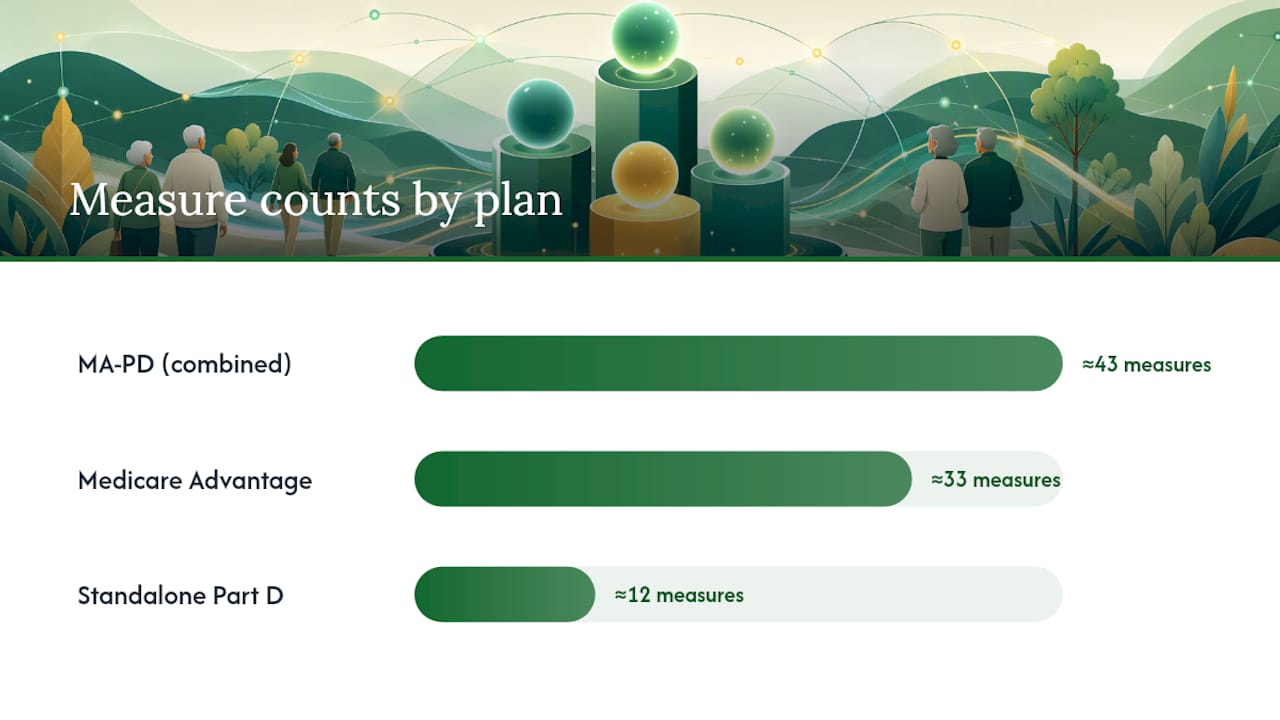
Not every plan type gets measured the same way. A combined MA-PD plan can be scored on close to 43 individual measures for 2026, according to CMS’s technical notes. A Medicare Advantage plan without drug coverage is scored on around 33, since it skips the Part D measures entirely. A standalone Part D prescription drug plan (PDP) is judged on a much shorter list, closer to 12 measures, because it only handles drug benefits.
The star scale itself runs from 1 (poor) to 5 (excellent), and CMS allows half stars in summary and overall ratings, so you’ll see plans rated things like 3.5 or 4.5. A 5 star overall rating is rare and means a plan is performing at the top of nearly every category CMS tracks. A 3 star plan isn’t necessarily bad. It might excel at chronic care management while lagging on customer service; checking the domain breakdown, not just the headline number, reveals these differences.
How CMS Calculates the Rating: Measures, Weights, and Cut Points
CMS doesn’t average every measure equally. Some carry far more weight than others, and understanding that hierarchy explains why two plans with similar headline scores can feel very different in practice.
The calculation moves through a few stages. Individual measures get scored first, then grouped into domains, then combined into a Part C summary rating and a Part D summary rating. For plans that offer both medical and drug coverage, CMS blends those two summaries into one overall MA-PD rating using a weighted average per the technical notes.
The weight categories break down roughly like this:
- Outcome and intermediate outcome measures carry the heaviest weight, generally 3 times a standard process measure because they reflect actual health results rather than whether a step got completed
- Patient experience and complaints/access measures carry a moderate weight
- Process measures, like whether a screening got scheduled, carry the lightest weight
- Improvement measures track whether a plan got better or worse year over year and factor separately into the summary score
For 2026, CMS adjusted the weighting in 2026 to reduce the emphasis on patient experience and access measures, giving more influence to outcomes and clinical performance. The agency also folded in a new kidney health evaluation measure and brought back two previously retired measures, both starting at an initial weight of 1 before scaling up in future years.
Cut points, the score thresholds that separate a 3 star measure from a 4 star measure, get recalculated every single year based on how all plans performed nationally. That’s a critical detail: a plan can deliver the exact same clinical results two years running and still lose a star if the entire industry improved and the bar moved up. CMS also requires a minimum number of rated measures before it will issue a summary or overall rating at all. A brand-new plan without enough measure history typically shows up as “Not enough data” rather than a star score.
Pro Tip: Don’t assume outcome and process measures count the same. A plan that nails its diabetes control numbers (an outcome measure) is doing something more valuable, statistically speaking, than one that simply schedules more annual wellness visits (a process measure), even if both show up as single line items on the report card.
Where to Find Official Star Ratings
Skip the marketing brochures. The star rating a plan advertises on its own website should match what CMS publishes, but the safest place to check is always the source.
- Start at Medicare Plan Finder. Go to Medicare and enter your ZIP code. Every Medicare Advantage and Part D plan available in your area shows its current overall star rating right next to the plan name.
- Filter by star level. Medicare Plan Finder lets you sort or filter results, so you can quickly isolate 4 star and 5 star plans if quality is your top priority.
- Look for the “high performing” icon. Plans that hit the top tier get a visual badge on Medicare Plan Finder, separate from the numeric star, that flags them at a glance.
- Download CMS’s own documentation if you want the full technical picture. CMS publishes a Star Ratings fact sheet every fall, along with detailed technical notes, a measures and weights PDF, and raw distribution tables through its Part C & D Performance Data portal.
New ratings post to Medicare Plan Finder each fall, ahead of the Open Enrollment Period that runs October 15 through December 7. If you’re comparing plans for the year ahead, check the tool after the fall update rather than relying on last year’s numbers, which may no longer be accurate.
Recent Trends: Why 2026 Ratings Look Different
The average Medicare Advantage star rating dropped in the transition from the 2025 ratings to 2026, continuing a pattern CMS itself has documented in its newsroom fact sheet. Compared to prior cycles, fewer plans are achieving 4 and 5 star ratings, and the gap between the highest and lowest performers has increased.
Part of this comes down to the cut point mechanics explained above: as the industry average improved in past years, CMS tightened the thresholds, and plans that stood still relative to their peers got pulled down. Analysts have also pointed to a broader correction after several years of ratings inflation, where methodology adjustments are now catching up with that trend.
That volatility has real financial consequences. CMS awards quality bonus payments to Medicare Advantage plans with ratings of 4 stars or higher. These bonuses often support additional benefits, reduced premiums, and enhanced supplemental coverage. When fewer plans clear that bar, bonus money concentrates among a smaller group of high performers, often regional or integrated health systems that combine insurance with their own provider networks. National carriers spread across dozens of markets sometimes struggle to match that consistency, because a single weak market can drag down an otherwise strong overall score.
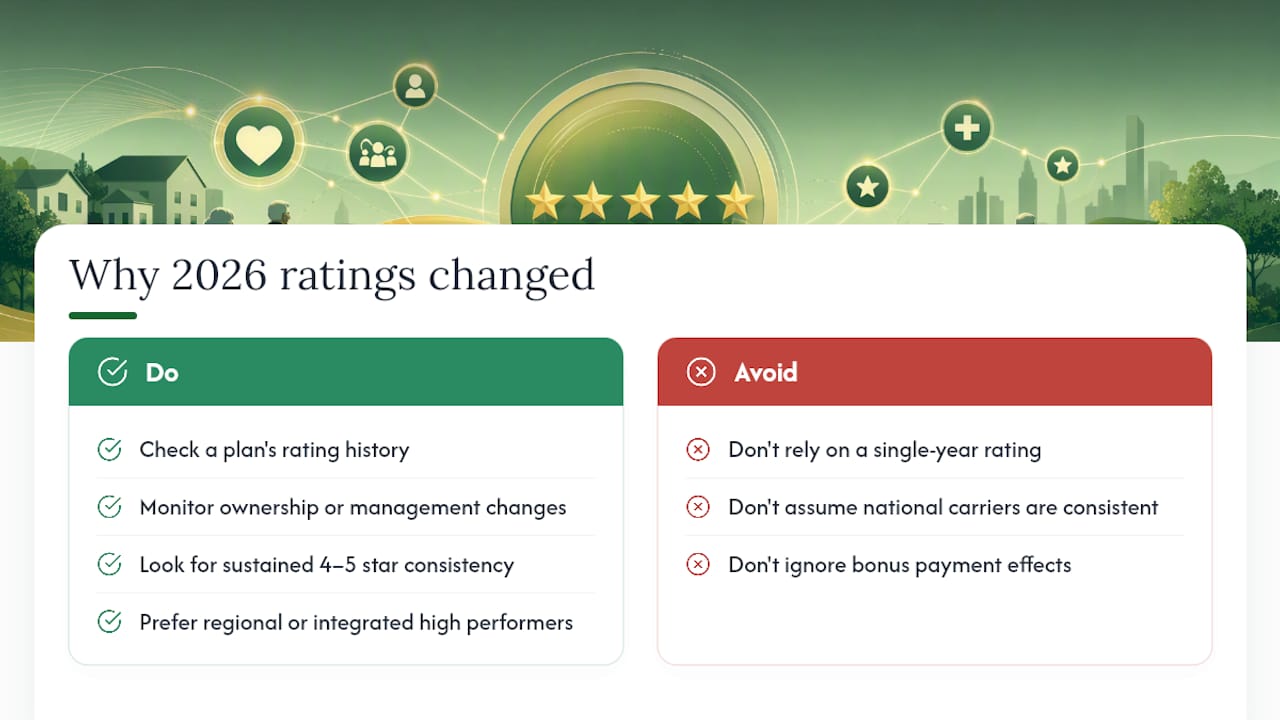
Practical takeaway: don’t just check this year’s star rating. Pull up a plan’s rating history if you can, and watch for ownership or management changes, since those often precede a rating shift before CMS’s own data catches up. A plan riding high on a single strong year is a different bet than one that’s held 4 or 5 stars consistently across multiple cycles.
A Checklist for Choosing a Plan Using Star Ratings
Star ratings are a filter, not a finish line. Here’s a recommended order to work through when comparing options.
- Check the overall and domain-level stars first. If you manage a chronic condition, weight the chronic care management domain more heavily than the headline number.
- Confirm your doctors and hospitals are in-network. A 5 star plan that drops your cardiologist isn’t a 5 star plan for you.
- Verify your medications are on the formulary. Part D coverage varies plan to plan, and a drug that’s a low copay on one plan can sit in a high cost tier on another.
- Estimate total annual out-of-pocket costs, not just the premium. Copays, deductibles, and prior authorization requirements add up fast for anyone managing multiple prescriptions or specialist visits.
- Ask about prior authorization and appeals timeliness. A plan can score well on paper and still frustrate members with slow approval processes.
- Look at multi-year rating stability. A plan holding 4 stars for three straight years is a safer bet than one that jumped from 3 to 4.5 stars in a single cycle.
- Ask if a 5 star plan is available in your area, since a genuine 5 star rating triggers a Special Enrollment Period that lets you switch mid-year outside the normal enrollment window.
Pro Tip: When you talk to a broker or counselor, ask them directly: “Has this plan’s rating been stable for the last three years, and did the ownership or provider network change recently?” That question alone filters out a lot of plans that look great on paper but carry hidden risk.
Why the Star Rating Number Alone Misleads People
Most people treat the overall star rating like a report card grade, a single number that settles the question. It doesn’t, and treating it that way is the most common mistake I see beneficiaries make.
Here’s what gets lost: two plans can post identical 4 star overall ratings while performing completely differently on the measures that actually affect a person managing diabetes or heart disease. Because outcome measures carry roughly three times the weight of process measures, a plan can coast on strong satisfaction survey scores and administrative process metrics while its actual clinical outcomes lag. The overall number hides that gap unless you go looking for it in the domain breakdown.
The lag problem deserves more attention than it gets, too. Star ratings reflect prior-year performance, which means a plan that just changed ownership, cut its provider network, or brought in new management might already be behaving differently than its current rating suggests. CMS can’t update the score in real time, so the rating you’re looking at today describes yesterday’s plan, not necessarily today’s.
None of this means star ratings aren’t useful. They’re one of the few standardized, government-verified quality signals available to compare plans that otherwise all claim to be the best option. The mistake is expecting a single number to do all the work. Pair it with a domain-level look, a network check, and a formulary review, and the rating becomes genuinely useful instead of a marketing talking point repeated in every plan brochure.
— Zach
How to Turn Star Ratings Into the Right Plan for You
Reading a star rating is one thing. Knowing what it means for your specific prescriptions, your specific doctors, and your specific budget is another, and professional Medicare Insurance Planners can help by cross-referencing CMS star data with your actual drug list and provider network, something no ratings chart on its own can do.

We offer free, no-obligation consultations for beneficiaries turning 65, comparing Medicare Advantage against Medigap and Part D options, or simply reviewing coverage during Annual Enrollment. That support doesn’t end once you sign up. We stay available for claims questions, appeals, and annual coverage reviews for as long as you’re a client, which is part of why families across Clay County and the greater Jacksonville area keep coming back year after year. If you want a plan comparison built around your actual needs instead of a generic star icon, schedule a consultation with Greenins and get a straight answer before Open Enrollment closes.
Sources
- 2026 Medicare Advantage and Part D Star Ratings (CMS fact sheet)
- 2026 Part C & D Star Ratings technical notes (CMS)
- Medicare
This article is general information, not a substitute for advice from a qualified doctor. Consult a qualified healthcare professional about your own circumstances before acting on anything here.
FAQ
What is the highest rated Medicare company?
There’s no single “highest rated” company, since ratings apply to individual plans within a company’s lineup, not the carrier as a whole. Regional and integrated health systems often post stronger, more consistent ratings than large national carriers, but you need to check the specific plan available in your ZIP code on Medicare Plan Finder.
Where can I find star ratings for Medicare?
The official source is Medicare Plan Finder at medicare.gov, which displays the current star rating for every Medicare Advantage and Part D plan by ZIP code. CMS also publishes the underlying data through its Part C & D Performance Data portal.
Where can I find the CMS star ratings for 2026 in a PDF format?
CMS publishes the 2026 Star Ratings fact sheet and technical notes as downloadable PDFs, alongside measure and weight tables on its Part C & D Performance Data page.
What states have 5 star Medicare Advantage plans for seniors?
Five star plans shift by state and by year based on CMS’s annual recalculation, and no state is guaranteed to have one every cycle. The only reliable way to check is searching your own ZIP code on Medicare Plan Finder, since availability changes as cut points and plan performance shift each fall.
Do star ratings affect my monthly premium?
Yes. CMS pays quality bonus payments to Medicare Advantage plans rated 4 stars or higher, and plans often funnel that money into lower premiums or richer supplemental benefits, which is one reason bonus dollars concentrate among fewer, higher performing plans in recent cycles.