


A Medicare Part B giveback is a benefit some Medicare Advantage plans use to reduce or repay part of your monthly Part B premium, which stands at $202.90 in 2026. The reduction can range from a few dollars to the entire premium, but only certain plans offer it, and availability depends on your ZIP code. Whether it’s worth chasing depends on what else the plan gives up in exchange.
TL;DR:
- The availability and amount of Medicare Part B givebacks depend heavily on your ZIP code and the specific plan, with some plans covering the entire premium in certain areas.
- The reduction is applied through plan credits, Social Security adjustments, or refunds, which can take one to two billing cycles to reflect fully in your Social Security deduction.
- To qualify, you must be enrolled in a plan offering the benefit in your region and responsible for paying your Part B premium, with eligibility often restricted by geography.
- Finding a giveback plan requires using Medicare’s Plan Finder, reviewing the plan’s official documents, and confirming the exact dollar amount directly with plan representatives.
- For lower-income beneficiaries, Medicare Savings Programs generally offer broader financial coverage than giveback plans, especially when considering other costs like deductibles and coinsurance.
Table of Contents
- What Is a Medicare Part B Giveback Benefit?
- How Do Part B Giveback Plans Actually Work?
- Who Qualifies for Medicare Giveback Eligibility?
- How Do You Find Plans With a Part B Giveback?
- When Do You Actually See the Money?
- Is a Giveback Plan Worth It, or Should You Look at MSPs Instead?
- Checklist: Questions to Ask Before You Enroll in a Giveback Plan
- When a Giveback Makes Sense, and When It Doesn’t
- Get a Free Plan Review
- Sources
- FAQ
What Is a Medicare Part B Giveback Benefit?
A Part B giveback isn’t a government check or a federal rebate program. It’s a supplemental benefit built into certain Medicare Advantage plans, where the insurer applies a credit toward the Part B premium you’d otherwise pay in full. This is different from Original Medicare, which sets one national premium for everyone, and it’s different from state-run Medicare Savings Programs, which pay premiums through a separate application process.
Giveback amounts vary widely from plan to plan:
- Some plans knock a few dollars off the standard Part B premium [2026 amount].(https://www.medicare.gov/basics/costs/medicare-costs)
- Others cover a meaningful chunk, such as moderate to substantial amounts per month
- A smaller number of plans cover the full premium, though these tend to be less common and more geographically limited
How Do Part B Giveback Plans Actually Work?
The mechanics come down to who touches your money and when.
- Plan credit at the point of enrollment. The insurer builds the reduction into your monthly billing so you simply owe less, or nothing, out of pocket.
- Direct adjustment through Social Security. If your Part B premium is normally deducted from your Social Security check, the plan coordinates with the Social Security Administration so your deduction shrinks to reflect the giveback.
- Reimbursement after the fact. Less common, but some arrangements involve a refund process rather than an upfront reduction.
Timing depends entirely on plan design, and it can take one to two billing cycles for a new enrollment to show up correctly in your Social Security deduction. The Evidence of Coverage is the document that spells out exactly how your specific plan handles it, and it’s the first thing to pull up before assuming anything about your own deduction.
Who Qualifies for Medicare Giveback Eligibility?
You have to be enrolled in the specific Medicare Advantage plan offering the benefit, and you have to actually be paying Part B out of your own premium or through your Social Security deduction. That’s the baseline. Beyond that, geography does a lot of the deciding.
- Giveback benefits are frequently restricted to specific states, counties, or even ZIP codes within a county
- A plan can offer a $75 giveback in one county and none at all one county over
- CMS guidance confirms that Medicare Advantage benefit design, including supplemental perks like this one, varies by plan and location year to year
Before assuming a plan you’ve heard about applies to you, run your ZIP code through Medicare’s Plan Finder and cross check the Evidence of Coverage for the exact plan you’re considering.
How Do You Find Plans With a Part B Giveback?
Finding a legitimate giveback plan takes a few concrete steps, not a Google search and a hope.
- Start with Medicare Plan Finder. Enter your ZIP code, along with your current prescriptions and pharmacy, so the tool surfaces plans available where you actually live.
- Pull the Summary of Benefits and Evidence of Coverage. Search those documents for the giveback or Part B premium reduction language directly. Marketing brochures oversimplify; the EOC does not.
- Call the plan’s member services line, or talk to a licensed agent. Get the exact dollar amount and the delivery timeline in writing or recorded, not paraphrased from a sales flyer.
Skipping step three is where most confusion starts. A quoted “up to” amount on a website is not the same as the number that will show up on your Social Security statement.
When Do You Actually See the Money?
Picture three beneficiaries. One gets a $15 monthly credit that quietly lowers her Social Security deduction. Another gets $50 back, noticeable enough to change her monthly budget for groceries or gas. A third enrolls in a rarer full giveback plan and stops paying Part B out of pocket entirely.
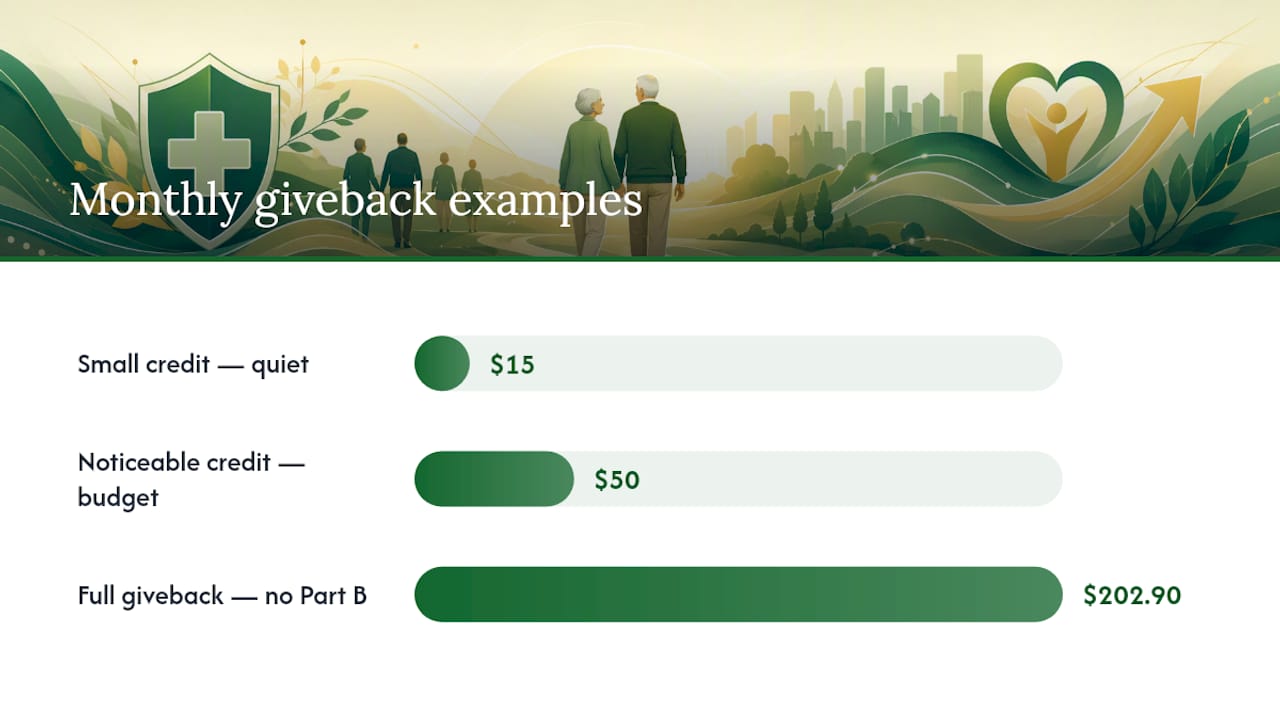
All three should expect a short lag, often one to two billing cycles, while Social Security and the plan sync up the new deduction amount. None of this happens automatically at the moment you sign the enrollment form. Check your Evidence of Coverage for your plan’s specific timeline, and watch your Social Security statement for the actual change rather than assuming it kicked in on day one.
Is a Giveback Plan Worth It, or Should You Look at MSPs Instead?
A giveback plan gives you something real: lower monthly premium costs and better cash flow, starting almost immediately once the adjustment takes effect. That’s genuinely useful if you’re on a fixed income and every dollar back in your pocket matters.
But the trade-offs are worth weighing honestly:
- Pros: monthly premium relief, improved cash flow, no separate application process beyond enrolling in the plan
- Cons: Medicare Advantage networks limit which doctors you can see, many services require prior authorization, and total annual costs (premium plus copays and coinsurance) can end up higher than a plan with no giveback at all
Here’s the number that changes the math for a lot of people: Medicare Savings Programs can pay your Part B premium AND cover deductibles, coinsurance, and copayments, depending on which MSP tier you qualify for. That’s a much broader safety net than a giveback provides, and millions of eligible people still aren’t enrolled. If your income is limited, checking MSP eligibility through your state Medicaid office is worth doing before you lock into a giveback plan for the premium relief alone.
Checklist: Questions to Ask Before You Enroll in a Giveback Plan
Before signing up for any plan touting a giveback, run through this list on your call with the agent or plan representative:
- What’s the exact giveback amount, in dollars, not a percentage or “up to” figure?
- How is it delivered: plan credit, Social Security adjustment, or reimbursement?
- What does the Evidence of Coverage say about timing and eligibility conditions?
- Which doctors, specialists, and hospitals are in-network?
- What services require prior authorization, and how often do claims get denied?
- How does this plan’s Part D drug coverage compare to what you currently have?
- What’s your realistic total annual cost, premium plus expected copays, not just the giveback headline?
Red flags include a vague EOC that never names a specific dollar amount, a big advertised giveback paired with high specialist copays, and any representative who can’t tell you when the adjustment actually starts.
Pro Tip: Call your local State Health Insurance Assistance Program (SHIP) or 1-800-MEDICARE before you enroll, not after. They can help you compare the actual math between a giveback plan and an MSP for free, with no sales incentive either way.
When a Giveback Makes Sense, and When It Doesn’t
A Part B giveback is a smart, immediate win if you have moderate income, want to stay in Medicare Advantage anyway, and just want the premium bite reduced. It’s a pragmatic fix, not a financial strategy. Where I see people leave money on the table is skipping the MSP eligibility check first. As a certified Medicare Insurance Planner®, I’ve walked clients through both paths, and for lower income beneficiaries, an MSP consistently beats a giveback on total savings.
— Zach
Get a Free Plan Review
Expert Medicare Insurance Planners® can help you compare giveback amounts, network restrictions, and MSP eligibility rules against each other to find what fits your situation. They can review the actual Evidence of Coverage for plans available in your area, check whether you qualify for a Medicare Savings Program or Extra Help, and walk through the full annual cost picture, not just the advertised giveback number.

This local agency offers personalized, education-first consultations, with a strong reputation from client reviews and community recognition. Consultations are free, and advisors are compensated by the carrier, not by you. If you’re weighing a giveback plan against a Medicare Savings Program, or you just turned 65 and need a clear starting point, schedule a consultation to get a straight answer on what actually fits your situation.
Sources
- Medicare
- CMS press release — Medicare Advantage and Medicare prescription drug programs expected to remain stable in 2026
FAQ
Is the Medicare Giveback Program Legitimate?
Yes. It’s a real supplemental benefit offered by certain Medicare Advantage plans, not a scam, though the amount and availability depend entirely on the specific plan and your ZIP code.
Who Gets Money Back From Medicare Through a Giveback?
Anyone enrolled in a Medicare Advantage plan that specifically offers a Part B giveback benefit in their area qualifies, provided they’re already paying the Part B premium themselves.
What Medicare Giveback Plans Are Available in 2026?
Availability varies by county and insurer, so the only reliable way to see current options is to enter your ZIP code into Medicare’s Plan Finder and check each plan’s Evidence of Coverage.
Who Is Eligible for a Medicare Part B Premium Reduction?
You need to be enrolled in a Medicare Advantage plan that offers the giveback benefit in your specific county, and you must be responsible for paying the Part B premium. Income limits don’t typically apply to giveback eligibility the way they do for Medicare Savings Programs.
Are Medicare Giveback Plans Better Than Medicare Savings Programs?
Not necessarily. Givebacks only touch the Part B premium, while Medicare Savings Programs can also cover deductibles and coinsurance, making MSPs the stronger option for many lower income beneficiaries.