

Medicare Excess Charges: 8 States That Ban Them and How to Avoid Costs

Not every provider can charge it, not every state allows it, and the right Medigap plan can wipe out the risk entirely. The short version: check assignment status before you get care, and know whether your state or your supplemental plan already has you covered.
TL;DR:
- Most Medicare claims do not involve excess charges because participating providers accept the Medicare-approved amount, but non-participating providers can bill up to 115% of that amount in certain cases.
- Eight states ban excess charges within their borders, but travel outside those states or private contracts with opt-out providers can expose beneficiaries to additional costs.
- Medigap Plan G covers all Part B excess charges and is recommended for frequent travelers or those seeing multiple specialists who might bill outside of assignment.
- Confirm provider assignment status and get written estimates before services to avoid surprises and have documentation for disputes if overcharged.
- Excess charges are rare for most beneficiaries but become a significant cost over multiple visits or when care is received from non-participating or out-of-state providers.
Table of Contents
- What Are Medicare Excess Charges, and How Are They Calculated?
- What Do Participating, Non-Participating, and Opt-Out Mean?
- Which States Ban Excess Charges?
- Does Medigap Cover Excess Charges?
- How Can You Avoid Excess Charges Before You Get Billed?
- What Should You Do If You Were Billed an Excess Charge?
- Why Do Excess Charges Exist in the First Place?
- How Common Are Excess Charges in Practice?
- How Much Do Excess Charges Actually Cost Beneficiaries?
- What Happens to Providers Who Overcharge?
- Could Future Medicare Policy Change Excess Charges?
- An Editorial Take on Excess Charges
- Get a Personalized Review of Your Medicare Exposure
- Sources
- FAQ
What Are Medicare Excess Charges, and How Are They Calculated?
The math starts with the Medicare-approved amount, the fee Medicare sets for a given service under the Physician Fee Schedule. A provider who accepts assignment agrees to take that amount as full payment, so the conversation about excess charges never even comes up.
Here’s the arithmetic on an example approved service. Standard Part B coinsurance is generally 20%, so you’d normally owe a corresponding share. You’d pay your usual coinsurance plus an excess charge on top of it, all out of pocket, since Medicare doesn’t cover any part of that markup.
Where excess charges tend to show up:
- Specialist visits with providers who don’t participate in Medicare, especially in rural or underserved areas
- Certain outpatient procedures billed by a non-participating physician even inside a participating facility
- Ambulance services and some durable medical equipment claims in specific circumstances
Excess charges cannot appear on Part A hospital charges, and they never apply once a provider accepts assignment. The PFS Look-Up Tool shows the exact approved amount and limiting charge for your area, since both figures shift by locality.
What Do Participating, Non-Participating, and Opt-Out Mean?
Every provider who bills Medicare falls into one of three categories, and the label determines whether excess charges are even possible.
- Participating providers sign an agreement to accept assignment on every claim, taking the Medicare-approved amount as full payment. There’s no excess charge exposure here, period.
- Non-participating providers haven’t signed that blanket agreement but can still accept assignment case by case. When they don’t, they can bill up to the 115% limiting charge, which is where excess charges actually come from.
- Opt-out providers have left the Medicare system through a private contract with you. Medicare pays nothing, the limiting charge doesn’t apply, and you’re responsible for whatever rate you agreed to in writing.
Before scheduling anything, search the provider on Medicare’s Physician Compare tool or simply ask the billing office, “Do you accept Medicare assignment?” That one question, confirmed with Medicare’s own explainer on assignment, tells you almost everything you need to know about your exposure.
Which States Ban Excess Charges?
Eight states outlaw Medicare Part B excess charges outright: Connecticut, Massachusetts, Minnesota, New York, Ohio, Pennsylvania, Rhode Island, and Vermont. Providers in these states must accept the Medicare-approved amount as payment in full for covered physician services, according to a Healthline breakdown of state protections.
That protection is tied to geography, not to you personally. A few things to keep in mind:
- The ban covers care received inside that state, so a trip to a neighboring state for a specialist can expose you to excess charges again.
- Snowbirds and frequent travelers are the most likely to get caught off guard by this gap.
- Private opt-out contracts sidestep state bans entirely, since you’ve agreed to pay whatever rate the contract specifies, law or no law.
If you split your year between, say, Pennsylvania and Florida, that state ban only protects you for half of it.
Does Medigap Cover Excess Charges?
Medigap Plan G covers Part B excess charges completely, which is the single biggest reason it’s become the most popular Medigap plan for new enrollees. Plan F covers them too, but it’s closed to anyone who became Medicare-eligible on or after January 1, 2020, so it’s a shrinking option. Plan N, by contrast, leaves you exposed. Medicare’s own plan comparison spells out exactly which letter plans include this benefit and which don’t.
Medicare Advantage plans work on a completely different model. You’re not exposed to excess charges, but you are exposed to network restrictions if your specialist isn’t in-plan.
- Plan G: full excess-charge protection, no network restrictions, higher monthly premium
- Plan F: same protection, but only if you were eligible before 2020
- Plan N: lower premium, but excess charges land on you
- Medicare Advantage: no excess-charge risk, but coverage runs through a defined network
Pro Tip: If you travel often or see specialists who don’t always accept assignment, Plan G’s flat premium usually beats gambling on random excess charges that can hit $30 to $50 per visit.
How Can You Avoid Excess Charges Before You Get Billed?
Most excess charges are preventable with a five-minute check before you ever sit in the waiting room.
- Confirm assignment status through Care Compare or by asking the billing office directly, and get the answer in writing if the visit involves a costly procedure.
- For elective or planned care, request a written estimate showing the Medicare-approved amount alongside any potential excess charge, so nothing is a surprise later.
- If full protection matters more to you than saving on premiums, ask an agent about switching to Medigap Plan G during your next enrollment window.
- Remember that non-participating surgeons performing higher-cost elective procedures are required to give you written notice of estimated costs in advance.
Pro Tip: Save every written estimate you get. If the final bill runs higher than the estimate, that paper trail is exactly what you need to dispute the charge later.
What Should You Do If You Were Billed an Excess Charge?
Start by pulling two documents: the itemized bill from the provider and your Medicare Summary Notice, which shows the actual approved amount for that service. Line them up side by side, and the excess charge, if there is one, becomes obvious fast.
- Call 1-800-MEDICARE to report a suspected overcharge or file a complaint online through Medicare.gov.
- Contact the Medicare Administrative Contractor for your region if the provider disputes the charge.
- Reach out to a State Health Insurance Assistance Program (SHIP) counselor for free, unbiased help walking through the appeal.
Providers who bill above the limiting charge risk penalties and potential exclusion from the Medicare program, so most legitimate practices correct billing errors quickly once flagged.
Why Do Excess Charges Exist in the First Place?
Excess charges trace back to a compromise built into Medicare’s original design. When Congress created Part B, it needed a way to control physician costs without forcing every doctor into a fixed-fee system overnight.
The idea was to protect access to care in areas where doctors might otherwise refuse Medicare patients altogether, while still keeping a lid on runaway billing. It worked reasonably well as a compromise, but it also left a permanent gap in the program. Unlike deductibles and coinsurance, which are predictable and capped, excess charges are variable and depend entirely on which provider you happen to see.
That gap is exactly why eight states eventually passed their own laws closing it. Lawmakers in those states decided the federal compromise didn’t go far enough and simply banned excess charges outright for services delivered within their borders. It’s a patchwork solution, but it reflects a real tension in the program: how do you keep physician participation broad while still shielding seniors on fixed incomes from unpredictable bills? Fifty years later, that tension still isn’t fully resolved, and excess charges are the residue of it.
How Common Are Excess Charges in Practice?
Most Medicare claims never involve an excess charge at all, since the overwhelming majority of physicians who bill Medicare accept assignment on every claim. Non-participating status is the exception, not the rule, concentrated more heavily among certain specialists and in regions where physician density is lower.
The limiting charge is a ceiling, not a fixed rate, so plenty of non-participating providers bill somewhere below the maximum rather than at it. That’s a meaningful distinction: seeing a non-participating provider doesn’t guarantee you’ll be charged the full excess amount, but it does mean you’re exposed to the possibility in a way a participating provider’s patient simply isn’t.
Frequency also depends heavily on geography. In the eight states that ban excess charges, the exposure drops to zero for in-state care, full stop. Outside those states, exposure clusters around specialty care, certain outpatient services, and regions where physician participation rates run lower. Someone who sees the same participating primary care doctor and a couple of participating specialists year after year may never encounter an excess charge. Someone who travels for care, sees multiple specialists, or lives somewhere with fewer participating providers faces meaningfully higher odds.
The practical takeaway is that excess charges are neither rare edge cases nor a routine cost of being on Medicare. They’re a real but avoidable risk concentrated in specific, identifiable situations.
How Much Do Excess Charges Actually Cost Beneficiaries?
A single excess charge on one visit rarely breaks the bank. On a moderately priced specialist visit, the markup might run $20 to $40 above your normal coinsurance. The real damage comes from repetition.
Compare that to Medicare’s baseline cost structure. The 2026 Part B deductible sits at $283, and standard coinsurance applies on top of that for most covered services. Excess charges don’t count toward the deductible and don’t reduce your coinsurance obligation. They’re pure add-on cost, stacked on expenses you’d owe regardless.
The bigger financial risk isn’t any single bill. It’s the compounding effect for beneficiaries managing multiple chronic conditions who see several specialists throughout the year, especially outside one of the eight protected states. A retiree relying on a fixed Social Security check can feel a few hundred dollars in unplanned annual excess charges far more than someone with a larger cushion, which is precisely why choosing the right supplemental coverage upfront matters more than dealing with it bill by bill.
What Happens to Providers Who Overcharge?
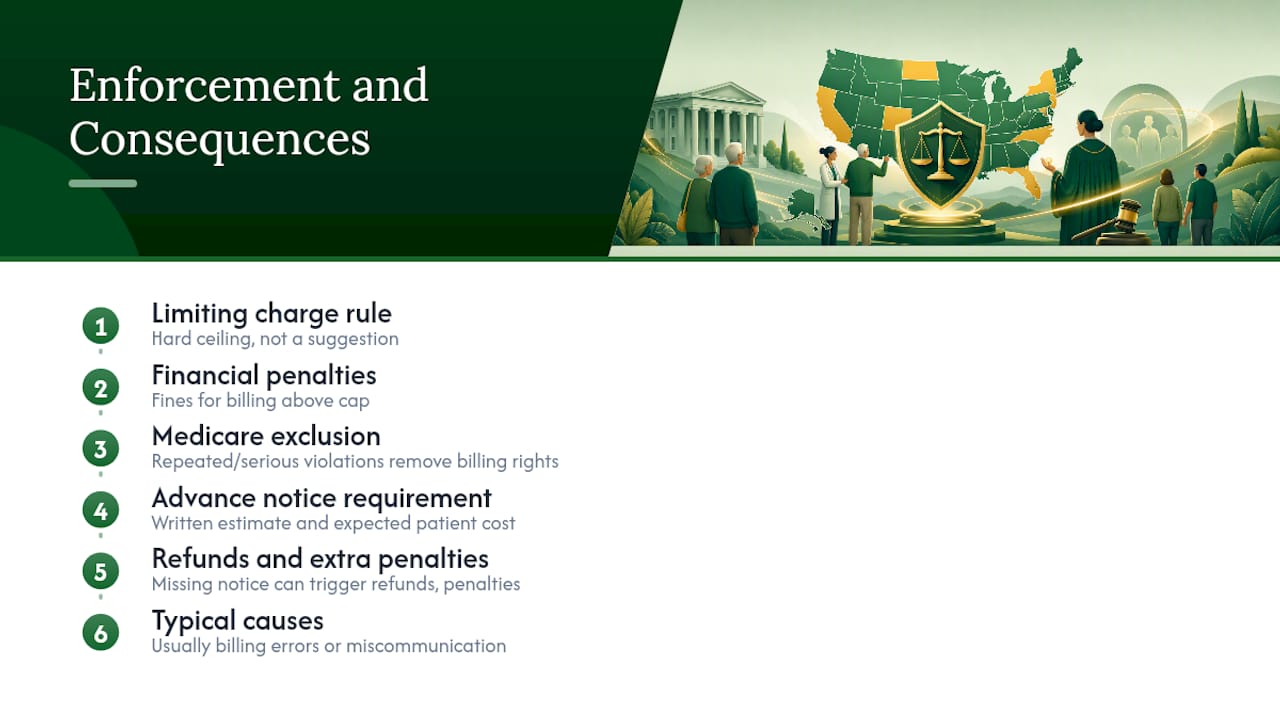
Federal law treats the limiting charge as a hard ceiling, not a suggestion, and providers who bill above it face real consequences. Enforcement mechanisms exist specifically to make sure the cap functions as an actual protection rather than a guideline providers can quietly ignore.
Providers found billing above the limiting charge can face financial penalties, and repeated or serious violations can lead to exclusion from the Medicare program entirely. That’s a significant deterrent for most practices, since losing the ability to bill Medicare cuts off a substantial share of patients for many physicians, particularly those treating older populations.
Beyond the limiting charge itself, non-participating providers performing higher-cost elective procedures carry an additional obligation: they must give you written notice in advance showing the estimated Medicare-approved amount and your expected out-of-pocket cost. Skipping that notice isn’t just a paperwork lapse. It can trigger refund obligations back to the patient and additional penalties against the provider.
In practice, most overcharges that do happen trace back to billing errors or miscommunication about assignment status rather than deliberate fraud. But the enforcement structure matters because it gives you leverage. If you catch a genuine overcharge and it’s confirmed, refund enforcement mechanisms back you up. You’re not just hoping the provider corrects it out of good faith.
Could Future Medicare Policy Change Excess Charges?
Excess charges haven’t been a major target of recent Medicare legislation, but the pressure to close the gap keeps building. Every state that has banned excess charges did so through its own legislature, not federal action, and that pattern of state-level intervention could keep spreading as more seniors and advocacy groups push back on unpredictable billing.
Broader Medicare cost trends add pressure of their own. The standard Part B premium runs $202.90 in 2026, and rising baseline costs tend to make beneficiaries and lawmakers more sensitive to any extra charge layered on top. If premiums and deductibles keep climbing, expect louder calls to either lower the federal limiting charge or extend outright bans beyond the current eight states.
There’s also a structural angle worth watching: as more beneficiaries shift toward Medicare Advantage, which sidesteps the excess-charge mechanism entirely through network-based pricing, the political urgency around fixing Part B’s limiting charge could actually shrink. Fewer people exposed to the problem tends to mean less pressure to solve it. Whether that shift accelerates or reverses will depend heavily on out-of-pocket cost trends and how loudly Medigap enrollees advocate for expanding state-level protections. Nothing here is settled, but it’s a policy space worth watching if you’re weighing Medigap against Advantage for the long haul.

An Editorial Take on Excess Charges
Excess charges are one of the most avoidable costs in the entire Medicare system, and yet they catch people off guard constantly. The reason isn’t complexity. It’s that nobody asks the one question that matters, “Does this provider accept assignment?” before they walk into an appointment. That single habit closes most of the gap the limiting charge leaves open.
Where I disagree with a lot of generic Medicare advice: treating Medigap Plan G as a “nice to have” undersells it badly for anyone who sees multiple specialists or travels. Certified Medicare Insurance Planners walk clients through this tradeoff, comparing plan costs against real provider networks rather than guessing. That kind of personalized review, done annually, catches exposure most people never notice until the bill arrives.
— Zach
Get a Personalized Review of Your Medicare Exposure
This service provides access to a certified Medicare Insurance Planner who checks your specific doctors’ assignment status before recommending a plan, rather than guessing based on generic averages.

A free consultation with Greenins covers whether your current providers accept assignment, whether Plan G’s premium makes sense against your real specialist visits, and whether Medicare Advantage’s network model fits your situation better than traditional Medigap. If you’re turning 65, reviewing coverage during open enrollment, or just tired of guessing whether a bill is fair, schedule a consultation with Green Insurance Agency and get a plan comparison built around your actual doctors, not a spreadsheet of averages.
This article is general information, not a substitute for advice from a qualified financial advisor. Consult a qualified financial professional about your own circumstances before acting on anything here.
Sources
FAQ
Which states ban Medicare Part B excess charges?
Connecticut, Massachusetts, Minnesota, New York, Ohio, Pennsylvania, Rhode Island, and Vermont all prohibit Part B excess charges, requiring providers to accept the Medicare-approved amount as full payment for covered services delivered in-state.
Should I worry about Medicare excess charges?
It depends on your care pattern. If you mostly see participating providers, exposure is minimal, but frequent specialist visits, travel between states, or living outside one of the eight protected states raises your risk enough that checking assignment status or choosing Medigap Plan G is worth the effort.
Are Medicare premiums increasing?
Medicare’s standard Part B premium is set annually by CMS and reached $202.90 in 2026, a figure separate from any excess charges you might face from non-participating providers.
Does Medigap Plan G cover Part B excess charges?
Yes, Plan G fully covers excess charges, and so does Plan F, though Plan F is only available if you became Medicare-eligible before January 1, 2020.