


Most people with Original Medicare and no other coverage have Medicare pay first, but once an employer plan, retiree plan, or accident claim enters the picture, that order can flip. The safest move is simple: tell every provider about all your coverage, and lean on the Centers for Medicare & Medicaid Services (CMS) and its Benefits Coordination & Recovery Center (BCRC) as the final word when you’re unsure.
TL;DR:
- Employers with 20 or more employees generally pay first for those over 65, while smaller employers typically shift the primary payer to Medicare.
- Retiree coverage almost always pays second, making Medicare the primary payer unless the person is under 65 and qualifying through disability.
- The initial 30-month period of ESRD treatment usually sees employer plans paying first, after which Medicare becomes the primary payer.
- If another insurer does not settle claims within 120 days, Medicare issues conditional payments, requiring prompt review and potential recovery actions.
- Early reporting of coverage changes and thorough documentation can prevent delays, denials, and confusion over primary and secondary payer responsibilities.
Table of Contents
- How Medicare Decides Who Pays First
- Common Coordination Scenarios You’ll Actually Run Into
- What Happens When Medicare Pays First By Mistake
- Your Checklist For Smooth Coordination
- Where To Get Official Answers
- What I See At Intake That The Rulebook Doesn’t Mention
- What Actually Matters Here
- How Greenins Helps You Sort Out Coordination Problems
- Sources
How Medicare Decides Who Pays First
Coordination of benefits exists for one reason: to stop two insurers from paying for the same claim twice. The goal, according to CMS, is that combined payments never exceed 100% of what a claim actually costs, with one plan designated as the primary payer that pays first and covers most of the bill, and a secondary payer that picks up some or all of what’s left.
Medicare determines that order using a handful of factors, not guesswork. Four variables drive almost every decision:
- Type of other coverage you carry, such as an employer group health plan, retiree coverage, or a no-fault or liability policy.
- Your age, since the rules shift once you’re under 65 and covered through disability.
- Employer size, measured by how many employees the company has, which changes who pays first for both active workers and their spouses.
- Special medical statuses, including end-stage renal disease (ESRD) or dependent status under a family plan.
Original Medicare and Medicare Advantage follow the same underlying who pays first logic, but the mechanics differ. With Original Medicare, claims typically flow through CMS’s coordination systems automatically once your other coverage is on file. Medicare Advantage and Part D plans, by contrast, take on their own duty to investigate coordination issues for their enrollees, which means your plan carrier, not just CMS, may reach out if something doesn’t line up.
Common Coordination Scenarios You’ll Actually Run Into
Rules on paper only help once you can match them to your own situation. Here’s how the most frequent cases usually shake out:
- You’re 65 or older, still working, with employer coverage. If your employer has 20 or more employees, the employer plan usually pays first and Medicare pays second. Employers with fewer than 20 employees typically flip this: Medicare pays first.
- You’re 65 and retired, with retiree coverage. Retiree plans almost always pay second to Medicare, unlike active employer plans.
- You’re under 65 and qualify for Medicare through disability. The same employer size test applies, but the threshold changes to 100 or more employees for the employer plan to stay primary.
- You have ESRD. For the first 30 months of dialysis or transplant eligibility, an employer group health plan usually pays first. After that 30 month coordination period ends, Medicare typically becomes primary.
- You have a liability, no-fault, or workers’ compensation claim. These payers are generally responsible first for care related to the injury; Medicare pays only after that coverage is exhausted or denied.
- You have VA, TRICARE, or Medicaid alongside Medicare. Medicare generally pays first for TRICARE and Medicaid situations, while VA benefits and Medicare typically don’t coordinate. You choose one system per service instead.
What Happens When Medicare Pays First By Mistake
Sometimes another insurer doesn’t act fast enough, and Medicare steps in anyway. When another payer hasn’t settled a claim within roughly 120 days, Medicare can issue what’s called a conditional payment, covering the bill temporarily on the assumption it will get reimbursed once the real primary payer is identified.
That 120-day window matters more than most beneficiaries realize. It’s the practical trigger CMS uses to decide when Medicare steps in rather than waiting indefinitely for a slow-moving insurer, liability case, or workers’ comp claim to resolve.
Once the primary payer is confirmed, recovery kicks in. The BCRC identifies these situations, while the Commercial Repayment Center pursues repayment from group health plans specifically. If you get a repayment notice:
- Read it carefully to confirm which claims and dates it covers.
- Compare it against your own settlement or insurer records before paying anything.
- Call BCRC promptly if the notice looks wrong or you need more time to gather documentation.
Common causes behind these notices include a slow liability settlement, an employer that never reported group coverage to Medicare, or a provider that billed Medicare by default instead of checking for other insurance first.
Your Checklist For Smooth Coordination
A little paperwork up front saves months of phone calls later. Work through this before and after you receive care:
- Tell every provider about all your coverage at every visit, not just at enrollment. Bring your Medicare card and any other insurance cards to appointments.
- Ask your employer or plan administrator to report your coverage to Medicare directly. This is what actually updates Medicare’s records, not just your own memory of having coverage.
- Keep copies of policy numbers, enrollment dates, and COBRA or retiree plan documents somewhere you can find them fast.
- Call the BCRC when you need to report new coverage, correct an error, or check your current payer order. Have your Medicare number, Social Security number, and Part A/B start dates ready before you dial.
- Follow up on any denied or delayed claim quickly. Ask the provider which payer was billed first, then contact BCRC or your Medicare Advantage plan if the order looks wrong, and file a formal appeal if the denial stands.
Pro Tip: Verifying your employer’s exact headcount with HR, in writing, is often faster than waiting on Medicare’s records to update. A short email confirming “our group plan has X employees” can settle a primary/secondary dispute in a day instead of weeks.
Where To Get Official Answers
When you want a definitive ruling instead of a guess, three sources carry real authority. Medicare.gov’s coordination guidance walks through who pays first in plain language with examples. The BCRC handles the actual recordkeeping: reporting new coverage, correcting Medicare’s files, and investigating mistaken payments.
For anyone who wants the full technical picture, CMS publishes a coordination of benefits workbook originally built for community trainers, covering payer types, claims systems, and scenario walkthroughs in more depth than the consumer pages.
- Medicare.gov: who pays first rules and examples
- BCRC: coverage reporting, error correction, and recovery
- CMS workbook: in-depth training material for educators and beneficiaries
What I See At Intake That The Rulebook Doesn’t Mention
Two mistakes show up constantly in client files. First, providers bill Medicare as primary by default because that’s the coverage on file, even when an active employer plan should have paid first. Second, employer records go stale. Someone retires, HR never updates the group plan roster, and Medicare’s system still shows active coverage months later.
A certified Medicare Insurance Planner catches both. Verifying employer reporting before a claim gets denied, organizing documentation ahead of a BCRC call, and representing clients through the recovery or appeals process turns a paperwork problem into a phone call instead of a months-long standoff.
What Actually Matters Here
The rules themselves aren’t complicated. Employer size, age, and a handful of medical statuses decide almost every case. What trips people up is the assumption that Medicare, employers, and insurers will sort it out behind the scenes without any input from the beneficiary.
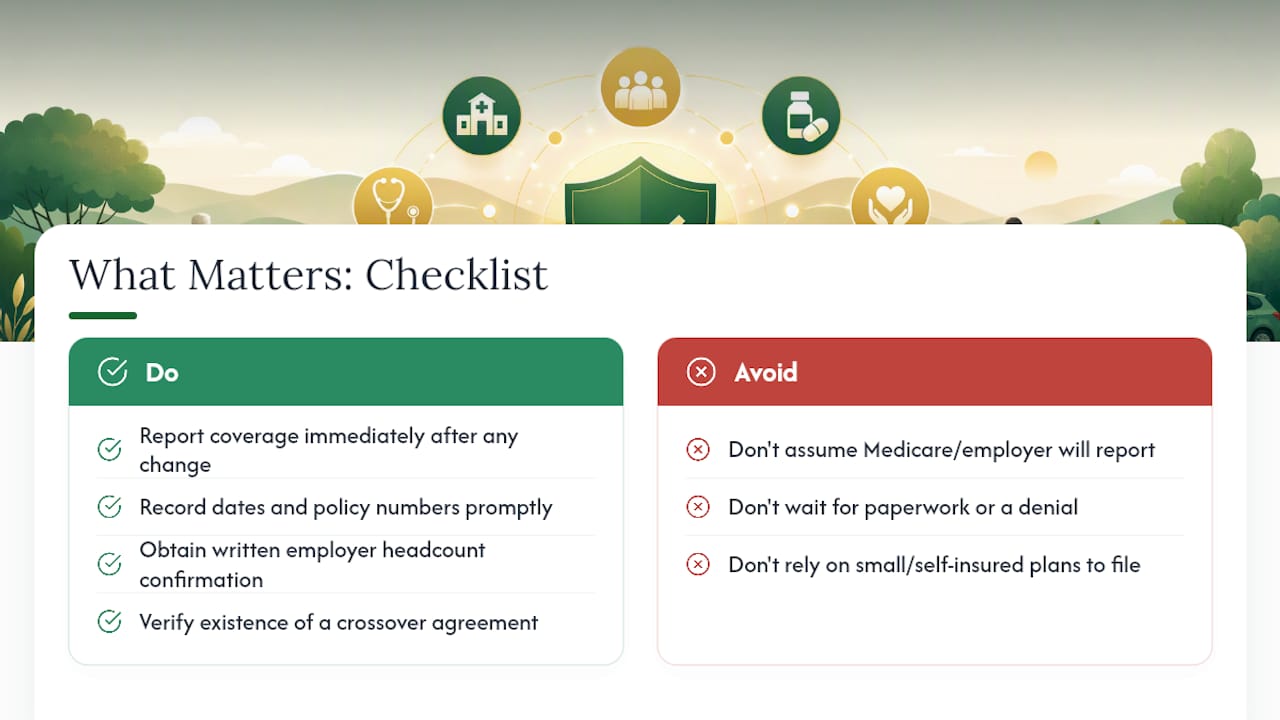
They usually won’t, unless a formal crossover agreement exists between Medicare and that other payer. Small and self-insured employer plans rarely have those agreements in place, which quietly shifts the reporting burden onto you.
The conventional advice, “just wait for the paperwork,” is backwards. The better habit is reporting coverage the moment it changes, whether that’s a new job, a retirement, or a settled liability claim, rather than waiting for a denied claim to force the issue. Prioritize documentation first: dates, policy numbers, and a written confirmation of employer headcount. That single habit prevents most of the conditional payment notices people scramble to fix months later.
— Zach
How Greenins Helps You Sort Out Coordination Problems
Greenins gives Medicare beneficiaries personalized support from a certified Medicare Insurance Planner® who reviews your coverage details and helps address primary/secondary payer questions as part of ongoing assistance after enrollment.

That includes verifying employer group plan status, gathering documentation before a BCRC call, and helping with appeals if a claim gets denied over a coordination error. Green Insurance Agency has built its reputation with numerous client reviews and local recognition, as clients often return with coordination questions well after their initial enrollment. If your coverage picture has changed, whether you’re turning 65, retiring, or adding a new plan, schedule a free consultation with Greenins and get a clear answer on who pays first before a claim gets denied.