


Find the denial notice, whether it’s a Medicare Summary Notice or a letter from your Medicare Advantage plan, and file a Level 1 appeal before the deadline printed on it. Pull together your provider’s clinical notes now, since documentation from your doctor carries more weight than anything you write yourself. Everything else in the medicare appeals process, the four levels beyond this one, the forms, the deadlines, builds from this first move.
TL;DR:
- Filing a Level 1 appeal quickly and attaching your provider’s detailed clinical notes significantly increases the chance of success in Medicare appeals.
- The appeals process involves five levels, starting with the Medicare contractor’s review and potentially ending in federal court for high-dollar disputes, with deadlines tightening at each stage.
- Completeness and organization of your evidence packet, including clinical notes and clear explanations, are crucial for prompt and thorough reviews at each level.
- Expedite appeals only if your health or life is at immediate risk, and require a doctor’s written statement to ensure rapid processing within days.
- Getting free or paid assistance from local SHIP counselors or certified Medicare Insurance Planners can greatly improve your chances of winning your appeal.
Table of Contents
- Understanding the Medicare Appeals Process: Five Levels, Two Paths
- How Do You File an Appeal at Each Medicare Level?
- Which Forms Do You Need, and How Are Deadlines Counted?
- When Can You Request a Fast Medicare Appeal?
- How to Appoint a Representative and Build a Strong Evidence Packet
- What Happens After You File an Appeal?
- Where Can You Get Free or Paid Help With Medicare Appeals?
- A Note From Zach on Filing Medicare Appeals
- Get Hands-On Help With Your Medicare Appeal
- Sources
Understanding the Medicare Appeals Process: Five Levels, Two Paths
Original Medicare runs on a five-level ladder, and each level exists because the one before it can get things wrong.
- Level 1, redetermination: A Medicare Administrative Contractor (MAC), the company that processed your original claim, takes a second look.
- Level 2, reconsideration: A Qualified Independent Contractor (QIC) reviews the case with fresh eyes, uninvolved in the first decision.
- Level 3, OMHA hearing: The Office of Medicare Hearings and Appeals assigns an Administrative Law Judge (ALJ) to hear your case.
- Level 4, Appeals Council review: The Medicare Appeals Council examines whether the law was applied correctly.
- Level 5, federal court: A U.S. district court takes the case, typically reserved for high-dollar disputes.
That’s the Original Medicare appeals process as CMS defines it. Medicare Advantage and Part D work differently. You start with your plan, not a MAC, requesting reconsideration directly through the insurer’s own appeals process listed on your member ID card. If the plan upholds its denial, it’s required to forward your case automatically to an Independent Review Entity, the Part C/D equivalent of a QIC. From there, the path merges back into OMHA escalation. The catch: plan deadlines run shorter than Original Medicare’s, often just 60 days, so check your plan handbook the moment you get a denial.
How Do You File an Appeal at Each Medicare Level?
Each level has its own paperwork, its own address, and its own clock. Here’s how to move through them without losing time to a technicality.
- Level 1, redetermination. Your Medicare Summary Notice lists the MAC’s address. File using form CMS-20027 or a written request that states what you’re appealing and why. Attach your provider’s records. Keep copies of everything, including the envelope or confirmation screen. MACs generally decide within about 60 days.
- Level 2, QIC reconsideration. You have several months from the MAC’s redetermination decision to file. Include the Medicare Redetermination Notice (MRN) number and a specific explanation of why the MAC got it wrong, not just that you disagree. The QIC reviews the full record, including any new evidence you submit.
- Level 3, OMHA hearing. Filing requires meeting a minimum dollar threshold known as the Amount in Controversy, which CMS adjusts periodically, so confirm the current figure with OMHA before assuming you qualify. You can request a hearing by phone, video, or in writing, or ask for a decision “on the record” without a hearing if you’d rather skip the appearance and let the judge rule on your paperwork alone.
- Level 4, Appeals Council. Request this when you believe the ALJ misapplied the law or ignored evidence. Spell out the specific error, attach the ALJ’s decision, and expect review timing to vary more than earlier levels.
- Level 5, federal court. Reserved for cases meeting a separate, higher Amount in Controversy threshold. At this point, most beneficiaries bring in an attorney.
Pro Tip: File everything by certified mail or through the OMHA portal, and never rely on memory for what you sent. A missing tracking number has sunk more appeals than a weak medical argument.
Which Forms Do You Need, and How Are Deadlines Counted?
Three forms cover most of what you’ll file: CMS-20027 for redetermination, CMS-20033 for reconsideration, and the OMHA hearing request form for Level 3. Add CMS-1696 if someone else will speak for you. All of them live on Medicare’s appeals forms page.
Deadlines hinge on when you’re presumed to have received your notice, and Medicare assumes that’s five days after the date printed on it, unless you can show otherwise. From there:
- You have 120 days from receiving the initial determination to request redetermination.
- You have 180 days from the MAC’s redetermination decision to request QIC reconsideration.
- Missed a deadline for a real reason, like hospitalization or a lost notice? Document it and ask for “good cause” for late filing; MACs and QICs can grant it, but only with a specific explanation, not a general apology.
Keep a copy of every form, every attachment, and every mailing receipt. Appeals get denied on technicalities more often than on medicine.
When Can You Request a Fast Medicare Appeal?
Expedited appeals exist for one narrow situation: your health or life is at risk if you wait for the standard timeline, or a hospital, skilled nursing facility, or home health agency is discharging you before you think you’re ready. Providers are required to give you written notice of these discharge or termination rights, a duty CMS enforces through its beneficiary notice requirements. Some categories, like Part B drug denials or certain pre-service requests, carry their own specific expedited thresholds, so ask your provider or plan which rule applies to your case.
To request one:
- Get a written statement from your doctor confirming the urgency.
- Mark your appeal request “expedited” in bold, at the top.
- Call the plan or your MAC directly to confirm they received it. Don’t just mail it and wait.
Pro Tip: Expedited reviews move in a matter of days, not weeks, but only if you flag the urgency loudly and early. A quiet request gets processed on the standard clock.
How to Appoint a Representative and Build a Strong Evidence Packet
Anyone can help you appeal, a family member, an attorney, a patient advocate, but Medicare needs it in writing. File form CMS-1696 or a signed letter with your name, your representative’s name, and the scope of what they’re authorized to do. The appointment holds for one year and can cover related future appeals unless you revoke it.
For the evidence itself:
- Request full clinical notes from every provider involved, not just a summary. This single step does more to strengthen an appeal than any argument you could write yourself.
- Gather prior authorizations, test results, and exact service dates tied to the denial.
- Pull the relevant lines from your MSN or remittance advice so reviewers can match your claim to their records instantly.
- Write a short cover statement connecting each piece of evidence directly to the reason for denial. Don’t make the reviewer guess why you included it.
- Organize everything into a single labeled PDF with a table of contents, in chronological order. ALJs and QICs review dozens of files a week; a clean packet gets read more carefully than a shoebox of papers.
What Happens After You File an Appeal?
MACs and QICs generally aim for roughly 60-day decisions, though OMHA hearing timelines swing much wider depending on caseload and complexity. Extensions happen for legitimate reasons on both sides, so a delay isn’t automatically a red flag.
Decisions arrive as a letter or an updated Medicare Redetermination Notice, and every one should spell out your next appeal deadline if you disagree. Read that section first. If a decision runs well past its expected window with no explanation, you can escalate or request status directly from the deciding office. For dismissed appeals, disputes involving a high Amount in Controversy, or anything touching a constitutional question, bring in an attorney or a qualified advocate before the next filing, not after.
Where Can You Get Free or Paid Help With Medicare Appeals?
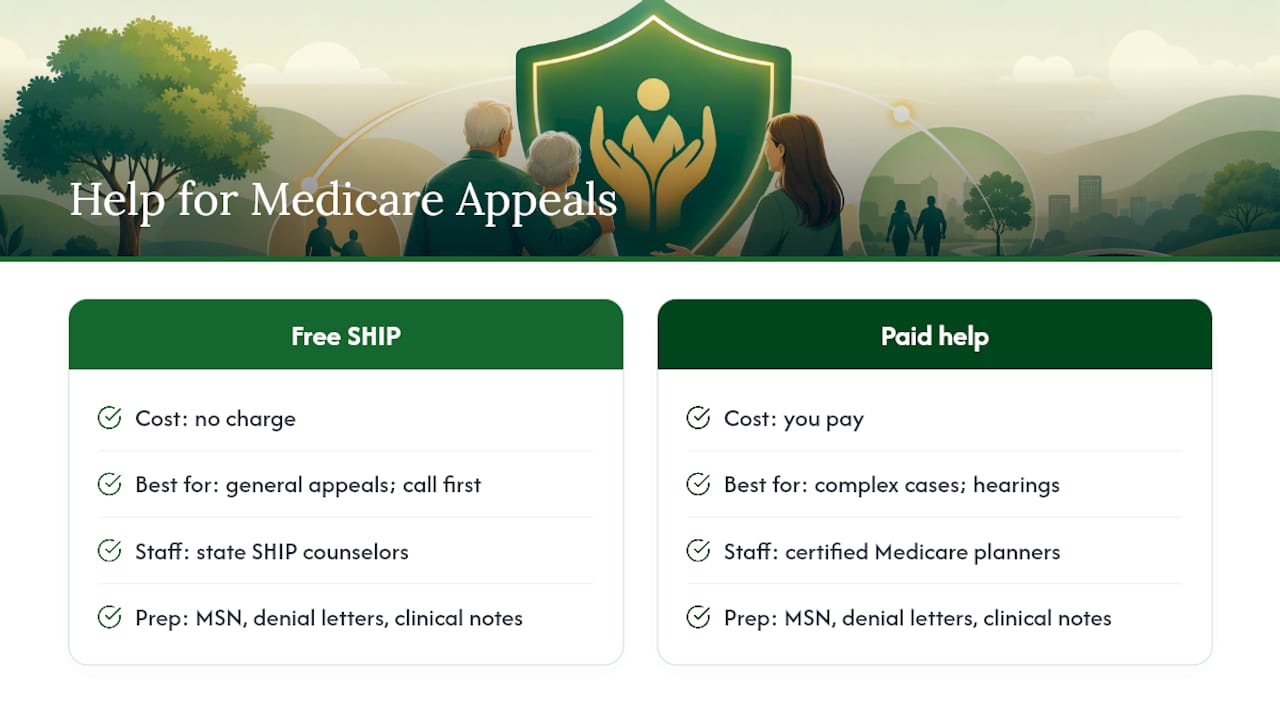
Every state runs a State Health Insurance Assistance Program (SHIP), staffed by counselors who help with appeals at no cost. It’s worth calling before anything else.
Paid help earns its cost when a case involves a lengthy hearing, a thick administrative record, or repeated denials on the same issue. Green Insurance Agency’s certified Medicare Insurance Planners® assist with exactly that kind of complexity. Before reaching out, have your Medicare Summary Notice, denial letters, and provider clinical notes on hand.
A Note From Zach on Filing Medicare Appeals
Most denials aren’t final, they’re just the first answer. The mistake I see most often is people accepting a denial without ever asking their provider for the clinical notes behind it. Request them every time, and appoint a representative the moment the process feels like too much to manage alone. Green Insurance Agency has built its reputation in Clay County on exactly this kind of hands-on, education-first support, and that doesn’t stop once you’re enrolled.
— Zach
Get Hands-On Help With Your Medicare Appeal
Green Insurance Agency is the alternative to figuring out a Medicare appeal alone at your kitchen table. Where SHIP counselors offer general guidance and a lawyer charges by the hour, our certified Medicare Insurance Planners® work directly with you on document assembly, filing at each level, and ongoing plan reviews, at no cost to you.

Before reaching out, gather your Medicare Summary Notice, any denial letters, and your provider’s clinical notes. That’s everything we need to start building your case. Visit Green Insurance Agency to schedule a consultation and get a real person looking at your appeal this week, not a call center script.
This article is general information, not a substitute for advice from a qualified financial advisor. Consult a qualified financial professional about your own circumstances before acting on anything here.