


If you’re becoming eligible for Medicare Part A, you generally should not keep your Marketplace plan. Enroll in Medicare during your Initial Enrollment Period and end your Marketplace coverage the day before Medicare starts. Medicare and the Marketplace are separate systems, and having Medicare typically ends your eligibility for Marketplace savings. Miss the window, and you risk a lifetime Part B penalty plus a tax bill for subsidies you weren’t entitled to keep.
TL;DR:
- Enrolling in Medicare during your initial seven-month window is crucial to avoid late penalties and prevent a lifetime Part B premium increase.
- Medicare eligibility, not just enrollment, terminates your Marketplace subsidies, and failure to report this can lead to repayment obligations during tax filing.
- To avoid coverage gaps, set your Marketplace plan’s end date to the day before Medicare begins and confirm both plans’ terminations with documentation.
- Certain situations, such as end-stage renal disease and employer coverage, require case-by-case evaluation before changing plans.
- Comparing provider networks and out-of-pocket costs is more important than premiums when selecting a Medicare plan, especially between Advantage, Medigap, and Part D options.
Table of Contents
- When Should You Sign Up for Medicare and Marketplace Coverage Ends?
- What Happens to Your Marketplace Savings Once Medicare Starts?
- How Do You End Marketplace Coverage Without a Coverage Gap?
- Are There Exceptions to the Standard Medicare and Marketplace Rule?
- What Should You Compare Once You’re Choosing a Medicare Plan?
- Your Marketplace-to-Medicare Transition Checklist
- How Does Medicaid Fit In If You Qualify for Both Programs?
- What Special Enrollment Periods Apply to This Transition?
- What Financial Help Exists After You Lose Marketplace Subsidies?
- Does Switching Change Your Preventive Care or Out-of-Pocket Cap?
- Why Proactive Planning Beats Reacting to Deadlines
- How Greenins Helps You Move From Marketplace to Medicare
- Sources
When Should You Sign Up for Medicare and Marketplace Coverage Ends?
Your Initial Enrollment Period (IEP) runs seven months: the three months before your birthday month, your birthday month, and the three months after. When you sign up inside that window determines when coverage actually starts, and that timing decides whether your Marketplace plan and Medicare ever overlap.
Sign up in the three months before your birthday month, and coverage starts the first day of your birthday month. Sign up during your birthday month or any of the three months after, and coverage typically starts the first day of the following month. If you’re already collecting Social Security retirement benefits, Medicare enrollment happens automatically and your card arrives before your 65th birthday.
Missing the whole seven-month window to sign up for Part B can result in a late enrollment penalty that increases your monthly premium and may last as long as you have Part B.
Practical timing:
- Start comparing Medicare options 3 to 6 months before your 65th birthday.
- Confirm whether you’ll be auto-enrolled or need to apply manually through Social Security.
- Mark your IEP start and end dates on a calendar the day you decide to act.
What Happens to Your Marketplace Savings Once Medicare Starts?
Premium tax credits stop the moment you become eligible for Part A, whether or not you actually enroll in it, and the same applies once you’re enrolled in a Medicare Advantage plan. That distinction trips people up constantly. Eligibility, not enrollment, is what ends your subsidy.

HealthCare.gov and the Marketplace run periodic data matching with CMS to catch beneficiaries who are still receiving Advance Premium Tax Credits (APTC) after becoming Medicare-eligible. When that match happens, you can be asked to repay some or all of those credits when you file your federal taxes.
Statistic Callout: The Part B late enrollment penalty adds 10% to your premium for each full 12-month period you delay signing up, and it typically stays attached to your premium indefinitely.
What this looks like in practice:
- Keep both plans, and you’ll generally pay full Marketplace premium once your subsidy is cut off.
- File taxes without reporting the change, and the IRS reconciliation process can claw back the difference.
- Some insurers cancel Marketplace policies outright once they learn a member has Medicare, sometimes with little notice.
How Do You End Marketplace Coverage Without a Coverage Gap?
Coordinating the two dates is the whole job here, and it’s more mechanical than complicated once you know the sequence.
- Log into HealthCare.gov and report your Medicare start date. You can do this up to three months before your Medicare coverage actually begins.
- Set your Marketplace plan’s end date to the day before your Medicare coverage starts, never the same day and never a week later.
- If other people are covered on the same Marketplace application, don’t cancel the whole policy. Call the Marketplace Call Center and request that only your name be removed so household members keep their coverage intact.
- Watch for a termination confirmation from both the Marketplace and your insurer, and save that documentation somewhere you can find it again.
Removing a single person from a shared application sometimes triggers a system-assigned termination date that doesn’t match what you asked for. CMS guidance for this scenario recommends requesting a HICS case through the call center to force the exact date you need.
Pro Tip: Call the Marketplace Call Center a week before your intended end date, not the day of. System processing lags can push your actual termination a few days later than you requested, and that gap is exactly the kind of overlap that triggers a subsidy repayment notice.
Are There Exceptions to the Standard Medicare and Marketplace Rule?
The default advice (enroll in Medicare, drop the Marketplace plan) doesn’t fit everyone. A few situations change the math enough to warrant a second look before you act.
- End-stage renal disease (ESRD): Medicare eligibility rules work differently for ESRD patients, and some people in this situation keep Marketplace coverage for a period. This is not a do-it-yourself decision.
- Paying a premium for Part A: If you don’t qualify for premium-free Part A, staying on a subsidized Marketplace plan may cost less, but you need to weigh that against the Part B late penalty clock still running.
- Disability-based Medicare with active employer coverage: The interaction between employer group plans and Medicare eligibility follows its own set of rules, separate from the standard 65-and-up timeline.
- Limited equitable relief: In narrow, case-by-case circumstances, CMS allows Social Security to reduce or waive Part B penalties for people who were dually enrolled through no clear fault of their own. Contact SSA directly to see if your situation qualifies.
What Should You Compare Once You’re Choosing a Medicare Plan?
Marketplace shopping trains you to look at one number: the monthly premium. Medicare shopping punishes that habit. The plan with the lowest sticker price can easily cost you more over a year once you factor in network restrictions and drug costs.
Three things matter more than premium once you’re comparing Medicare Advantage plans or building an Original Medicare setup with Part D and Medigap:
- Provider network access. Medicare Advantage plans run HMO, PPO, and other network structures that determine which doctors and hospitals you can see without extra cost.
- Total out-of-pocket exposure. Original Medicare alone has no annual out-of-pocket cap, which is exactly why most people pair it with a Medigap policy.
- Part D formulary fit. A plan that covers your specific medications at a reasonable tier beats a plan with a lower premium and a bad drug list, every time.
Medicare Advantage bundles hospital, medical, and often drug coverage into one plan with its own network and cost-sharing rules. Original Medicare plus a standalone Part D plan plus Medigap gives you broader provider access nationwide but comes as three separate pieces you have to manage together. Medicare.gov’s plan comparison tool lets you check what’s actually available by ZIP code, including plan star ratings, before you commit to ending your Marketplace policy.
Your Marketplace-to-Medicare Transition Checklist
Break the transition into three checkpoints and it stops feeling like a project.
- Three months out: Review what you’re currently paying on the Marketplace, confirm your exact IEP dates, and start comparing local Medicare Advantage or Medigap options.
- One month out: Report your Medicare start date on HealthCare.gov, finalize your plan choice, and gather the documents you’ll need (Social Security number, current Marketplace policy number, Medicare card).
- On your start date: Confirm your Marketplace plan ended the day before, and save every confirmation email and letter from both the Marketplace and your new Medicare plan.
Keep these on hand: the Marketplace Call Center number, 1-800-MEDICARE, and your local Social Security office contact.
Pro Tip: Take a screenshot of your HealthCare.gov termination confirmation the day it appears. Marketplace account portals don’t always keep old records visible for long, and you’ll want proof if a repayment notice shows up at tax time.
How Does Medicaid Fit In If You Qualify for Both Programs?
Dual-eligible beneficiaries (people who qualify for both Medicare and Medicaid) follow a different playbook than the standard Marketplace-to-Medicare handoff. If you’re approved for Medicaid, you’re not eligible for Marketplace premium tax credits regardless of your Medicare status, so the Marketplace piece of this decision often disappears entirely once Medicaid enters the picture.
Medicaid typically works alongside Medicare rather than replacing it. Medicare pays first as your primary coverage, and Medicaid picks up costs Medicare doesn’t cover, things like premiums, deductibles, and coinsurance, depending on your state’s specific dual-eligible category. Some states run Medicare Savings Programs that cover your Part B premium even if you don’t qualify for full Medicaid benefits.
The enrollment sequencing matters here too. If you’re approved for Medicaid before you become Medicare-eligible, your state Medicaid agency usually handles the transition paperwork on your behalf, including notifying the Marketplace that you no longer need subsidized coverage there. If Medicaid approval comes after you’ve already got Medicare running, you generally keep Medicare as primary and add Medicaid as a supplement rather than swapping one for the other. Either way, dual-eligible status changes the calculation enough that a case-by-case check with a benefits counselor or a certified Medicare planner beats guessing.
What Special Enrollment Periods Apply to This Transition?
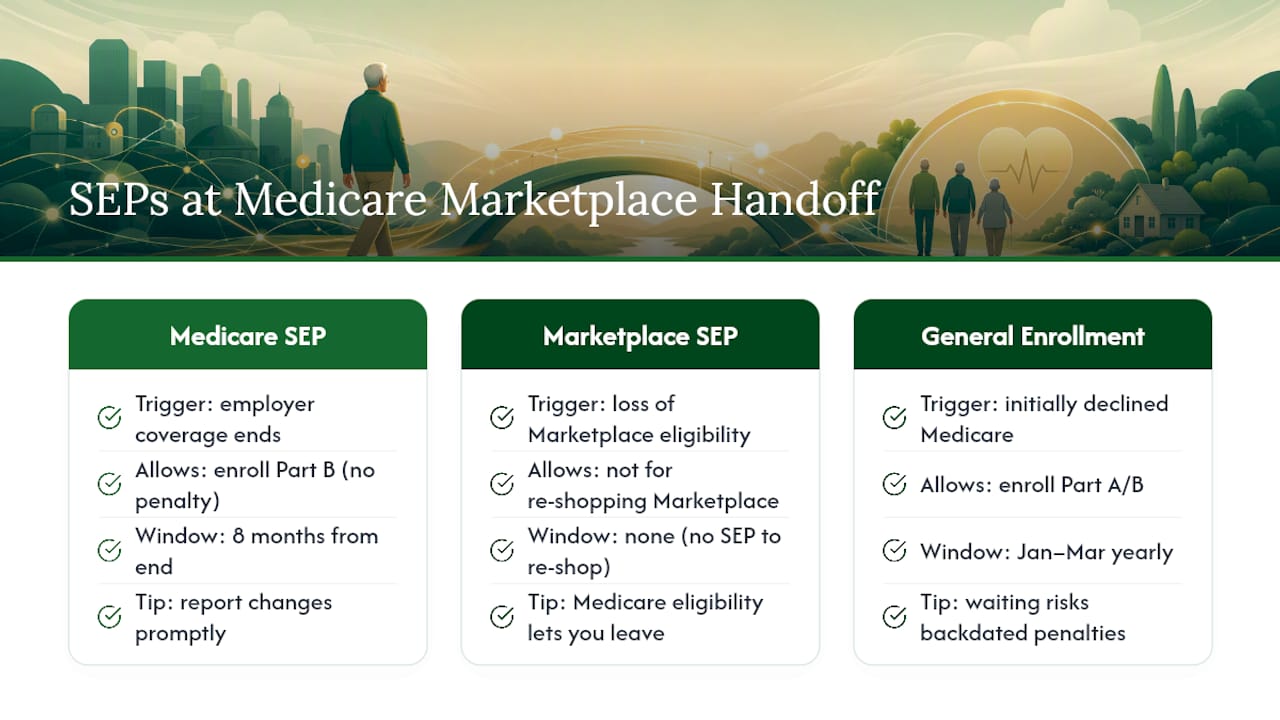
Special Enrollment Periods (SEPs) exist specifically because life doesn’t always line up with the standard seven-month IEP window, and the Medicare-Marketplace handoff generates more than one kind.
If you’re still covered by an employer group health plan when you turn 65, you get a Medicare SEP that starts once that employer coverage ends, giving you eight months to sign up for Part B without a late penalty. This matters because some people mistakenly assume they need to act during their IEP even while working, and end up either double-paying for coverage or missing their actual window entirely.
On the Marketplace side, losing eligibility for a Marketplace plan (which happens automatically once you become Medicare-eligible) doesn’t grant you a Marketplace SEP to shop for a new Marketplace plan. It works the other direction: becoming Medicare-eligible is a qualifying event to leave the Marketplace, not to re-shop within it. If you initially declined Medicare and later change your mind, you’ll typically need to wait for the General Enrollment Period (January through March) unless a qualifying SEP applies to your specific situation, such as the employer coverage SEP mentioned above.
Timing SEPs correctly is one of the more common places people lose money. Report changes as soon as they happen rather than waiting for open enrollment; both Medicare and the Marketplace tend to backdate penalty calculations to when you first became eligible, not when you finally got around to filing the paperwork.
What Financial Help Exists After You Lose Marketplace Subsidies?
Losing your Advance Premium Tax Credit isn’t the end of financial assistance. It just means the help moves to a different program with different rules.
Extra Help (also called the Part D Low-Income Subsidy) reduces or eliminates your Part D premium, deductible, and copays if your income and resources fall under certain limits. Unlike Marketplace subsidies, Extra Help doesn’t require you to buy a specific plan tier. It applies directly to your drug costs regardless of which Part D plan you pick, and Social Security handles the application.
Medicare Savings Programs, run through your state, can cover your Part B premium and sometimes your deductibles and coinsurance if you meet income thresholds. These programs matter most for people whose Marketplace subsidy was doing a lot of financial heavy lifting, since a Part B premium you were never paying before suddenly becomes a monthly line item.
Medicare Advantage Special Needs Plans (SNPs) exist for people who qualify for both Medicare and Medicaid, or who have specific chronic conditions, and often carry lower out-of-pocket costs than standard plans.
None of these programs enroll you automatically the way a Marketplace subsidy adjusts your premium in real time. Each requires its own application, which is exactly why the months before your Medicare start date are worth spending on research rather than assuming the financial safety net carries over intact.
Does Switching Change Your Preventive Care or Out-of-Pocket Cap?
Marketplace plans, under Affordable Care Act rules, cover a defined set of preventive services (screenings, vaccines, annual wellness visits) at no cost to you, and every Marketplace plan caps your annual out-of-pocket spending. Medicare works differently on both counts, and the differences catch people off guard.
Original Medicare covers many preventive services at no cost, including an annual wellness visit and specific cancer and cardiovascular screenings, but the list is defined by Medicare rules rather than the ACA’s essential health benefits framework, so it’s not a one-to-one match with what your Marketplace plan covered. More important: Original Medicare has no annual out-of-pocket maximum. Without a Medigap policy or a Medicare Advantage plan’s built-in cap, a serious hospital stay or extended treatment can generate costs that keep accumulating all year.
Medicare Advantage plans do include an annual out-of-pocket maximum, set by the plan and required by CMS rules, which makes them structurally closer to what you’re used to from a Marketplace plan. That’s one of the clearest reasons to check a plan’s out-of-pocket cap specifically, rather than assuming Medicare works like the Marketplace did just because both terms sound similar.
Why Proactive Planning Beats Reacting to Deadlines
The biggest cost in this whole transition isn’t a bad plan choice. It’s inertia: putting off the decision until a deadline forces your hand. People who wait until the month they turn 65 to even look at their options routinely miss the window to compare Medigap pricing while medical underwriting still favors them, or they let the Part B penalty clock start running because they assumed Medicare “just happens” automatically.
Clients who sit down for a turning-65 consultation three to six months out consistently avoid the two costliest mistakes: enrolling late and picking a plan that doesn’t fit their actual prescriptions or providers. If your situation involves ESRD, employer coverage, or a shared Marketplace application, get a second opinion before you touch anything.
— Zach
How Greenins Helps You Move From Marketplace to Medicare
Coordinating enrollment dates, comparing Part D formularies, and figuring out whether Medicare Advantage or Medigap fits your prescriptions isn’t something you should have to piece together from government PDFs on your own. Greenins runs turning-65 consultations specifically built around this transition: comparing Advantage, Medigap, and Part D options side by side, confirming your exact enrollment dates, and helping you avoid the Part B penalty timeline entirely.

Our certified Medicare Insurance Planners® handle the coordination piece too, helping you time your Marketplace end date against your Medicare start date so you never pay for double coverage or trigger a subsidy repayment. Support doesn’t stop at enrollment; Greenins offers annual coverage reviews so your plan still fits as your prescriptions or providers change. If you’re within six months of your 65th birthday or already navigating a Marketplace-to-Medicare switch, schedule a consultation with Green Insurance Agency and get your specific timeline mapped out before any deadline sneaks up on you.
This article is general information, not a substitute for advice from a qualified financial advisor. Consult a qualified financial professional about your own circumstances before acting on anything here.