


Yes, mail-order pharmacy is a real option under most Medicare Part D and Medicare Advantage plans, and it typically lets you get a supply of covered drugs shipped to your home. The savings and convenience are real, but only if your specific plan covers the drug by mail and you use its designated mail-order pharmacy instead of a random vendor you found online.
TL;DR:
- Only plans that specify a designated mail-order pharmacy offer the lowest out-of-pocket costs, and switching vendors can lead to full retail payments or denials.
- Shipping can take up to 10 days, requiring early ordering at least two weeks before running out and enabling automatic refills for convenience.
- If qualifying for Extra Help, ensure documentation is ready to avoid paying full price, as reimbursement depends on proper verification from your plan.
- Filling before your Medicare card arrives is possible using enrollment confirmation or last four digits, but delays may require emergency retail fills with receipts for reimbursement.
- Mail-order is unsuitable for urgent, controlled, or specialty medications, which are better obtained through local pharmacies to avoid shipping or storage risks.
Table of Contents
- How does mail-order pharmacy work with Medicare?
- How do I check if my plan covers mail-order?
- How to sign up for mail-order: four practical methods and timing
- Costs, supply lengths, and savings: what affects your out-of-pocket price
- What to bring if you’re filling before your Medicare card arrives
- When mail-order isn’t the right call
- A Medicare planner’s checklist for mail-order setup
- Get Help Setting Up Mail-Order Through Your Medicare Plan
- Official resources for verifying mail-order coverage
- Sources
How does mail-order pharmacy work with Medicare?
Every Medicare drug plan that offers mail-order has a designated mail-order pharmacy written into its contract. That’s the vendor tied to your lowest cost-sharing tier. Fill through a different mail pharmacy, and you might pay full retail or get denied entirely.
Mail-order works best for maintenance drugs, the pills you take every day for blood pressure, cholesterol, diabetes, and so on. Specialty drugs (biologics, injectables, anything requiring cold-chain shipping) often stay restricted to specialty pharmacies rather than the standard mail vendor. Most plans let you choose a 1- to 3-month supply, and many will set up automatic refills once you’re enrolled, so you’re not calling in every cycle.
Delivery timing matters. Once your order processes, standard shipping can take up to about 10 days, which means last-minute orders are a genuine risk. Some plans may require a signature on delivery for controlled substances, so don’t assume a package will just sit on your porch.
How do I check if my plan covers mail-order?
Start with your plan’s formulary and the “pharmacies” section of your member handbook. Both should state clearly whether mail-order is offered and which company handles it.
If that’s not clear, Medicare Plan Compare is the official tool for confirming coverage details and in-network pharmacies for any Part D or Advantage plan. You can also call member services directly. Have your member ID ready, ask two specific questions: is this drug covered by mail-order, and is there one specific vendor I have to use for the best price?
Write down who you spoke with and when. If you end up paying out-of-pocket before your coverage is fully verified, keep every receipt. You’ll need them if you request reimbursement later, and a documented phone call can save you an argument with a plan representative down the road.
How to sign up for mail-order: four practical methods and timing
Before you start, gather what you’ll need: your Medicare card or plan member ID, the actual prescription (or your prescriber’s contact info), a payment method, and the correct shipping address. Then pick whichever setup method fits your comfort level:
- E-prescribe from your doctor. Ask your provider to send the prescription electronically straight to your plan’s mail-order pharmacy. This is usually the fastest route for a brand-new medication.
- Sign up online. Most plans let you create an account on the member portal, enter your prescriptions, and manage refills digitally.
- Mail in a paper form. Plans typically publish a mail-order enrollment form on their website that you fill out and send with your prescription.
- Call member services. An agent can place the order for you over the phone, which is often the simplest option if you’re less comfortable online.
Timing is where people trip up. Place your first order at least two weeks before you’ll run out, since initial setup often takes longer than routine refills while the pharmacy verifies your prescription and benefits. Once you’re established, enroll in automatic refills so you’re not tracking supply dates manually. If a shipment is late, call the pharmacy’s customer service line directly, not your doctor’s office, since they can track the package and expedite a replacement.
Pro Tip: Set a phone reminder for the day you hit your last 2-week supply, not the day you run out. That buffer covers you if the first shipment gets delayed.
Costs, supply lengths, and savings: what affects your out-of-pocket price
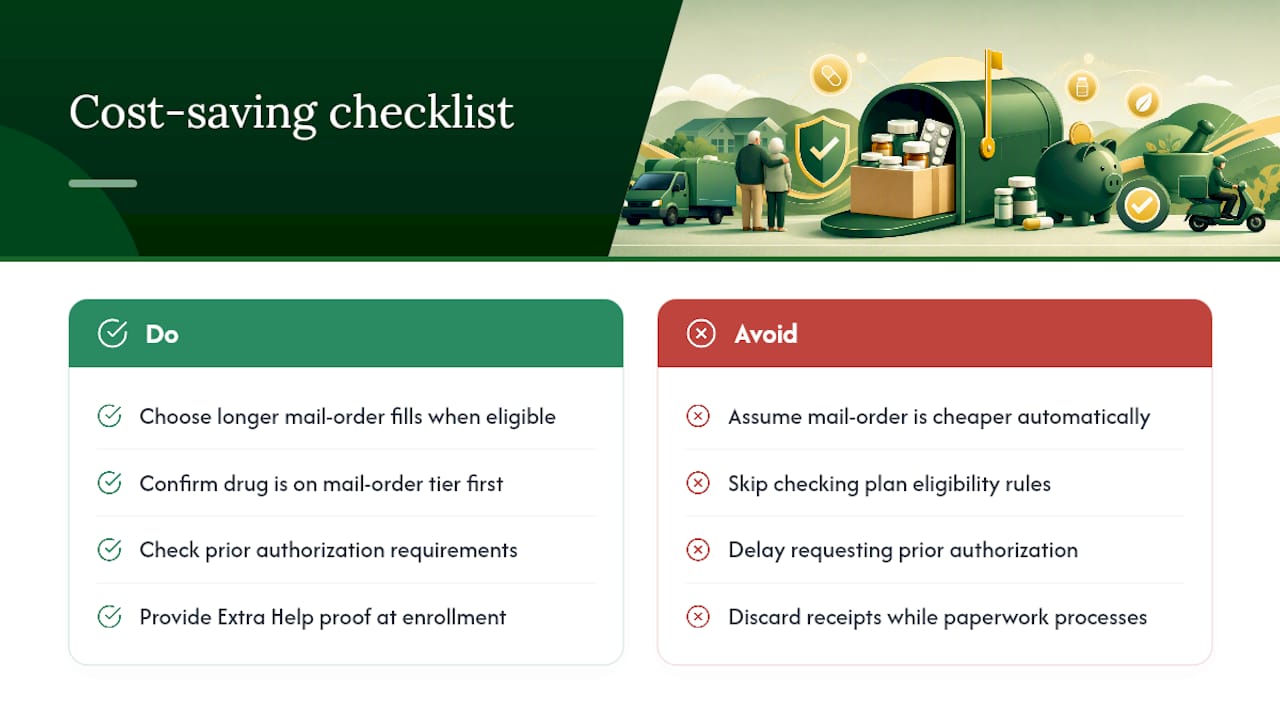
A longer mail-order fill usually costs less per month than multiple separate retail fills, because plans often price the larger supply at roughly two months’ worth of copay instead of three. That’s the core financial argument for switching. But it only applies if the drug is on your plan’s mail-order-eligible tier; some plans also require prior authorization before they’ll ship certain medications by mail at all.
If you qualify for Extra Help (the Low-Income Subsidy), your cost-sharing drops regardless of whether you fill by mail or retail, but you’ll need to have your eligibility documentation on hand when you enroll so the pharmacy applies it correctly from your first order. If you end up paying full price while that paperwork processes, save every receipt. Plans generally allow reimbursement claims once your Extra Help status is confirmed, but you have to submit proof.
What to bring if you’re filling before your Medicare card arrives
You’ll typically need a photo ID, your Medicare card, your plan’s member ID, and Extra Help documentation if that applies to you. New enrollees often try to fill a prescription before the physical plan card shows up in the mail.
That’s fixable. Pharmacies can usually verify coverage using your enrollment confirmation letter, your plan-issued member number, or the last four digits of your Social Security number. If a shipment is delayed and you need medication immediately, ask your plan about an emergency retail fill exception. Keep every receipt; it’s your paper trail if you need a credit later.
When mail-order isn’t the right call
Mail-order isn’t built for every situation. If you need a new prescription started urgently, want face-to-face counseling from a pharmacist, or you’re filling a controlled substance, a retail pickup is usually faster and simpler. Specialty drugs and temperature-sensitive medications also carry real shipping and storage risks by mail, particularly in extreme heat or cold.
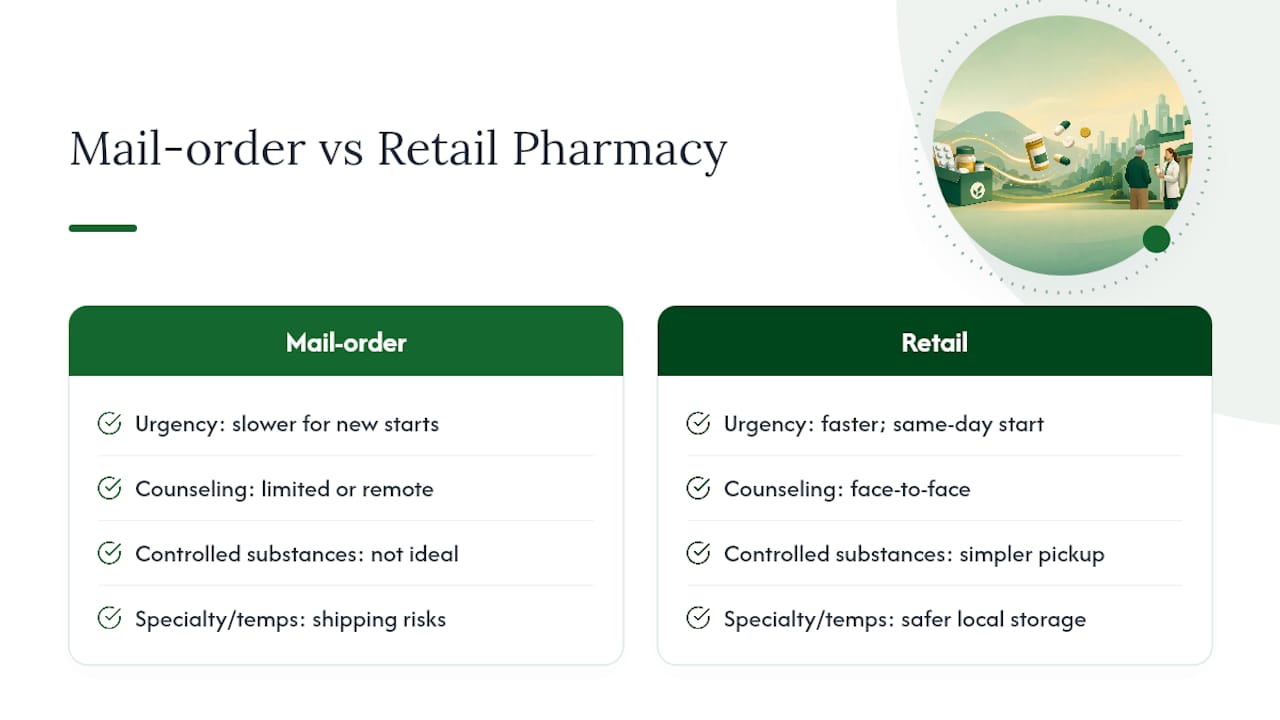
Plenty of beneficiaries split the difference: maintenance drugs go through mail-order, anything urgent or specialty goes to a local pharmacy. If you travel seasonally or plan to relocate, confirm your shipping address and delivery window before your next refill ships.
A Medicare planner’s checklist for mail-order setup
Before I ever tell a client to switch to mail-order, I confirm three things: the plan’s designated vendor, the drug’s formulary tier, and whether prior authorization is required. Skipping that step is how people end up with a denied shipment two weeks after they needed it.
The three mistakes I see most: assuming any mail pharmacy works with any plan, waiting until the bottle is nearly empty to reorder, and never actually checking whether a drug sits on a restricted tier. A quick review with an advisor can confirm Extra Help eligibility and get your first shipment moving faster than doing it solo.
— Zach
Get Help Setting Up Mail-Order Through Your Medicare Plan
Greenins helps Medicare beneficiaries in Clay County and across the Jacksonville area verify exactly what their plan covers, including whether mail-order pharmacy applies to their specific medications and which vendor they’re required to use. Our certified Medicare Insurance Planners® review your plan for free, walk you through enrollment paperwork, and stay available long after you’ve signed up, not just during open enrollment.
If you’re unsure whether your current plan even offers mail-order, or you’re comparing options as you turn 65, schedule a consultation with Greenins and get a straight answer instead of guessing your way through a formulary document.
Official resources for verifying mail-order coverage
Confirm details directly through Medicare.gov, CMS enrollment data, and Usa for federal program guidance.
This article is general information, not a substitute for advice from a qualified doctor. Consult a qualified healthcare professional about your own circumstances before acting on anything here.