
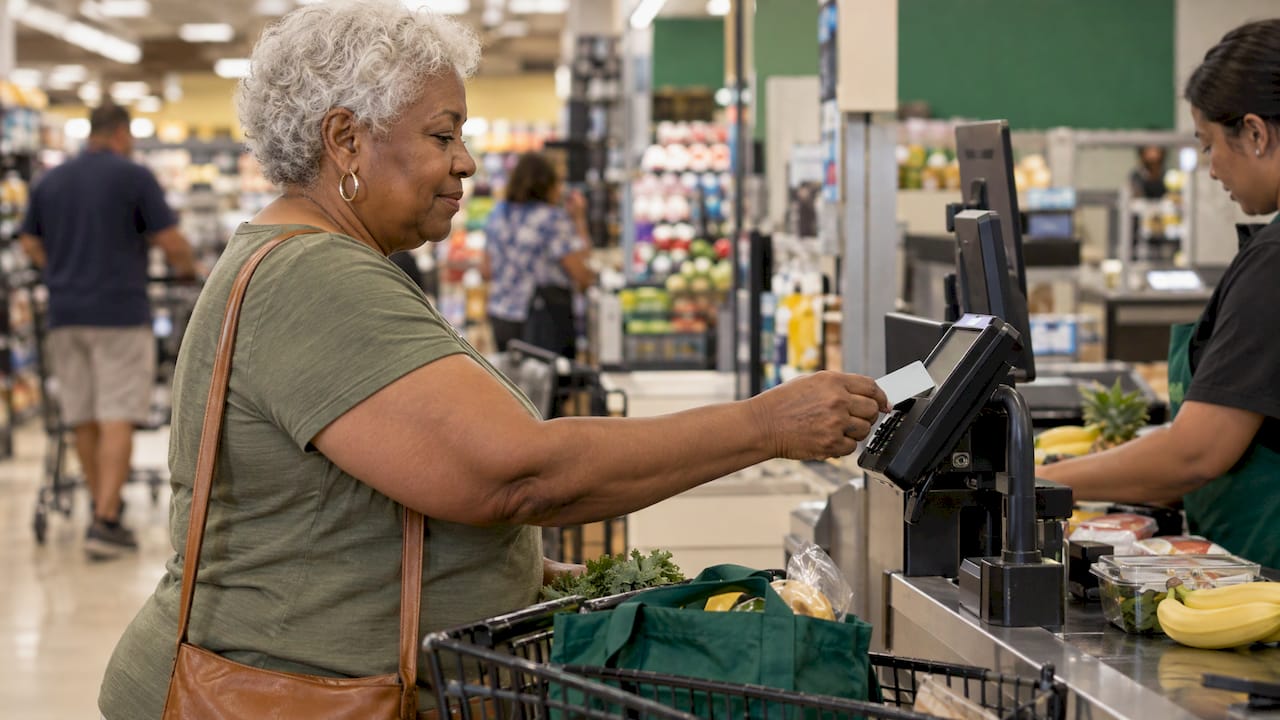
Yes, food cards for seniors exist, but there is no single national “senior food card,” and Original Medicare does not issue one. The cards you will actually run into come from two places: a private Medicare Advantage plan that includes a flex card or grocery allowance, or a government program such as SNAP, which pays out on an EBT card. Which one fits you depends on the coverage you have and your income. Checking your plan’s benefits before you enroll or switch is the step most people skip, and it is where we help: our Medicare Insurance Planners compare Medicare Advantage plans, and our consultations are free to you.
TL;DR
- Original Medicare (Parts A and B) has no food or grocery card. Some private Medicare Advantage plans offer a flex card that works as a food allowance.
- Not every Medicare Advantage plan has one, and grocery benefits are often limited to enrollees with certain chronic conditions.
- Government options for people 60 and older include SNAP (EBT card), the Senior Farmers’ Market Nutrition Program, CSFP food packages and senior meal programs.
- If someone calls you offering a flex card, treat it as a scam. Verify any card through your plan or a government agency.
Table of Contents
- Where a senior food card really comes from
- Does Medicare cover groceries?
- Government food programs for people 60 and older
- How to tell a real food card from a scam
- Choosing a plan with a food benefit
- Work with a Medicare planner
- Our perspective
- FAQ
- Sources
Where a senior food card really comes from
People search for a “food card for seniors” and expect a government card mailed at 65. That does not exist. What exists is a set of separate benefits that all get called food cards:
- A Medicare Advantage flex card or grocery allowance. It is a benefit of a private plan, not of the government.
- A SNAP EBT card. It is a state-run benefit funded through USDA, based on income and resources.
- Coupons and food packages from the Senior Farmers’ Market Nutrition Program and the Commodity Supplemental Food Program.
- Meals delivered to your home or served at a senior center.
The first one is the one most seniors are really asking about, because it comes with health coverage you may already be choosing. We start there.
Does Medicare cover groceries?
Original Medicare does not. USAGov explains that a Medicare flex card is a benefit offered by some insurers, not issued by the government. If you have Medicare Advantage (Part C), you may be eligible for one. It can act as a food allowance card and, depending on the plan, can also help pay for utilities and for transportation to medical appointments.
Two details matter when you compare plans:
- Not all Medicare Advantage plans offer a flex card. The plan’s own benefit documents tell you whether yours does, and what the card can be spent on.
- The benefit can change from one plan year to the next. A card that came with last year’s plan is not guaranteed on this year’s.
We cover the full flex card picture, including how to avoid declines, on our page about Medicare flex cards under the 2026–2027 rules.
Who qualifies for a Medicare Advantage grocery benefit
Many grocery benefits are offered through what Medicare calls Special Supplemental Benefits for the Chronically Ill, or SSBCI. The HHS Food is Medicine resource hub says Medicare Advantage plans may offer SSBCI to chronically ill enrollees, including nutrition-related benefits such as produce, frozen foods and canned goods. CMS must approve these benefits, and non-healthy food is prohibited.
The same page notes that the definition of a “chronically ill enrollee” is set in the Social Security Act and may not include everyone with a chronic condition. Plans can consider social factors such as food insecurity when identifying eligible members, but cannot use them as the only basis for eligibility.
In practice, according to U.S. News reporting from September 2026, qualifying usually means:
- You are enrolled in a plan that offers SSBCI, most often a Chronic Condition Special Needs Plan (C-SNP) or a Dual Eligible Special Needs Plan (D-SNP).
- You have a serious chronic condition that limits function or carries a high risk of hospitalization.
- Your doctor may need to confirm the condition in writing.
- For a D-SNP, you must also be eligible for both Medicare and Medicaid.
The practical lesson: the grocery card is tied to a specific plan type and to your health profile, so the plan that looks best on premium alone may not be the one that carries the benefit you need.
Does a plan food card affect your SNAP benefits?
A common worry is that accepting a plan benefit will cost you government food help. USDA’s Food and Nutrition Administration states that Medicare Advantage supplemental benefits are excluded from SNAP income (page updated February 25, 2026). Under federal rules, a legitimate plan food card does not reduce your SNAP eligibility.
Government food programs for people 60 and older
If you do not have a plan with a food benefit, or you want help on top of one, four federal programs serve older adults. USAGov lists them on its senior food programs page, and a Congressional Research Service report from April 2026 describes the same set in more detail.
| Program | What you get | Who it is for |
|---|---|---|
| SNAP | Monthly money on an EBT card for groceries | Low-income households, with more favorable rules for people 60+ |
| Senior Farmers’ Market Nutrition Program (SFMNP) | Coupons for fresh fruits, vegetables, honey and herbs at farmers markets | People 60+ with income at or below 185% of the federal poverty guidelines |
| Commodity Supplemental Food Program (CSFP) | Monthly food packages through local agencies | People 60+ with income at or below 185% of the federal poverty guidelines |
| Older Americans Act senior nutrition | Home-delivered and group meals through area agencies on aging | Older adults; local agencies set how it is offered |
SFMNP and CSFP do not operate in every state or area, so availability depends on where you live. USAGov notes that SNAP is the route if neither is available to you.
SNAP rules that favor older adults
SNAP is the program closest to a true “food card,” because benefits land each month on an Electronic Benefit Transfer (EBT) card that works like a debit card at authorized grocery stores. For SNAP, “elderly” means age 60 or older, and USDA gives those households easier tests. For the October 1, 2026 to September 30, 2027 period, the Food and Nutrition Administration says:
- A household with a member 60 or older only has to meet the net income test, meaning income after allowable deductions, instead of both the gross and net tests most households face.
- For a one-person household, the limits are $1,729 gross and $1,330 net per month.
- Countable resources (cash and bank money) can be up to $4,750 if someone in the household is 60 or older, compared with $3,000 for other households. These amounts are updated every year.
- Households made up entirely of elderly or disabled members are exempt from SNAP work requirements.
States can set their own, more generous limits. Maine, for example, publishes gross monthly limits at 200% of the poverty level, which for one person is $2,609 for 2026–27, with a maximum monthly benefit of $306. Your state agency’s page has the figures that apply to you.
What SNAP can and cannot buy
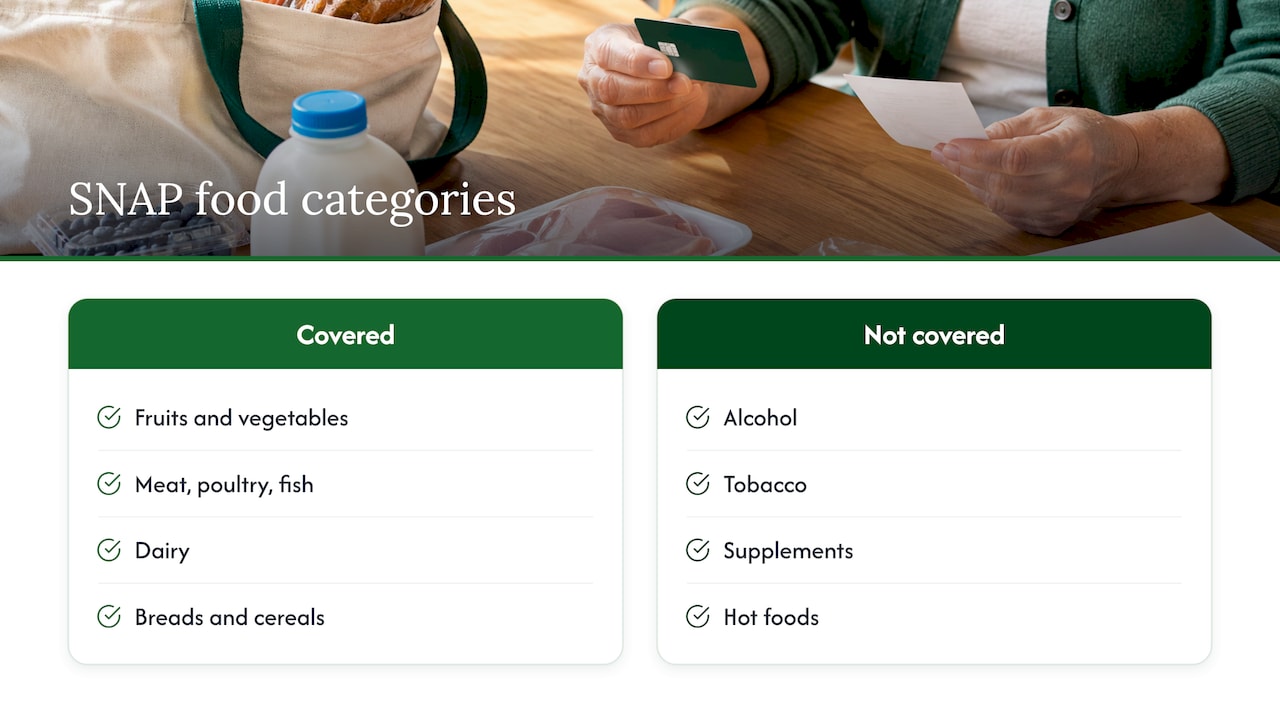
SNAP covers household food: fruits and vegetables, meat, poultry, fish, dairy, breads and cereals, snack foods, non-alcoholic beverages, and seeds and plants that produce food. It does not cover alcohol, tobacco, supplements, hot foods or nonfood items. The full list is on USDA’s eligible food items page.
How to apply for SNAP
You apply in the state where you live. According to USDA, you can visit your local SNAP office, use your state agency’s website or call the state’s toll-free SNAP hotline. Some states take online applications, and you can name an authorized representative in writing to apply for you, which helps if a family member handles your paperwork.
A typical path looks like this:
- Gather basics: ID, proof of address, income (Social Security statements, pension) and a list of bank balances and housing costs.
- Submit the application to your state agency. Some states offer a shorter form for seniors.
- Ask about fast processing. You may be eligible for benefits within 7 days if your household has less than $100 in liquid resources and $150 in monthly gross income, or if your income and resources together are less than your monthly rent or mortgage and utilities. Otherwise, expect a decision notice within about 30 days.
- Receive your EBT card. Approved benefits are back-dated to the day you applied.
A proposed rule worth watching
The AARP Public Policy Institute reported on November 23, 2026 that a proposed USDA rule would end broad-based categorical eligibility, which 44 states, DC, Guam and the Virgin Islands currently use. USDA’s own estimate is that 6.3 million participants, including more than 1 million adults 60 and older, would lose benefits if it were adopted. It is a proposal, not current law, so check your state agency before assuming either way, and apply if you meet today’s limits.
How to tell a real food card from a scam
Food card offers are a favorite hook for fraud, because the benefit is real enough to sound plausible. The rule from CMS is short: if a caller offers you a flex card, it is a scam. Medicare does not issue flex cards, and only some private Medicare Advantage plans offer them. Scammers use fake applications to collect Social Security, credit card and bank account numbers.
A few habits keep you safe:
- Never give your Medicare number, Social Security number or bank details to an unsolicited caller or to a website that promises a “free grocery card.”
- Confirm the benefit in your plan’s own documents or through the member services number on the back of your insurance card.
- Do not pay a fee for a government food benefit. Feeding America warns that its network food banks, pantries and programs never charge a fee, and it reports fake discounted food box offers on social media.
- Apply to SNAP only through your state agency.
If you are unsure whether an offer you received is real, call us. We can look at which plans carry a food or flex benefit and which do not.
Choosing a plan with a food benefit
If a grocery or flex card matters to you, it should be part of the plan comparison, not an afterthought. A good comparison looks at:
- Whether the plan has a food or flex benefit at all, and what it can be spent on (groceries, utilities, transportation).
- Whether you would qualify. Many grocery benefits depend on a chronic condition or a special needs plan type.
- Your doctors, hospitals and prescriptions, because a food card does not help if your care is out of network or your medicines are not covered.
- Other extras, such as over-the-counter allowances. See our guide to Medicare OTC benefits and the midyear unused benefit notice for how those work.
- How the plan fits next year. Benefits are set per plan year, so review them every fall.
That is a lot to line up, and plan documents bury the details. It is the work our certified Medicare Insurance Planners do, comparing local plans across top carriers so the benefit you want is checked against your doctors and drugs.
Work with a Medicare planner
Green Insurance Agency helps people in Orange Park, Fleming Island and Jacksonville, FL, and Medicare beneficiaries who need guidance more broadly. Our services include Medicare enrollment assistance, plan comparison, annual coverage reviews and claims support, and our consultations are free to you. We take an education-first approach: you should understand what each Medicare Advantage plan offers, including any flex card or grocery benefit, before you choose.
Turning 65? Our Medicare enrollment help walks you through your options. If you are not sure whether you qualify for Medicare yet, try the Medicare eligibility calculator. We also stay available after you enroll, for annual reviews, claims and appeals.
Our perspective
A food card is a good example of why Medicare decisions go wrong. People pick a plan because of a premium or a mailer, and only later learn what the plan does or does not include.
We start from the opposite end. We ask what you need: your doctors, your prescriptions, your budget, and whether help with groceries would make a real difference to you. Then we compare plans across top carriers to see which ones carry it, and whether your health situation would qualify you for it.
Our certified Medicare Insurance Planners are built around education first, in person and locally, rather than a call center script. Our goal is that you understand the plan you pick, and that you know where to turn in January, in the spring and years later when something changes.
If you are already enrolled, a yearly review is the right moment to check whether your plan’s food, flex or OTC benefits still match how you live.
Zach
FAQ
Is there a food card for seniors from Medicare?
Original Medicare does not provide one. Some private Medicare Advantage plans offer a flex card that works as a food allowance, according to USAGov. Check the plan’s benefits before you enroll, because not every plan includes it.
How do I qualify for a senior grocery allowance?
For a plan-based allowance, you generally need a Medicare Advantage plan that offers the benefit, often a special needs plan, and a qualifying chronic condition. Your doctor may need to confirm it. For SNAP, you apply through your state and meet income and resource limits, which are easier for households with someone 60 or older.
Does a Medicare food card count against my SNAP benefits?
No, under federal rules. USDA states that Medicare Advantage supplemental benefits are excluded from SNAP income as of its February 2026 update. Report your benefits accurately when you apply, and ask your state agency if you have questions.
What can a senior food card buy?
A SNAP EBT card buys household food such as produce, meat, dairy and bread, but not alcohol, tobacco, supplements, hot foods or nonfood items. A Medicare Advantage flex card can cover food and, depending on the plan, utilities and transportation to medical appointments. Your plan’s documents list what is allowed.
Are food allowance card offers by phone legitimate?
Treat them as scams. CMS says that if a caller offers a flex card, it is a scam, because Medicare does not issue them. Hang up and confirm any benefit through your plan’s member services number.
Sources
- Food assistance programs for older adults | USAGov
- Medicare Advantage Health Plans | odphp.health.gov
- SNAP Medicare Advantage Supplemental Benefits Excluded from Income | USDA FNA
- SNAP Special Rules for the Elderly or Disabled | USDA FNA
- SNAP Eligibility | USDA FNA
- What Can SNAP Buy? | USDA FNA
- Supplemental Nutrition Assistance Program | Maine DHHS
- SNAP Eligibility Changes Could Affect Older Adults | AARP Public Policy Institute
- Medicare OEP Bootcamp Fraud Awareness | CMS
- Social Media Fraud Warning | Feeding America