


A hybrid long-term care policy pairs life insurance or an annuity with long-term care benefits, so your money either pays for care or leaves a death benefit for your family. It costs more than stand-alone long-term care insurance for the same coverage, but it fits people who want a guaranteed payout either way and can afford a larger upfront commitment. The rest of this guide walks through the mechanics, the costs, and a checklist for comparing policies before you talk to an agent.
TL;DR:
- Hybrid policies cost more upfront than stand-alone long-term care insurance but provide a guaranteed payout either way, making them suitable for those with larger investable assets.
- Premium options include single-pay, limited-pay, and level premiums, with single-pay offering certainty but tying up a substantial amount of money initially.
- Benefits only start after meeting strict certification and a wait period of 30 to 90 days, with payout types varying between reimbursement and fixed indemnity amounts.
- The overall cost is influenced by coverage size, inflation protection, age at purchase, and elimination period, with older buyers facing higher premiums.
- When choosing a policy, consider specific trigger language, riders, and carrier reputation, and consult a financial advisor to align coverage with your retirement and estate plans.
Table of Contents
- What Is Hybrid Long-Term Care Insurance?
- How Do Hybrid Policies Pay Out Benefits?
- What Does a Hybrid Policy Actually Cost?
- Hybrid vs. Stand-Alone LTC vs. Self-Funding: Which Wins?
- How Do You Choose the Right Hybrid Policy?
- How Green Insurance Agency Approaches Hybrid LTC Planning
- Ready to Talk Through Your Long-Term Care Options?
- Sources
What Is Hybrid Long-Term Care Insurance?
Hybrid, or “linked-benefit,” long-term care insurance solves a specific complaint people had about traditional LTC policies: if you never need care, you get nothing back for years of premiums — learn more about life insurance mechanics and long-term care riders here. Nearly 900,000 Americans held combination policies in 2022, and that number keeps climbing as stand-alone LTC premiums have risen sharply over the past decade.
There are three main structures on the market, and they work differently under the hood.
- Asset-based/linked-benefit policies. These combine a life insurance chassis with an LTC rider. You fund the policy, and if you need care, you draw down a pool of money set aside for that purpose.
- Life insurance with an LTC rider. You buy (or already own) a permanent life policy, and a rider lets you access part of the death benefit while you’re still alive to pay for qualifying care.
- Annuity-based hybrids. An annuity’s cash value gets earmarked for LTC expenses, often at a multiplier, so a dollar of annuity value might convert into two or three dollars of care benefit.
In every version, using the LTC benefit reduces what’s left over. If you draw down care benefits through a rider, the death benefit your heirs would have received drops by roughly that amount. If you never trigger care, the policy pays out as ordinary life insurance or an annuity death benefit.
Premium funding typically comes in three shapes: single-pay (one lump sum, often $50,000 to $150,000 depending on benefit size), limited-pay (spread over 5 to 10 years), and ongoing level-pay premiums similar to traditional life insurance. Single-pay locks in your cost immediately and avoids the risk of future rate hikes. Limited and level-pay options ease the cash flow hit but leave you exposed if the insurer later raises premiums on the underlying policy, something that’s been common with older stand-alone LTC contracts.
How Do Hybrid Policies Pay Out Benefits?
Benefits only start flowing once you meet specific medical and contractual triggers, and the details vary enough between carriers that reading the fine print matters more than the sales brochure.
To qualify, a licensed health care practitioner generally must certify that you’re chronically ill under the federal standard: unable to perform at least two of six activities of daily living (bathing, dressing, eating, toileting, transferring, and continence) or that you require substantial supervision due to severe cognitive impairment like Alzheimer’s disease. This certification usually needs renewing periodically, and insurers can request their own assessment before approving a claim.
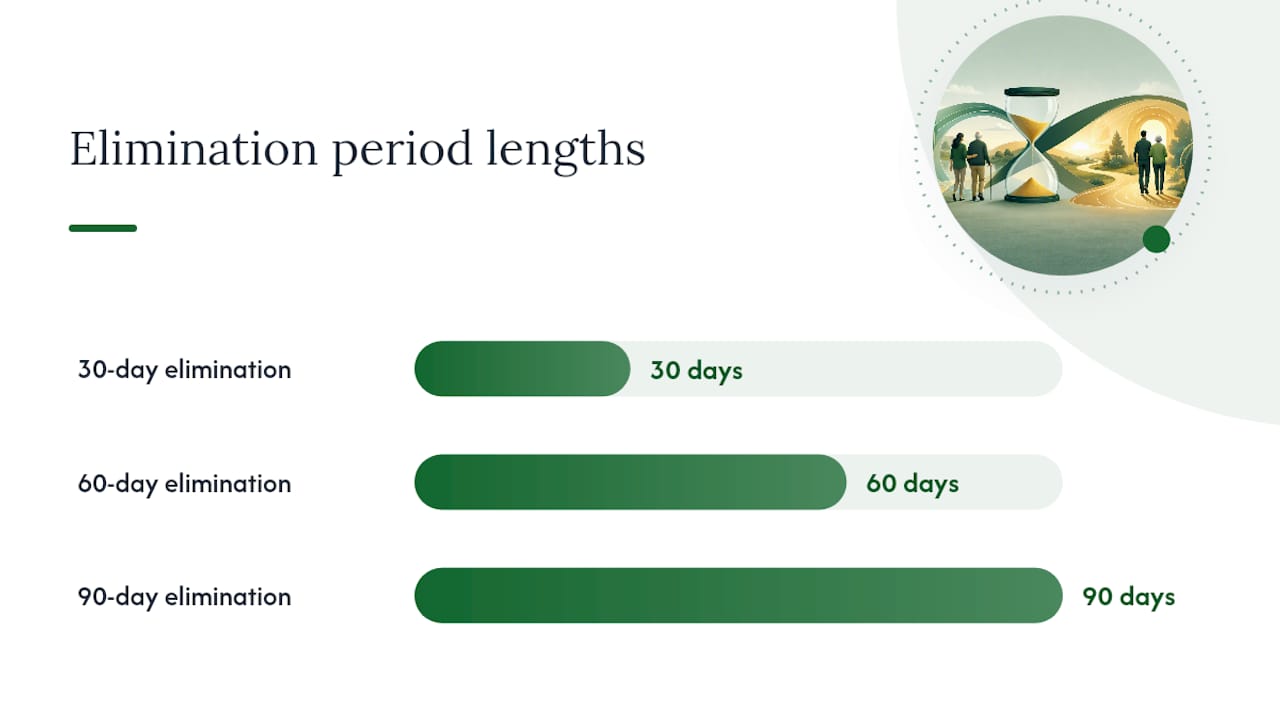
Once you’re certified, most hybrid policies apply an elimination period before payments begin.
- 30-day elimination periods are the most generous but come with higher premiums.
- 60-day periods are the most common middle ground offered today.
- 90-day periods lower your premium but mean three months of out-of-pocket care costs before benefits kick in.
After the waiting period, benefits arrive as either reimbursement or indemnity payments. Reimbursement policies pay actual verified care costs up to your daily or monthly cap. Indemnity policies pay you a fixed monthly amount regardless of your actual expenses, which gives you more flexibility to use family caregivers or informal care arrangements. Every policy also carries a lifetime maximum benefit, and inflation riders (simple or compound) determine whether that cap grows over the years you might hold the policy before ever filing a claim. Some contracts add continuation or extension riders that keep paying care benefits after the life insurance or annuity value is exhausted, though these riders add to the premium and reduce the death benefit further when used.
What Does a Hybrid Policy Actually Cost?
Cost depends on four levers: the size of the benefit pool, whether you add inflation protection, your age and health at purchase, and the elimination period you choose. Buying in your late 50s versus mid 60s can mean a meaningfully lower premium, since insurers price heavily on age and underwriting is typically less strict for hybrids than for stand-alone LTC coverage.
Funding structure changes the math too. A single-pay policy avoids future premium increases entirely, but it ties up a large sum of money that could otherwise stay invested. Opportunity cost is the real trade-off here: money locked into a hybrid policy isn’t earning market returns elsewhere, and for buyers with a longer time horizon, that difference compounds. Limited-pay and ongoing premium options reduce the initial cash outlay but stretch your commitment over years.
NAIC guidance is blunt about the price gap: hybrid policies generally cost more than stand-alone LTC insurance for comparable care limits, because you’re paying for the guarantee that something comes back to you or your heirs even if you never need care.
As a rough suitability check, financial guidance from sources like AARP and the NAIC generally points toward hybrid policies making sense for people with investable assets in the $200,000 to $2 million range, enough to self-insure partially but not so much that self-funding care outright is trivial. A common premium-to-income heuristic many planners use is keeping LTC premiums under 5% of your gross income, though your own budget and other obligations should drive the final number.
On taxes: long-term care benefits paid out are generally not counted as taxable income, and premium treatment depends on how the policy is structured under Internal Revenue Code Section 7702B, which defines qualified long-term care contracts. Deductibility rules differ for hybrids funded through life insurance versus annuities, and they shift depending on whether you’re itemizing or the policy is held inside a retirement account. Talk to a tax advisor before assuming any premium is deductible.
Hybrid vs. Stand-Alone LTC vs. Self-Funding: Which Wins?
None of the three approaches wins outright. Each one trades cost, flexibility, and certainty differently, and the right answer depends on your assets, health, and how much you value a guaranteed outcome over pure economics.
- Hybrid policies give you a death benefit if you never need care, which removes the “wasted premium” anxiety that drives a lot of buyers away from stand-alone LTC. They also tend to have simpler underwriting and a fixed-pay option that shields you from the premium hikes that have hit older stand-alone policyholders hard. The downside: higher upfront cost, and inflation protection that’s often weaker unless you pay extra for it. Using the LTC benefit also shrinks the death benefit your family would have received.
- Stand-alone LTC insurance usually delivers more care coverage per premium dollar and often includes stronger inflation riders as standard features. But premiums aren’t guaranteed level forever on many legacy contracts, and if you never need care, you get nothing back.
- Self-funding means covering care costs from savings and investments as they arise. It offers maximum flexibility and no insurance underwriting, but it exposes your full estate to the risk of extended care needs, which can run into six figures a year for a nursing facility stay.
Risk tolerance and family situation matter as much as the numbers here. Someone with substantial assets and no interest in leaving an inheritance might reasonably self-fund. Someone with a moderate portfolio who wants certainty and doesn’t want to gamble on future premium increases often leans hybrid.
How Do You Choose the Right Hybrid Policy?
Shopping for a hybrid policy works best as a sequence, not a scattershot comparison of brochures. Walk through it in order.
- Set your target benefit amount. Estimate a realistic daily or monthly care cost for your area and multiply by how many years of coverage you want as a cushion.
- Choose your funding style. Decide whether a single-pay lump sum, a limited-pay schedule, or ongoing premiums fits your cash flow and risk tolerance for future rate changes.
- Pick an elimination period. A 30 or 60-day window costs more but limits your out-of-pocket exposure at claim time; a 90-day window trims premium cost.
- Evaluate inflation protection. Confirm whether it’s simple or compound, and run the numbers on what your benefit pool looks like in 15 or 20 years without it.
- Confirm the trigger language. Read exactly how the policy defines chronic illness and which ADLs count, since wording differs slightly by carrier.
- Compare non-forfeiture and return-of-premium options. Some policies let you get back part of your premium if you cancel; others don’t, and that difference matters if your circumstances change.
Bring specific questions to any agent or carrier: What exactly reduces the death benefit when I file a claim? What does the appeals process look like if a claim gets denied? Can you show me a real claims example, redacted, from a policy like this one? Is this policy guaranteed renewable, and under what conditions can premiums change?
Watch for vague trigger definitions, unclear language about how continuation riders interact with the base policy, and carriers unwilling to walk through a sample claim scenario. Favor carriers that participate in your state’s long-term care partnership program and give you plain, specific answers instead of marketing talking points.
Pro Tip: When comparing a single-pay hybrid against a limited-pay or ongoing-premium version, convert the lump sum into an equivalent monthly cost over your expected payment years. That’s the only way to compare a $100,000 single payment against a 10-year, $12,000-a-year plan on equal footing.
How Green Insurance Agency Approaches Hybrid LTC Planning
Hybrid long-term care decisions rarely happen in isolation. They intersect with Medicare choices, retirement income planning, and how much of an estate you want to preserve for family. When Green Insurance Agency walks a client through a hybrid LTC evaluation, that conversation starts with a full financial picture, not just a benefit chart, because a policy that looks affordable on paper can still strain a fixed retirement income.
Green Insurance Agency brings an education-first approach to long-term care questions similar to the approach used for Medicare Advantage and Supplement decisions. The practice is known for explaining contract language clearly rather than pushing a product.
— Zach
Ready to Talk Through Your Long-Term Care Options?
Reading about elimination periods and inflation riders only gets you so far. The real value comes from someone sitting down with your actual numbers, your existing Medicare coverage, and your retirement timeline, and showing you what a hybrid policy would realistically cost versus what it would pay out. That’s the gap a self-service comparison tool can’t close, and it’s the gap a personalized consultation fills.

A consultation starts with a needs assessment covering your assets, health history, and how long-term care coverage fits alongside your existing Medicare plans. From there, agents model various funding scenarios side by side, such as single-pay versus limited-pay and different elimination periods, to clarify trade-offs. Because these policies interact with retirement income and estate goals, having someone explain the carrier’s actual contract language before you sign matters more than most buyers realize. If you’re ready to see how a hybrid policy would fit your situation, schedule a consultation with Green Insurance Agency and bring your questions.