


If you want a guaranteed rate you can count on, a multi-year guaranteed annuity (MYGA) is the simpler fit. If you want a possibility of higher growth without risking your principal in a downturn, a fixed indexed annuity (FIA) serves that purpose, with trade-offs in the cap on gains and complexity in contract terms. Most retirees over 50 end up using both, at different points on the calendar.
TL;DR:
- Fixed annuities, typically MYGAs, offer guaranteed rates locked for 2 to 10 years, backed by the insurer, not government guarantees.
- Fixed indexed annuities tie credited interest to market index performance, with caps, participation rates, and spreads that reset at renewal, which can reduce future upside.
- Surrender charges and market value adjustments can significantly decrease returns if you withdraw early, especially beyond the free withdrawal allowance.
- Matching your timeline with product features is crucial; MYGAs suit short-term needs, while FIAs are better for long-term growth with associated surrender and renewal risks.
- Verifying issuer ratings and understanding renewal terms, caps, and surrender schedules in writing are essential steps before committing to any annuity contract.
Table of Contents
- Fixed Annuity vs. Indexed Annuity: How the Mechanics Differ
- Who Actually Fits Each Product at 50 or Older
- What Eats Into Your Actual Return
- Your Pre-Purchase Checklist Before Signing Anything
- A Simple Way to Split Your Retirement Dollars
- What I’ve Learned Advising Retirees on This Choice
- Get Personalized Guidance on Fixed and Indexed Annuities
- Where to Verify These Numbers Yourself
- Sources
- FAQ
Fixed Annuity vs. Indexed Annuity: How the Mechanics Differ
A fixed annuity, usually structured as a MYGA, pays a declared interest rate for a set term, typically 2 to 10 years, and behaves a lot like a certificate of deposit without FDIC insurance behind it. Your rate is locked the day you sign the contract. You know exactly what your balance will be at the end of year three, five, or seven, because fixed annuities guarantee a set rate for the full term, backed by the issuing insurer rather than a government agency.
A fixed indexed annuity works differently. Instead of a declared rate, your credited interest is tied to the performance of a market index, often the S&P 500, using one of three crediting mechanisms:
- Cap rate: the maximum interest you can earn in a period, even if the index climbs higher.
- Participation rate: the percentage of the index’s gain you’re credited, say 50%.
- Spread: a percentage subtracted from the index’s return before your credit is calculated.
Dividends paid by the underlying index are excluded from every one of these calculations, which is one reason credited returns almost always trail the headline index number. FIAs typically carry a 0% floor, so a bad market year credits you nothing, but never costs you principal. Caps, participation rates, and spreads reset at renewal, and insurers are free to lower them, which is the single most overlooked risk in an FIA contract.
Neither product carries FDIC insurance. Every guarantee, fixed or indexed, rests on the issuing insurer’s claims-paying ability and, secondarily, on your state’s guaranty association coverage limits vary by state. MYGAs tend to suit shorter horizons of 2 to 7 years; FIAs are built for longer stretches, generally 7 to 10 years or more, since surrender periods and renewal cycles reward patience.

Who Actually Fits Each Product at 50 or Older
Your timeline and your tolerance for a shrinking cap rate matter more than your account balance.
- You need income in the next 2 to 7 years. A MYGA fits a defined, near-term goal, whether that’s bridging the gap before Social Security or funding a known expense.
- You’re 10 or more years from needing the money and can live with variable credited interest. An FIA lets you stay invested in a index-linked story without risking the drop that a bad market year would otherwise cost you.
- You want both. A laddered mix, several MYGAs maturing in staggered years plus one FIA sized for the long stretch, is how many advisors structure a retiree’s annuity allocation once other bonds and cash reserves are accounted for.
Your other holdings shape this decision as much as the annuity contract does. If you already hold a heavy bond allocation for stability, tilting toward an FIA for growth potential can balance that out. If Social Security is delayed to 70 for a bigger benefit, a MYGA ladder can cover the years in between.
Pro Tip: Before buying either product, write down the exact date you’ll need each dollar. That single exercise usually answers the MYGA vs FIA question faster than any brochure comparison.
What Eats Into Your Actual Return
Surrender charges are the biggest silent cost in both products. Most contracts carry a surrender period matching the term, often 5 to 10 years, and withdrawing beyond your free withdrawal allowance (commonly 10% annually) during that window triggers a charge that can wipe out a year or more of credited interest. Surrender charges and market value adjustments can turn a positive year into a net loss if you pull money out at the wrong moment.
- Both products grow tax-deferred, and withdrawals before age 59½ can trigger a 10% federal penalty on top of ordinary income tax owed on the gain.
- Rider fees for guaranteed lifetime income or enhanced death benefits typically run around one percent annually and are deducted directly from your contract value or your credited interest.
- Check AM Best, S&P, or Moody’s ratings on the issuer before signing, since your guarantee is only as strong as that company’s balance sheet.
Your Pre-Purchase Checklist Before Signing Anything
Walk into any annuity conversation with these questions written down, not just in your head.
- What is the guaranteed rate, and does it change at renewal or stay fixed for the entire term?
- Is there a Market Value Adjustment (MVA), and how would it affect an early withdrawal?
- For an FIA: what is the current cap, participation rate, or spread, and what has the renewal history looked like over the past five years?
- Can you show me a written, numeric example of credited interest under a flat, moderate, and strong index year?
- What is the exact surrender schedule, the free withdrawal percentage, and the dollar cost of any income or death benefit rider?
- What is the insurer’s current AM Best rating, and what does my state’s guaranty association cover if the company fails?
| What to check | Why it matters |
|---|---|
| Guaranteed rate vs. renewal terms | Rates can reset lower after year one on some contracts |
| Cap/participation/spread history | Shows whether the insurer has trimmed terms over time |
| Surrender schedule and MVA | Determines your real cost of accessing money early |
| Rider fees | Can quietly reduce credited interest by a percentage point or more |
| Issuer rating and guaranty limits | Your guarantee is only as solid as the company behind it |
A Simple Way to Split Your Retirement Dollars
A practical framework beats guesswork every time, and it takes three steps.
- Map your near-term cash needs. List every expense and income gap for the next 5 to 10 years, plus a cash buffer for emergencies.
- Size your certainty slice. Fund that near-term window with one or more MYGAs, laddered so each matures right when you need it.
- Allocate the remainder to growth potential. Whatever’s left for a 10-plus year horizon can go into an FIA, stress-tested against flat, moderate, and strong index scenarios so you know your worst-case credited return before you commit.
An illustrative example: a 62-year-old retiree with $200,000 to allocate might put $120,000 into a MYGA ladder covering ages 63 through 70, then place $80,000 into an FIA earmarked for age 72 and beyond. Combining a MYGA ladder with a longer-horizon FIA is a common structure precisely because it separates the money you need soon from the money that can afford to ride out a few flat index years. This is illustrative only, not a recommendation for your specific numbers.
What I’ve Learned Advising Retirees on This Choice
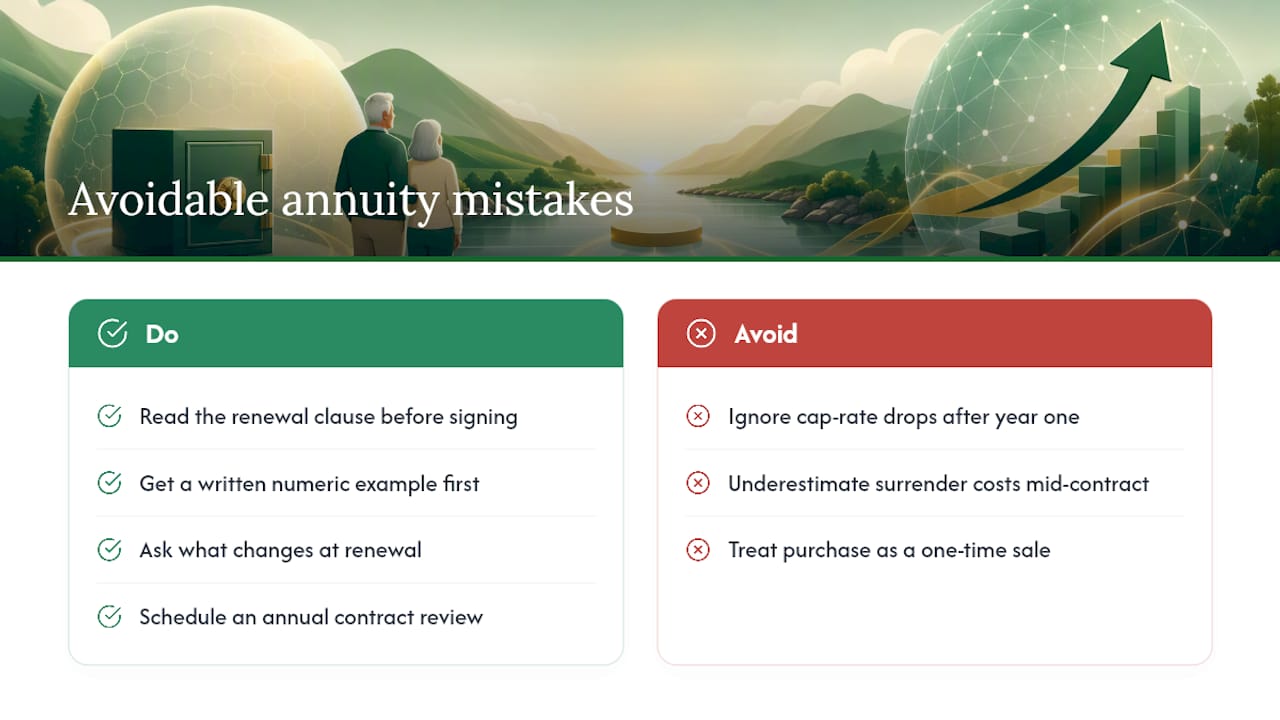
The mistake I see most often isn’t picking the wrong product. It’s not reading the renewal clause before signing. A cap rate that looked generous in year one can quietly drop in year three, and plenty of contract holders never notice until they compare their statement to what they expected.
The second mistake is underestimating surrender costs, especially when life throws an unplanned expense at you five years into a ten-year contract. That’s why an annual review matters as much as the initial purchase decision. Professional insurance planners build that review into ongoing client relationships, not just the sale. Get a written, numeric example before you sign anything, and ask what changes at renewal. That one habit prevents most of the regret I hear about later.
— Zach
Get Personalized Guidance on Fixed and Indexed Annuities
Comparing renewal terms, cap histories, and surrender schedules across insurers is exactly the kind of fine print that turns a good decision into a costly guess without someone walking through it with you line by line. Certified Medicare Insurance Planners® provide hands-on, education-first guidance on annuities alongside Medicare and retirement income planning, comparing options across carriers rather than pushing a single product.

Whether you’re weighing a MYGA ladder against a longer-horizon FIA, or you’re not sure which fits your timeline at all, Green Insurance’s retirement income planning and annuity guidance is built around your actual numbers, not a generic pitch. If you’re also approaching 65, the same team handles Medicare enrollment consultations so your health coverage and your income plan get reviewed together. Reach out through Greenins to schedule a consultation and get a written example specific to your situation.
Where to Verify These Numbers Yourself
Before signing any annuity contract, cross-check the terms against independent sources rather than relying solely on what an agent tells you.
- FINRA’s guide to indexed annuity risks
- Annuity
- Fidelity’s deferred fixed annuity comparison tool
- Annuity Journal’s guide to comparing annuities
Always confirm the issuer’s current AM Best or S&P rating and your state’s guaranty association coverage limits directly with those organizations before you commit.
This article is general information, not a substitute for advice from a qualified financial advisor. Consult a qualified financial professional about your own circumstances before acting on anything here.
Sources
- Annuity
- Complicated risks and rewards: indexed annuities | FINRA
- What’s the difference between fixed and fixed indexed annuities | Thrivent
- Compare deferred fixed annuities | Fidelity
- How to compare annuities | Annuity Journal
FAQ
Is a Fixed Annuity or Indexed Annuity Better for Retirement?
Neither is universally better. A fixed annuity (MYGA) suits retirees who want a guaranteed, predictable rate over a shorter term, while an indexed annuity fits a longer horizon where you want upside potential without risking principal to a market drop.
What Is the Main Risk of a Fixed Indexed Annuity?
The main risk isn’t losing principal, since most FIAs include a 0% floor. It’s that insurers can lower caps, participation rates, or spreads at renewal, which shrinks your future upside without any explicit notice beyond your contract statement.
How Are Annuity Withdrawals Taxed?
Both fixed and indexed annuity withdrawals are taxed as ordinary income on the gain portion, and withdrawing before age 59½ typically triggers an additional 10% federal penalty on top of that income tax.
Can I Lose Money in a Fixed Indexed Annuity?
You won’t lose principal to a market decline because of the built-in floor, but you can still come out behind if you withdraw during the surrender period and trigger a surrender charge or Market Value Adjustment. Reviewing surrender schedules before signing is the way to avoid that outcome.
Does Green Insurance Help With Annuity Decisions?
Yes. Green Insurance Agency’s certified Medicare Insurance Planners® offer retirement income planning and annuity guidance alongside their Medicare consultation services, comparing options across carriers rather than steering you toward one product.