


Anyone diagnosed with end-stage renal disease qualifies for Medicare regardless of age, as long as a doctor confirms the need for regular dialysis or a kidney transplant and the patient meets Social Security’s work-history or benefit conditions. Coverage usually starts on the first day of the fourth month of dialysis treatment, though home dialysis training and transplant admissions can move that date earlier. Sign up on time, because a 30-month coordination period with any employer group health plan and your Part B decision both affect what you pay and when.
TL;DR:
- Medicare coverage for ESRD typically begins on the first day of the fourth month of dialysis treatment, unless early home dialysis training or transplant admissions occur.
- Starting home dialysis training before the third month of treatment can eligible patients to qualify for Medicare coverage as early as the first month.
- Applying for Medicare requires direct contact with SSA and submitting documentation such as physician diagnosis letters, hospital admission records, and benefit award letters to avoid application delays.
- Employer group health plans remain the primary payer for 30 months after Medicare entitlement, making timely enrollment in Part B essential to avoid future penalties and gaps.
- Recent policy changes now allow ESRD patients to enroll in Medicare Advantage plans, but coverage and provider network restrictions vary, especially for those under 65 seeking Medigap plans.
Table of Contents
- What Are the ESRD Medicare Eligibility Requirements?
- When Does ESRD Medicare Start? The 4-Month Rule and Exceptions
- How Do You Apply for Medicare Based on ESRD?
- How Does the 30-Month Coordination Period Work With Employer Coverage?
- What Does Medicare Cover for Dialysis and Transplant Care?
- When Does ESRD Medicare Coverage End, and Can It Restart?
- Why Working With a Medicare Planner Helps ESRD Patients Avoid Costly Mistakes
- Does ESRD Change Your Medicare Advantage or Medigap Options?
- Are There Special Enrollment Periods for ESRD Patients?
- How Does ESRD Affect Medicaid and VA Benefits Eligibility?
- What Recent Changes Have Affected ESRD Medicare Rules?
- The Real Problem Isn’t Eligibility. It’s Timing.
- How Green Insurance Helps You Navigate ESRD Medicare Enrollment
- Where to Verify ESRD Medicare Rules Directly
- Sources
- FAQ
What Are the ESRD Medicare Eligibility Requirements?
End-stage renal disease means permanent kidney failure serious enough to require ongoing dialysis or a kidney transplant to stay alive. That’s a medical determination, not a bureaucratic one: your treating nephrologist documents the diagnosis, and that documentation becomes the backbone of your Medicare application. Age doesn’t factor into it at all. A 34-year-old on dialysis and a 74-year-old on dialysis follow the identical entitlement path.
The medical piece is only half the picture. To actually qualify for Medicare Parts A and B based on ESRD, you also need to meet one of these non-medical conditions:
- You have enough Social Security work credits (generally accumulated through paying Social Security or Railroad Retirement taxes).
- You’re already entitled to Social Security or Railroad Retirement Board benefits.
- You’re the spouse or dependent child of someone who meets either of the above.
If none of those apply to you directly, a spouse’s or parent’s work record can carry your eligibility. This trips up a surprising number of younger patients and caregivers who assume ESRD entitlement is purely medical.
One more detail worth knowing before you file anything: SSA’s Medicare sign-up guidance confirms that a signed inquiry can sometimes function as an application, and coverage can be backdated up to 12 months when the rules allow it. That retroactive window matters if you were already on dialysis for months before anyone told you Medicare applied to your situation. Ask your local Social Security office specifically about Form CMS-43, the application used for ESRD-based entitlement, and don’t leave any field blank. Incomplete forms are the single biggest reason applications stall.
When Does ESRD Medicare Start? The 4-Month Rule and Exceptions
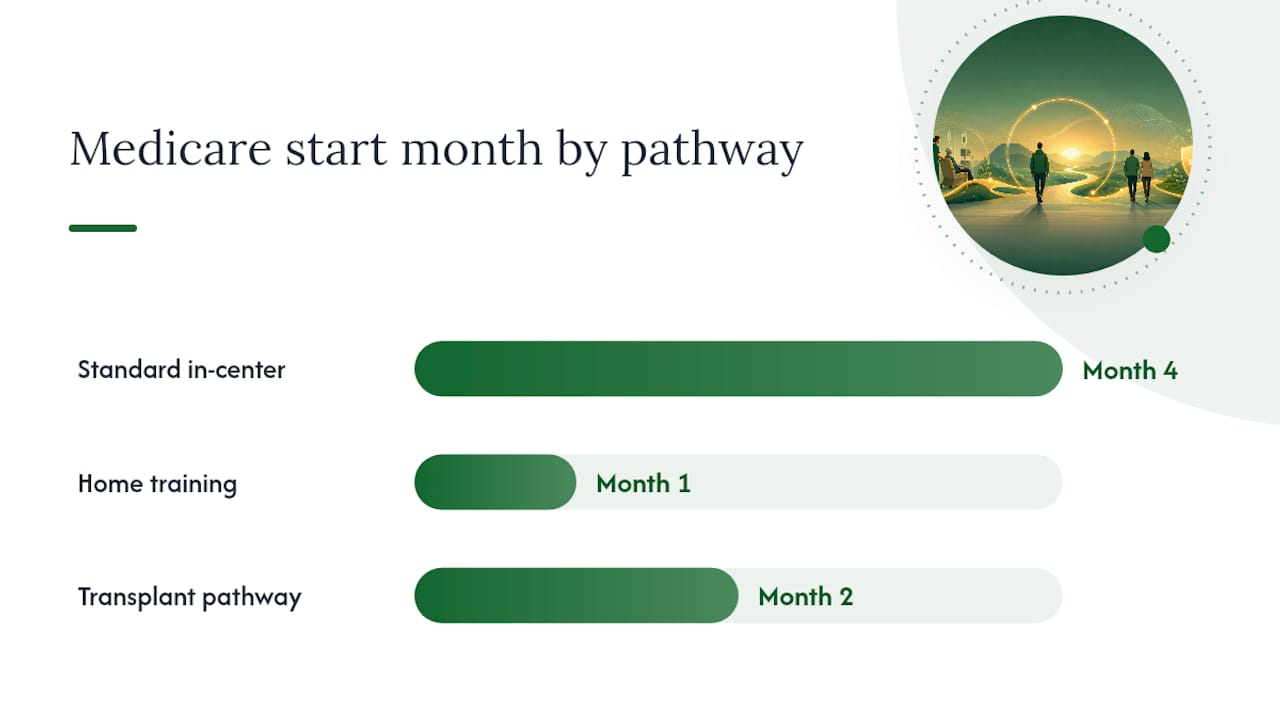
For most people on in-center hemodialysis, Medicare sets coverage to begin on the first day of the fourth month of continuous dialysis treatment. That’s not the day you’re diagnosed and not the day dialysis begins. It’s a fixed clock that starts ticking the moment regular treatment does.
Two major exceptions change that timeline:
- Home dialysis training exception. If you begin a self-dialysis training program before the end of the third month of dialysis, and your medical team expects you to complete that training and dialyze at home, Medicare coverage can start as early as the first month of dialysis. This is the single fastest legal path to earlier coverage.
- Kidney transplant timing. Coverage typically starts the month you’re admitted to a Medicare-approved hospital for a transplant, or for pre-transplant work related to it, as long as the transplant happens within that same month or within the following two months. If the transplant gets delayed beyond that window, Medicare can still count backward from the actual transplant month in many cases.
Here’s how that plays out for two real scenarios. Patient A starts in-center dialysis on January 10. Continuous treatment continues, so Medicare entitlement begins April 1, the first day of the fourth month. Patient B starts dialysis January 10 too, but enrolls in home training by February 15, before the third month closes. Because the training met the deadline, Patient B’s Medicare coverage can start January 1, three full months earlier than Patient A’s.
Pro Tip: Ask about home dialysis training the same week you’re diagnosed. Not every dialysis provider runs a Medicare-certified training program, so finding one early can be the difference between paying out of pocket for months and getting Medicare to pick up the bill almost immediately.
How Do You Apply for Medicare Based on ESRD?
Medicare entitlement isn’t automatic just because you started dialysis. You have to file, and the Social Security Administration runs that process, not your dialysis center or your doctor’s office.
Here’s the practical sequence:
- Contact SSA directly. Call the national line, visit ssa.gov to start the process online, or visit a local field office. Tell the representative specifically that you’re applying for Medicare based on end-stage renal disease. That phrasing routes your case correctly the first time.
- Gather your documentation before you call. You’ll want your physician’s statement confirming ESRD diagnosis and dialysis start date, hospital admission records if a transplant is involved, and your Social Security number along with any existing benefit award letters.
- File as early as possible. Because retroactive coverage can reach back up to a year in qualifying cases, waiting costs you real money if you delay unnecessarily. An early inquiry, properly documented, can preserve that backdating.
- Keep copies of everything you submit, including the date and name of whoever you spoke with at SSA.
Dialysis centers and transplant hospitals often have a social worker or financial counselor who can generate the physician statement and admission records same-day. Ask for that paperwork before you leave your first dialysis session.
How Does the 30-Month Coordination Period Work With Employer Coverage?
If you have a group health plan through your own job or a spouse’s job when you become Medicare-entitled through ESRD, that employer plan stays your primary payer for a coordination period of 30 months. CMS sets this coordination period specifically for ESRD entitlement, and it starts counting from your first month of Medicare eligibility, not your enrollment date.
Here’s what that actually means for your wallet and your paperwork:
- Your employer plan pays first on claims during those 30 months; Medicare pays second, covering gaps the employer plan leaves behind.
- You should still enroll in Medicare Part B during this period. Skipping it because “my employer plan covers everything” can leave you exposed on services your group plan handles poorly, and it risks a late-enrollment penalty once the coordination period ends and Medicare becomes primary.
- Employer group health plans are barred from dropping you or reducing benefits just because you developed ESRD or became Medicare-eligible.
Notify your HR or benefits administrator the moment you’re approved for ESRD Medicare, and ask them directly how claims will be coordinated. Keep a written record of every date: dialysis start, Medicare entitlement date, and any transplant admission. Administrative mix-ups during this window are one of the most common sources of surprise medical bills for ESRD patients.
What Does Medicare Cover for Dialysis and Transplant Care?
Full ESRD coverage generally requires both Part A and Part B working together. Medicare.gov’s dialysis coverage page lays out the split clearly: Part A covers inpatient dialysis during a hospital stay and inpatient transplant surgery, while Part B covers outpatient dialysis, doctor services, certain home dialysis equipment and support, and outpatient immunosuppressive care after a transplant. Carrying only one part leaves real gaps.
Part D deserves its own mention here. After a transplant, immunosuppressive drugs are often covered through Part D or a Medicare drug plan rather than Part B, and picking the wrong drug plan can mean higher copays on medications you’ll take for years. The Medicare coverage of kidney dialysis and kidney transplant services guide breaks down exactly which services fall under which part.
Expect these recurring costs:
- Part B premium, billed monthly regardless of income in most cases.
- Part A and Part B deductibles, which reset annually.
- 20% coinsurance on most Part B services, including outpatient dialysis, once the deductible is met.
If those costs strain your budget, ask about Medicaid, which many states extend to ESRD patients with limited income, and Medicare Savings Programs, which can cover premiums and cost-sharing for qualifying beneficiaries. Your dialysis center’s financial counselor or social worker usually knows the state-specific programs better than a general hotline will, so start there before assuming you don’t qualify.
When Does ESRD Medicare Coverage End, and Can It Restart?
ESRD-based Medicare entitlement isn’t necessarily permanent. Per CMS guidance, coverage ends under two common scenarios:
- 12 months after you stop dialysis, if you don’t resume treatment or receive a transplant.
- 36 months after a successful kidney transplant, if your kidney continues functioning and you don’t return to dialysis.
Both windows provide a set time after stopping dialysis or receiving a transplant before entitlement ends. If dialysis resumes, or if you receive another transplant within those windows, Medicare coverage restarts immediately, without a new waiting period. A fresh 30-month coordination period may apply again if you have new or continuing employer coverage at that point.
Track your dates carefully. If you’re approaching either the 12-month or 36-month mark, keep every piece of medical documentation on hand so you can re-establish entitlement the same day treatment resumes rather than waiting on paperwork to catch up.
Why Working With a Medicare Planner Helps ESRD Patients Avoid Costly Mistakes
Green Insurance Agency built its practice around exactly this kind of complexity. As one of the firm’s Certified Medicare Insurance Planners, Zach spends a lot of time untangling ESRD cases specifically because the timing rules are unforgiving and the paperwork rewards precision.
The mistakes that show up most often: filing late and losing retroactive months, declining Part B during the 30-month coordination period and getting hit with a penalty later, or picking a Part D plan that doesn’t cover a transplant patient’s actual immunosuppressive drug list. Each one is preventable with the right documentation review upfront.
A planner’s job on an ESRD case isn’t just picking a plan. It’s making sure the entitlement dates, the coordination period, and the drug formulary all line up before a bill ever gets sent. Most costly mistakes in this process happen quietly, months before anyone notices.
A first consultation typically means reviewing your dialysis or transplant dates, building an enrollment checklist, and setting up follow-up touchpoints for annual reviews.
— Zach
Does ESRD Change Your Medicare Advantage or Medigap Options?
For years, federal rules blocked most ESRD patients from enrolling in Medicare Advantage plans outside narrow exceptions. That changed. Since January 2021, federal law allows people with ESRD to enroll in any Medicare Advantage plan available in their area, the same as any other Medicare beneficiary. This opened real options for patients who previously had almost no choice but Original Medicare.
That said, not every Medicare Advantage plan handles dialysis provider networks the same way. Some plans include your current dialysis center in-network; others don’t, and switching plans mid-treatment can force a change in where you get care. Review the provider directory carefully before enrolling, not after.
Medigap is a tougher conversation. Federal law doesn’t guarantee ESRD patients under 65 the right to buy a Medigap policy, though a growing number of states now require insurers to offer at least one Medigap plan to under-65 beneficiaries, including those with ESRD. Availability, pricing, and plan options vary significantly by state, so what’s true for a patient in one state may not apply across the border. If you’re under 65 with ESRD and want supplemental coverage, checking your specific state’s rules is not optional. It’s the first question to ask.
Are There Special Enrollment Periods for ESRD Patients?
Yes, and missing them tends to be more expensive than missing them for other Medicare beneficiaries. The Initial Enrollment Period tied to ESRD entitlement functions differently from the standard age-65 enrollment window because it’s anchored to your dialysis or transplant date rather than a birthday.
If you already have Medicare through age or disability and then develop ESRD, that doesn’t reset your enrollment period, but it does open access to plans and coverage rules specific to ESRD entitlement, including the Medicare Advantage access described above.
There’s also a Special Enrollment Period relevant to people who had employer coverage during the 30-month coordination period. Once that employer coverage ends, whether through retirement, job loss, or plan termination, you typically get a window to enroll in Part B without facing the standard late-enrollment penalty, since you were covered another way during that stretch.
Transplant patients face their own quirk: if a transplant is delayed past the expected admission month, the enrollment and coverage-start calculations can shift, and it’s worth confirming the exact dates with SSA rather than assuming the original timeline still applies. Every one of these windows has hard deadlines attached, typically measured in a handful of months, so the moment your coverage situation changes, that’s the moment to call SSA and ask what window just opened.
How Does ESRD Affect Medicaid and VA Benefits Eligibility?
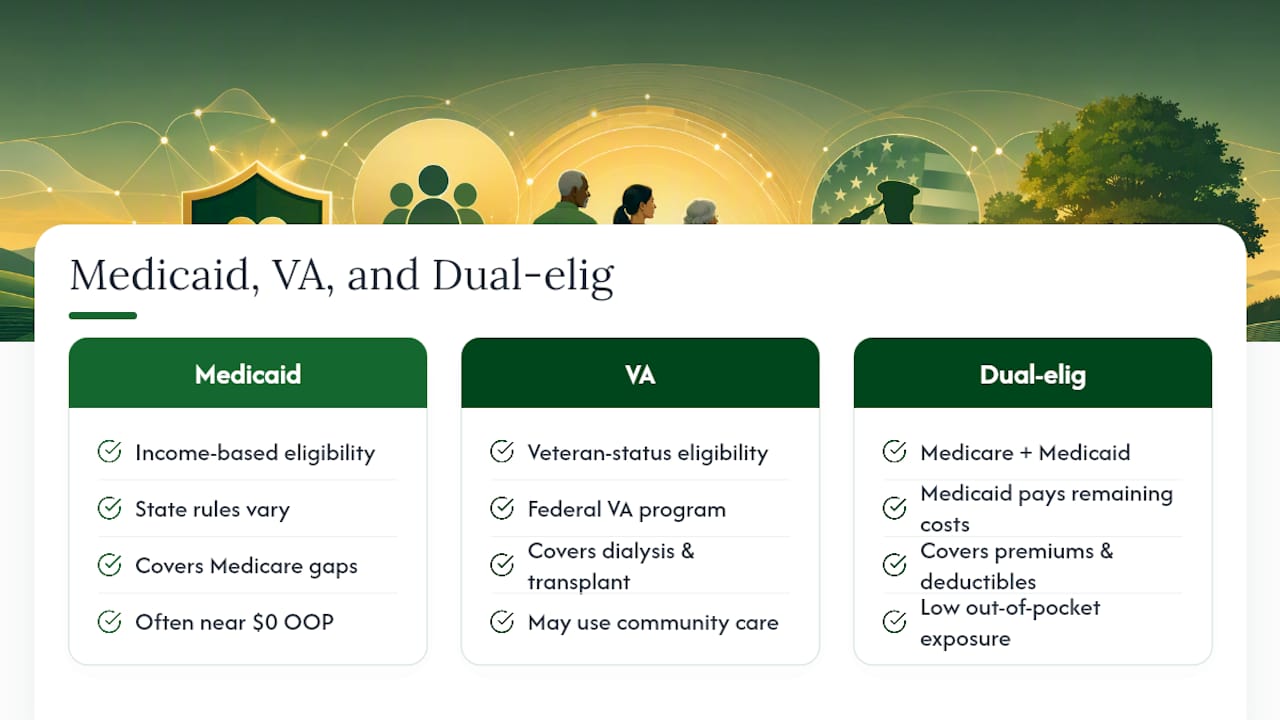
ESRD Medicare entitlement doesn’t replace Medicaid or VA benefits. It layers on top of them, and for many low-income patients, that layering is what makes treatment affordable at all.
Medicaid eligibility is based on income and state-specific rules, not your ESRD diagnosis directly, but many states extend Medicaid to ESRD patients who fall under income thresholds that wouldn’t otherwise qualify them. When someone has both Medicare and Medicaid, Medicaid typically covers costs Medicare doesn’t, including premiums, deductibles, and coinsurance in many cases, which is why dual-eligible ESRD patients often have close to zero out-of-pocket exposure. Every state runs its own program with its own income limits, so what qualifies in one state may not in a neighboring one.
Veterans with ESRD face a separate track through VA health benefits. The VA can cover dialysis and transplant-related care for eligible veterans, sometimes through VA facilities and sometimes through community care arrangements when a VA facility isn’t equipped for dialysis locally. Veterans with both VA eligibility and Medicare entitlement should coordinate both systems rather than assuming one automatically defers to the other. Which one pays first can depend on where care is delivered and whether it’s connected to a service-related condition.
If you’re navigating ESRD alongside Medicaid or VA benefits, loop in a caseworker familiar with all three systems early. Coordination mistakes here tend to surface as denied claims months after the fact, which is a hard place to start untangling things.
What Recent Changes Have Affected ESRD Medicare Rules?
The biggest shift in recent years was the Medicare Advantage access change that took effect in January 2021, opening enrollment to ESRD patients broadly rather than limiting them to a narrow set of Special Needs Plans. That single change reshaped how a large share of ESRD patients approach plan selection, since Medicare Advantage plans often bundle Part D and extra benefits that weren’t previously accessible to this group.
Beyond that structural change, CMS periodically updates dialysis facility payment rates, quality reporting requirements, and home dialysis incentives through its annual ESRD Prospective Payment System rulemaking. These updates don’t typically change who qualifies for Medicare, but they can affect which facilities offer home training programs and how dialysis centers get reimbursed, which indirectly shapes what’s available to patients locally.
State-level Medigap access rules for under-65 ESRD patients have also been shifting gradually, with more states adding guaranteed-issue protections in recent years. Because this area moves at the state level rather than federally, it’s worth rechecking your state’s current rules periodically rather than assuming last year’s answer still holds. The safest approach is treating ESRD Medicare rules as broadly stable at the federal entitlement level, while staying alert to state and payment-policy changes that shift more often.
The Real Problem Isn’t Eligibility. It’s Timing.
Most of the confusion around ESRD Medicare eligibility isn’t actually about who qualifies. The medical determination is usually straightforward, and the SSA work-credit rules, while bureaucratic, are well documented. The real damage happens in the gap between diagnosis and paperwork, when patients assume Medicare will simply activate the way it does at age 65.
It doesn’t. The four-month waiting period catches people off guard constantly, and the home dialysis training exception is a known path to earlier coverage for eligible patients. Conventional advice treats ESRD Medicare like a single eligibility checkbox. It’s really a sequence of decisions, each with its own deadline, stacked on top of a medical crisis where nobody has the bandwidth to research SSA rules.
If there’s one thing worth prioritizing above everything else in this article, it’s asking about home dialysis training the same week you’re diagnosed, before the three-month clock even starts running. That single conversation with your nephrologist can be worth three months of coverage most patients never realize they were entitled to.
— Zach
How Green Insurance Helps You Navigate ESRD Medicare Enrollment
A certified Medicare Insurance Planner can sit down with you, review your actual dialysis or transplant dates, and build an enrollment checklist specific to your timeline instead of a generic one pulled from a government pamphlet.

Enrollment assistance, plan comparison across Medicare Advantage, Medigap, and Part D options, claims support if something gets billed wrong during your coordination period, and annual coverage reviews are all part of the services available to ESRD patients and their caregivers. Before your first consultation, gather your dialysis start date or transplant admission records, any employer group health plan information, and your Social Security or benefit award letters. Having those on hand turns a first meeting into real progress instead of a fact-finding session.
Visit the Green Insurance services page to request a consultation and get a planner working through your specific ESRD timeline with you.
Where to Verify ESRD Medicare Rules Directly
- Medicare covers entitlement fundamentals and links to official coverage PDFs for dialysis and transplant services.
- CMS’s ESRD coordination of benefits guidance details the 30-month coordination period and employer plan protections.
- 42 CFR 406.13 provides the exact federal regulatory language on entitlement conditions and timing.
- The Social Security Administration’s Medicare sign-up page explains how to file and locate your nearest field office.
This article is general information, not a substitute for advice from a qualified doctor. Consult a qualified healthcare professional about your own circumstances before acting on anything here.
Sources
FAQ
How Long After ESRD Diagnosis Can You Get Medicare?
Most in-center dialysis patients become eligible for Medicare on the first day of the fourth month of continuous dialysis, according to Medicare.gov. Starting home dialysis training before the third month, or having a transplant admission, can move that date significantly earlier.
What Is the 30-Month Rule for ESRD?
The 30-month rule refers to the coordination period during which an employer group health plan remains the primary payer after you become Medicare-entitled through ESRD, as CMS explains. Medicare pays secondary during this window, and you should still enroll in Part B to avoid gaps and future penalties.
What Stage of Kidney Disease Qualifies for Medicare?
Medicare eligibility through kidney disease requires end-stage renal disease specifically, meaning permanent kidney failure requiring regular dialysis or a transplant, not earlier stages of chronic kidney disease. A treating physician must document this determination as part of the application process.
Do I Need Both Part A and Part B for Dialysis Coverage?
Yes. Medicare.gov confirms that Part A covers inpatient dialysis and transplant surgery, while Part B covers outpatient dialysis, physician services, and outpatient immunosuppressive drugs after transplant. Carrying only one part leaves real coverage gaps.
Can Medicare Coverage Restart After It Ends?
Yes. If dialysis resumes or another transplant occurs within the applicable window (12 months after stopping dialysis or 36 months after a transplant), Medicare entitlement restarts immediately without a new waiting period. A new 30-month coordination period may apply if you have employer coverage at that time.
How Do I Get Help Choosing a Plan After ESRD Entitlement?
A Certified Medicare Insurance Planner at Green Insurance can walk through your dialysis or transplant timeline, compare Medicare Advantage, Medigap, and Part D options available in your area, and help with claims questions during the coordination period. Consultations are personalized to your enrollment dates rather than generic guidance.