


Short-term care insurance pays for temporary recovery support, typically for a limited period of time, when you need home health aides, rehab, or assisted living after surgery, illness, or injury. It works best as a bridge, covering the elimination period on a long-term care policy or filling in where Medicare stops paying. If you’re generally healthy, want simplified underwriting, and don’t need decades of custodial coverage, it’s worth a serious look.
TL;DR:
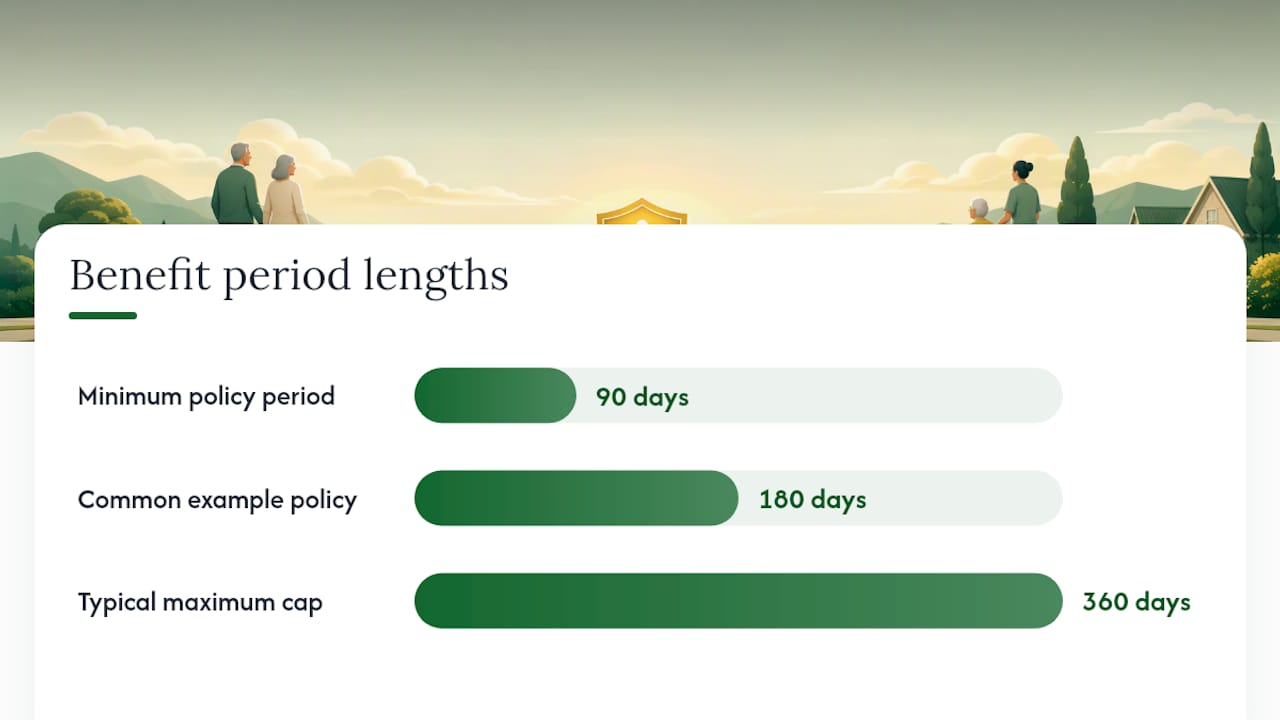
- Short-term care insurance typically pays for 90 to 360 days of recovery support, with a cap around 12 months, and is suited for specific short-term needs.
- The policies can cover home health aides, rehab stays, assisted living, adult day care, and homemaker services, with benefit amounts ranging from $50 to $400 daily.
- Premiums depend on age, health, benefit amount, period length, and riders, with lower costs for longer elimination periods and minimal riders, especially if purchased early.
- It is most appropriate for recovering from surgery, bridging LTC elimination periods, or filling Medicare gaps, but not for long-term custodial needs like dementia.
- A short-term care policy should be aligned with the elimination period of existing or planned long-term care coverage and purchased proactively before health issues arise.
Table of Contents
- What Does Short-Term Care Insurance Actually Cover?
- Who Actually Needs Short-Term Care Insurance?
- How Short-Term Care Policies Actually Work
- What Does Short-Term Care Insurance Actually Cost?
- Short-Term Care vs. Medicare vs. Long-Term Care: Who Pays for What
- How to Shop for and Compare Short-Term Care Policies
- How a Medicare Advisor Actually Uses Short-Term Care in a Plan
- The Honest Take on Short-Term Care Insurance
- Get a Personalized Review From Green Insurance Agency
- Sources
What Does Short-Term Care Insurance Actually Cover?
Short-term care insurance is built around one job: paying for help during a defined recovery window, not an open-ended custodial need. Policies typically pay benefits for anywhere from 90 to 360 days, and SmartAsset’s coverage breakdown confirms that most plans cap out around the 12-month mark. That single feature, the hard stop on duration, is what separates short-term care from a traditional long-term care policy.
The coverage itself spans several care settings, not just a hospital bed or a nursing home room. A policy might pay for:
- Home health aides who help with bathing, dressing, or medication reminders after a hospital discharge
- Skilled nursing or rehab facility stays following surgery, a stroke, or a fall
- Assisted living costs during a recovery period when someone can’t safely return home yet
- Adult day care programs that give a family caregiver a break during the day
- Homemaker services like meal prep or light housekeeping tied to a documented care need
Benefit periods and daily benefit amounts work together to set your payout ceiling. A policy offering a $150 daily benefit for 180 days gives you a maximum pool of $27,000 to draw from. Some plans set daily benefits as low as $50 and others as high as $400, according to policy examples from industry brochures on short-term care structures, so the range you pick should match realistic local care costs, not a generic number an agent hands you.
Payment style matters more than most buyers realize before they shop. Cash indemnity plans pay you the full daily benefit once you qualify, regardless of what the actual care costs, and you decide how to spend it. Reimbursement plans pay only for documented expenses, up to the daily cap, which means you need receipts and paperwork before a check shows up. Cash indemnity plans tend to cost a bit more, but they give you flexibility to pay a family member for care or cover costs a reimbursement plan wouldn’t recognize.
Restoration of benefits is a feature worth checking for specifically. If you use part of your benefit pool, recover, and then don’t need care again for a set period, often 180 days, some policies restore your full benefit amount as if you never used it. Without a restoration provision, every day of care permanently shrinks your remaining pool.
Riders extend the base policy in ways that matter for real-world claims. A home health rider can raise your benefit percentage for care received at home rather than in a facility. A hospital indemnity rider adds a flat cash payment for each day you’re hospitalized, stacking on top of your core benefit. Inflation protection riders increase your daily benefit over time, which matters more than people assume given how fast facility costs climb year over year.
Who Actually Needs Short-Term Care Insurance?
Short-term care insurance fits a specific slice of the population, not everyone shopping for senior coverage. The Administration for Community Living’s care-planning guidance makes the point that estimating how much care you’ll likely need, and for how long, should drive your product choice, not the other way around.
Here’s where it tends to make the most sense:
- You’re recovering from surgery or a hospital stay. Hip replacements, cardiac procedures, and major surgeries often require weeks of rehab that Medicare doesn’t fully cover once you exceed its skilled nursing limits.
- You need to bridge a long-term care elimination period. Many LTC policies have a 90-day waiting period before benefits kick in. A short-term care policy can cover that gap so you’re not paying entirely out of pocket while you wait.
- You’re worried about a Medicare coverage gap. Medicare’s skilled nursing benefit has strict qualifying rules, and short-term care can catch what falls through.
- You have modest savings you don’t want to drain. If depleting an emergency fund over a few months of recovery care worries you more than a decades-long custodial scenario, short-term coverage matches that risk.
- You have a health condition that makes long-term care underwriting difficult. Simplified underwriting, often just seven to ten health questions according to CBS News’s comparison of short-term and long-term policies, opens the door for people who’d get declined for full LTC coverage.
Short-term care isn’t the right tool if you’re already facing a diagnosis like dementia or Parkinson’s that points toward years of custodial support. In that scenario, a 12-month benefit cap runs out long before the need does, and you’re better served researching a long-term care policy or Medicaid planning instead, even though that path involves tougher underwriting.
How Short-Term Care Policies Actually Work
The mechanics of a short-term care policy come down to four moving parts: the elimination period, the benefit trigger, the daily benefit math, and the underwriting process. Understanding each one changes how you shop.
The elimination period is the number of days you pay for care yourself before the policy starts paying. Options usually range from 0 to 90 days. A 0-day elimination period means benefits start immediately, but you’ll pay a noticeably higher premium for that convenience. Choosing a 30 or 60-day elimination period lowers your premium since you’re self-insuring the early stretch of any claim.
Benefit triggers determine when you actually qualify for a payout. Most policies require documentation of either:
- Difficulty performing a set number of activities of daily living (ADLs), such as bathing, dressing, transferring, or eating
- A doctor-certified need for skilled nursing or rehabilitative care following a hospital stay
Insurers typically want a physician’s statement, discharge paperwork, and sometimes a functional assessment before approving a claim. Gathering that documentation early speeds up the process considerably.
The payout math is straightforward once you see it worked out. Say you have a $200 daily benefit and a 180-day benefit period. If you need 30 days of skilled nursing rehab after a hip fracture, that’s $200 times 30, or $6,000 in benefits paid, against a facility cost that could easily run higher without coverage. If you don’t use the full 180 days, some policies apply restoration rules and return your unused benefit pool to full strength after a claim-free stretch.
Underwriting for short-term care is deliberately lighter than what long-term care insurers require. Most applications ask seven to ten health questions covering things like recent hospitalizations, cognitive status, and current diagnoses. This is where CBS News notes short-term care becomes an option for people who’d otherwise get turned down. Denials still happen, usually tied to a recent major diagnosis, an existing need for daily living assistance at the time of application, or a history of specific conditions the insurer flags as high risk.
Pro Tip: Apply for short-term care coverage before you think you’ll need it, not after a health scare. Insurers price and approve based on your health status at the time of application, so waiting until after a diagnosis almost always means a higher premium or an outright decline.
What Does Short-Term Care Insurance Actually Cost?
Premiums for short-term care insurance vary enough that any single number thrown around online should be treated as a rough starting point, not a quote. What drives the price is a combination of five factors: your age, your health, the daily benefit you choose, the benefit period length, and any riders you add.
Age is the single biggest lever. Applying in your late 50s or early 60s typically locks in a noticeably lower premium than waiting until your 70s, partly because insurers price for risk and partly because health conditions tend to accumulate with age. Gender plays a role too, since women statistically use more paid care over their lifetimes, which insurers factor into pricing.
The cost context: rising U.S. health care spending has pushed out-of-pocket exposure higher across the board, which is exactly why products that pay a fixed daily benefit for recovery care have become more attractive to people trying to protect savings from a short but expensive care event.
Here’s how the pricing levers typically play out in practice:
- Daily benefit amount: Moving from a $100 to a $200 daily benefit roughly doubles your maximum payout, and the premium moves up accordingly, though not always in perfect proportion.
- Benefit period: A 360-day benefit period costs meaningfully more than a 90-day period since the insurer is on the hook for a longer potential payout.
- Elimination period: Choosing a 30 or 60-day elimination period instead of a 0-day option can shave a real chunk off your premium, since you’re covering more of the early claim cost yourself.
- Riders: Adding inflation protection or a home health rider increases your premium but also increases the real value of your coverage a decade down the road.
A practical example: two applicants of the same age might see very different quotes if one picks a $100 daily benefit with a 90-day benefit period and a 90-day elimination period, while the other picks a $300 daily benefit with a 360-day benefit period and no elimination period. The second policy could cost several times more, even though both are technically “short-term care insurance.”
If you’re trying to keep premiums manageable, a few moves tend to help. Ask about couple discounts if you and a spouse are applying together. Stretch the elimination period out if you have enough savings to self-fund the first month or two of a claim. And resist the urge to add every available rider. Inflation protection is usually worth the extra cost; some of the smaller add-ons are not, depending on your situation.
Short-Term Care vs. Medicare vs. Long-Term Care: Who Pays for What
Confusion about which program pays for what is probably the single biggest reason people either overpay for care or discover a gap too late. Here’s how the three actually divide responsibility.
Medicare Part A covers skilled nursing facility care, but only under specific conditions: you need a qualifying hospital stay of at least three days, and Medicare covers up to 100 days total, with a coinsurance charge kicking in after day 20. Once you hit day 101, or if you never had a qualifying hospital stay, Medicare stops paying and you’re on your own unless another policy fills the gap.
Long-term care insurance is built for a completely different scenario: ongoing custodial care that could last years, often for conditions like dementia where someone needs help with daily activities indefinitely. LTC policies usually carry longer elimination periods and tougher underwriting, since insurers are pricing for a much bigger long-run liability. MOAA’s comparison of the two coverage types frames long-term care as ongoing custodial support versus short-term care’s focus on recovery and rehabilitation.
Short-term care insurance sits in the middle and does two jobs well: it pays quickly with lighter underwriting for a defined recovery window, and it can pay in addition to Medicare, not instead of it, covering costs Medicare’s skilled nursing rules leave out. It also bridges the elimination period on a long-term care policy, so you’re not paying entirely out of pocket during the 90 days before your LTC benefits activate.
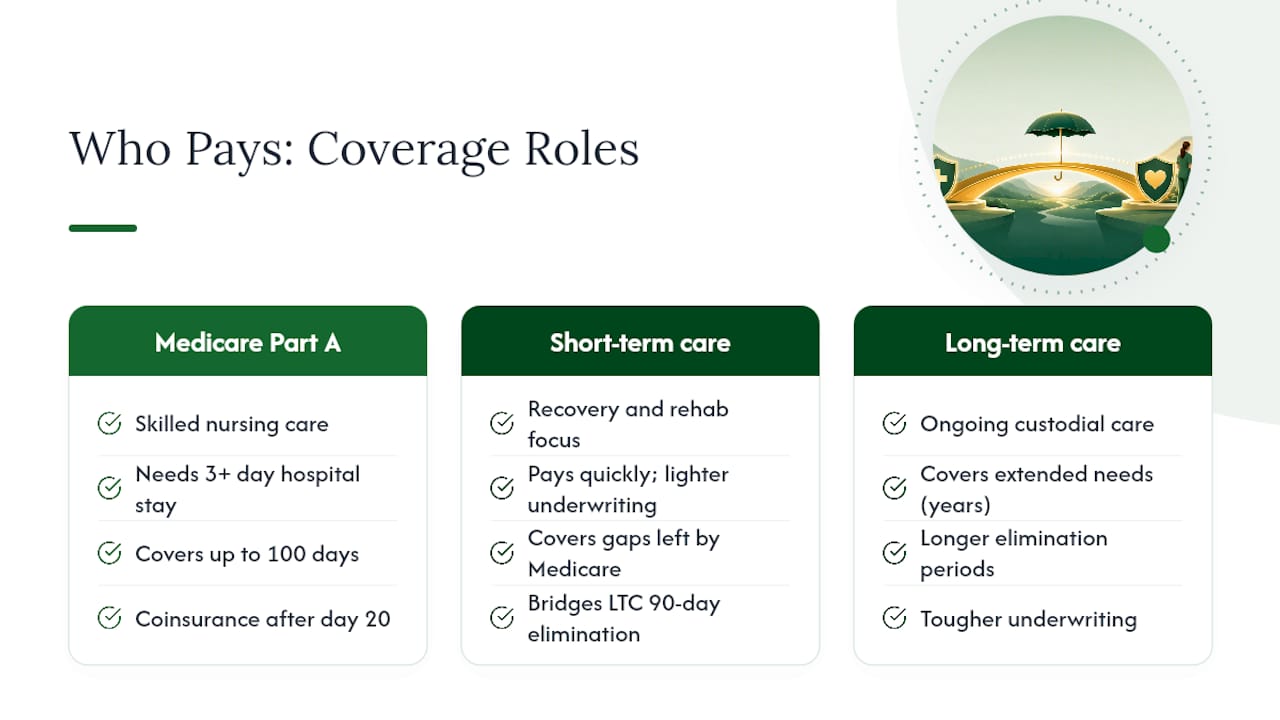
Medicaid enters the picture only for long-term custodial care once someone meets strict income and asset eligibility limits, which is a very different qualification bar than anything discussed here. For most families planning ahead, the practical order of operations looks like this: Medicare handles acute and short skilled nursing needs within its limits, short-term care insurance covers the gaps and bridges elimination periods, long-term care insurance (or Medicaid, if eligible) handles extended custodial needs.
How to Shop for and Compare Short-Term Care Policies
Comparing short-term care quotes gets a lot easier once you know exactly what to put side by side. Skip past the marketing brochure and go straight to these contract details.
- Compare the elimination period first. A 0-day option costs more but pays immediately; a 30 to 90-day option costs less but requires you to self-fund the early claim window.
- Check the daily benefit against real local costs. Call a nearby home health agency or rehab facility and ask their daily rate, then compare that number to the policy’s daily benefit before assuming it’s enough.
- Confirm the benefit period length. Ninety days works for a short recovery; 270 or 360 days gives more runway if you’re worried about a longer rehab stay.
- Ask whether restoration of benefits applies. This determines whether your coverage pool refills after a claim-free stretch or shrinks permanently with every day of use.
- Review the rider list. Home health riders and inflation protection tend to matter most; ask what each one actually adds in dollar terms, not just in name.
- Read the exclusions section closely. Every policy excludes something, commonly pre-existing conditions within a look-back window, self-inflicted injury, or care received outside the U.S.
- Ask about the claims process directly. Find out what documentation triggers a payout and how long claims typically take to process once submitted.
- Verify state licensing. Not every short-term care product is approved for sale in every state, so confirm with the agent or your state’s department of insurance that the specific policy is licensed where you live.
When you’re on the phone with an agent, ask pointed questions: “What exactly triggers a claim under this policy?” “Is this cash indemnity or reimbursement?” “What happens if I need care for longer than the benefit period allows?” Kiplinger’s rundown of short-term insurance plans flags watching closely for coverage limits and exclusions buried in plan language, which is exactly the kind of detail a rushed sales conversation glosses over. A legitimate agent should walk you through the exclusions list without hesitation. If they dodge the question or rush past it, that’s a red flag worth taking seriously.
How a Medicare Advisor Actually Uses Short-Term Care in a Plan
Advisors don’t sell short-term care insurance as a standalone product. It gets recommended as one piece of a larger income and coverage plan, usually after a specific gap becomes obvious during a Medicare consultation.
The most common scenario: a client is applying for a long-term care policy with a 90-day elimination period, and the advisor points out that those first three months would come entirely out of pocket without a bridge. A short-term care policy sized to match that elimination period closes the gap. Another frequent case involves someone facing a scheduled surgery, a knee or hip replacement, for example, where the recovery timeline and Medicare’s skilled nursing limits don’t quite line up. A short-term care policy purchased ahead of the surgery, while underwriting is still favorable, can offset the rehab cost.
On the claims side, timing and documentation make the biggest difference in how smoothly a payout goes. Advisors generally push clients to request discharge paperwork and a physician’s care plan immediately, since insurers lean on that documentation to verify the benefit trigger. Coordinating with Medicare matters too. Filing a short-term care claim while a Medicare Part A stay is still active, rather than after the fact, tends to avoid the back-and-forth that slows down reimbursement.
The Honest Take on Short-Term Care Insurance
Most of the content out there treats short-term care insurance as either a hidden gem or a scam, and neither framing is right. It’s a narrow tool that solves a narrow problem well: the gap between what Medicare pays and what a recovery actually costs.
Where conventional advice falls short is treating short-term care and long-term care as competing products you choose between. They’re not. The better question isn’t “which one should I buy?” It’s “where exactly is my gap, and which product actually closes it?” For someone with a 90-day LTC elimination period, that gap is obvious and short-term care is the right tool. For someone facing years of custodial dementia care, no 360-day policy was ever going to solve that problem, and pretending otherwise wastes premium dollars.
What readers should prioritize first isn’t the daily benefit amount, it’s the elimination period on whatever other coverage they already hold or plan to buy. Size the short-term policy to that number, not to a marketing brochure’s suggested range.
— Zach
Get a Personalized Review From Green Insurance Agency
Some insurance agencies build their approach around the idea that coverage decisions get better with a real conversation, not a generic quote form. A consultation with an experienced Medicare insurance professional can walk through your existing Medicare coverage, identify where a short-term care policy might close a real gap, whether that’s an elimination period bridge or a rehab cost concern, and compare actual quotes side by side so you’re not guessing at daily benefit amounts or benefit periods.

Expect the consultation to cover your current Medicare Advantage, Supplement, or Part D setup, a review of where short-term care or long-term care products might fit, and hands-on help completing an application if you decide to move forward. Consultations are typically offered without cost and without pressure to buy anything on the spot. If you want a straight answer about whether short-term care insurance makes sense for your situation, schedule a consultation with Green Insurance Agency and get a coverage review built around your actual health history and budget, not a generic estimate.
Sources
The facts and figures in this article draw from a mix of government guidance and established financial and health journalism, chosen because each one addresses a distinct piece of the short-term care picture.