

U.S. Medicare Savings Programs: Trigger Extra Help, Drugs Capped at $12.65

If you have limited income, Medicare Savings Programs can pay your Part A and Part B premiums and often lower other Medicare costs. Enrolling can trigger automatic drug cost help too. You apply through your state, not the federal government. Even if your income looks a little high on paper, apply anyway. States have room to count things differently, and denials based on a quick guideline check are often reversed once a caseworker actually reviews your file.
TL;DR:
- Medicare Savings Programs can help lower or cover Medicare Part A and B premiums, deductibles, and coinsurance, especially for those whose income exceeds full Medicaid limits.
- Applying broadly and letting caseworkers determine eligibility can prevent delays caused by incorrect program guesses or strict guideline interpretations.
- The four program types differ mainly by the specific costs they cover, with QMB offering the most comprehensive assistance, including cost-sharing and premium coverage.
- State thresholds for income and resources often surpass federal limits, and many states have more generous rules for eligibility for 2026.
- Enrolling in MSPs typically triggers automatic Extra Help for prescription drug costs, which can further reduce expenses and often exceeds expectations for saving.
Table of Contents
- What Are Medicare Savings Programs?
- The Four MSP Types: QMB, SLMB, QI, and QDWI
- Who Qualifies for Medicare Savings Programs in 2026?
- How to Apply for a Medicare Savings Program
- Paperwork That Speeds Up Your Application
- How a Certified Medicare Insurance Planner Can Help
- Get Personalized Help With Your Medicare Application
- Where to Verify Program Rules
- Sources
- FAQ
What Are Medicare Savings Programs?
Medicare savings programs are state-run benefits that help pay Medicare premiums and, depending on the program, deductibles, coinsurance, and copays too. You apply through your state’s Medicaid office, not Medicare directly, even though the savings show up on your Medicare bill.
These programs sit next to Medicaid but aren’t the same thing. Full Medicaid coverage pays for a wide set of medical services. An MSP, by contrast, is narrower. It targets Medicare’s premiums and cost-sharing specifically, which makes it a realistic option for people whose income is too high for full Medicaid but still tight enough that Medicare’s monthly bills hurt.
There’s a bonus baked into most of these programs: qualifying often triggers automatic enrollment in Extra Help, the Part D Low Income Subsidy that cuts prescription drug costs. That connection matters because:
- Extra Help caps what you pay per covered prescription
- You typically don’t have to file a second application once your MSP is approved
- The drug savings often exceed what people expect from a “premium assistance” program
The Four MSP Types: QMB, SLMB, QI, and QDWI
Not every Medicare Savings Program does the same job. Your state assigns you one based on your income and resources, and the differences between them are significant enough to affect your monthly budget by hundreds of dollars.
- Qualified Medicare Beneficiary (QMB) is the most comprehensive of the four. It covers Part A and Part B premiums and also picks up deductibles, coinsurance, and copays for Medicare-covered services. If you qualify for QMB, providers generally can’t bill you for those costs at all.
- Specified Low-Income Medicare Beneficiary (SLMB) covers the Part B premium only. It’s designed for people whose income is a bit above the QMB threshold but who still need help with that specific monthly cost.
- Qualifying Individual (QI) also covers just the Part B premium, but it works differently. QI is funded through a limited state allocation each year and awarded on a first-come, first-served basis. Applying early in the year gives you a real advantage over waiting until fall.
- Qualified Disabled & Working Individual (QDWI) is the outlier. It helps certain people with disabilities who lost premium-free Part A after returning to work, covering their Part A premium so going back to a job doesn’t mean losing Medicare coverage.
You don’t pick which program you get. You submit one application, and your state determines which of the four fits your income and resources.
Pro Tip: If you’re not sure which category you’ll land in, don’t try to guess or self-select on the application. Apply for Medicare Savings Programs broadly and let the caseworker determine the category. Guessing wrong can slow things down if you list the wrong program name.
Who Qualifies for Medicare Savings Programs in 2026?
Eligibility comes down to income and resources, and the federal guidelines Medicare publishes for 2026 are a starting point, not a hard national rule. States can and do set their own, often more generous, thresholds.
A general rule of thumb: QMB has the lowest income ceiling, SLMB and QI sit progressively higher, and QDWI uses a separate income test tied to disability work incentives. Resource limits (savings, investments, and similar assets) apply too, though several categories don’t count against you.
- Your primary home, one vehicle, and certain burial funds or life insurance policies are typically excluded from resource counts
- A $20 general income disregard applies in most states, so the first $20 of monthly income usually doesn’t count
- Some states have dropped the resource test entirely or raised the income limits well above the federal baseline
- Alaska and Hawaii use adjusted federal poverty figures, and married couples get different combined limits than single applicants
Here’s the number that surprises a lot of people: for 2026, Extra Help limits what enrollees pay to no more than $12.65 per covered prescription. That’s the ceiling, and many people pay less. Given how automatically that benefit follows MSP approval, the drug savings alone can rival the premium savings.
How to Apply for a Medicare Savings Program
Applying takes a few concrete steps, and none of them require going through Medicare.gov directly.
- Contact your state Medicaid office. This is the primary application route, and most states let you apply by phone, mail, or online through their Medicaid or medical assistance portal.
- Apply for Extra Help through the Social Security Administration if you haven’t already. SSA forwards your information to your state for MSP consideration automatically, unless you specifically opt out of that referral.
- Call your State Health Insurance Assistance Program (SHIP) for free, unbiased counseling. Dial 1-877-839-2675 or search for your state’s SHIP office to get help filling out paperwork at no cost.
- Wait for a decision notice. Timelines vary by state, but most process applications within 45 days. QI applications move faster if you apply early, since funding runs out on a first-come basis each year.
Paperwork That Speeds Up Your Application
Gathering documents ahead of time keeps your application from stalling in a request-for-information loop, which is the most common delay.
You’ll generally need proof of income (Social Security award letters or recent pay stubs), bank and retirement account statements, your Medicare card or proof of enrollment, a photo ID, and proof of your current address.
The mistakes that slow people down are predictable: leaving out a small savings account, forgetting to list a spouse’s income even when only one person is applying, skipping a signature, or letting a follow-up request from the caseworker go unanswered for too long.
- Keep copies of everything you submit, including the date you sent it
- Follow up with your caseworker by phone if you haven’t heard back in three to four weeks
- If you’re denied, ask your SHIP counselor to review the notice. State discretion means a denial isn’t always final.
Pro Tip: Note your appeal deadline the day you receive a denial letter. States typically require appeals within a limited timeframe; missing it means starting the whole application over.
How a Certified Medicare Insurance Planner Can Help
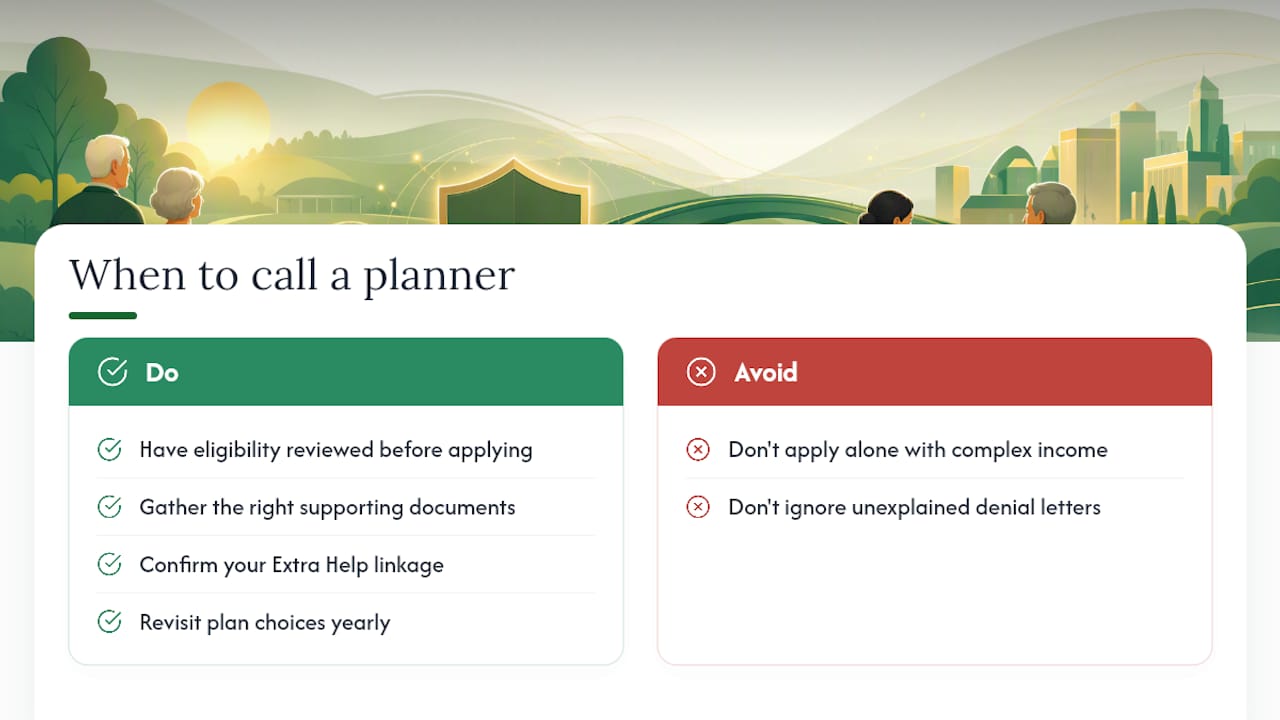
Applications get complicated fast when income comes from multiple sources, when someone’s recently stopped working, or when a denial letter shows up with no clear explanation. That’s usually where a second set of eyes earns its keep.
A Certified Medicare Insurance Planner® can review your eligibility before you apply, help you gather the right documents, confirm your Extra Help linkage went through, and revisit your plan choices each year as your income or health needs shift. Reaching out makes the most sense when your situation isn’t simple, or when a first application didn’t go the way you expected.
— Zach
Get Personalized Help With Your Medicare Application
Figuring out which Medicare Savings Program fits your situation, and making sure your paperwork doesn’t stall in review, can be supported by expert assistance at no cost. There is no obligation to enroll in any plan through an initial consultation with a Medicare insurance expert.

A first conversation typically covers your current income and resource picture, a plain-language walk-through of which MSP category you’re likely to fit, and a checklist of documents to have ready before you contact your state Medicaid office. Reviewing Part D and Advantage plan options together helps address all aspects of Medicare coverage comprehensively. If you’re in Orange Park, Fleming Island, or elsewhere in the Jacksonville area and want a straight answer about what you qualify for, schedule a consultation with Greenins and bring your questions.
Where to Verify Program Rules
For the official word on eligibility and applications, start with Medicare.gov’s MSP overview, the SSA Extra Help page, your state Medicaid office locator, and NCOA’s MSP guide.
This article is general information, not a substitute for advice from a qualified financial advisor. Consult a qualified financial professional about your own circumstances before acting on anything here.
Sources
- Medicare Savings Programs | Medicare
- Apply for Medicare Part D Extra Help program
- What Are Medicare Savings Programs (MSPs)? | NCOA
FAQ
Is the Medicare Savings Program Legitimate?
Yes. MSPs are administered by state Medicaid agencies under federal Medicare rules, and they’ve helped pay premiums and cost-sharing for eligible beneficiaries for decades.
What Are the Four Types of Medicare Savings Programs?
They are Qualified Medicare Beneficiary (QMB), Specified Low-Income Medicare Beneficiary (SLMB), Qualifying Individual (QI), and Qualified Disabled & Working Individual (QDWI), each covering different premiums or cost-sharing based on your income level.
Who Qualifies for the Medicare Giveback Benefit?
The giveback benefit is a feature of certain Medicare Advantage plans that reduces your Part B premium, separate from state-run MSPs; eligibility depends on the specific plan you enroll in rather than an income test. Working with a Certified Medicare Insurance Planner® can help you see whether a giveback plan or an MSP, or both, fits your situation.
What Can I Do if I Can’t Afford Medicare?
Apply for a Medicare Savings Program through your state Medicaid office even if you’re unsure whether you qualify, since state rules often count income and assets more favorably than the federal guidelines suggest.