

Defer RMDs to Age 85: Deferred Income Annuity (QLAC) for U.S. Retirees

A deferred income annuity (DIA) is a contract that converts a lump sum today into guaranteed income starting years from now, usually to protect against outliving your money. It fits people who have other savings for near-term needs and want a guaranteed income floor late in retirement. The catch: your money is largely locked up, and if you die before payments start, that principal can be gone unless you add a rider.
TL;DR:
- The payout from a deferred income annuity increases significantly with longer deferral periods, roughly doubling with every 10-year delay in start date.
- Choosing a return-of-premium or period-certain rider reduces monthly income but offers protection if you die early or want guaranteed heirs’ benefits.
- A QLAC, a type of DIA funded through an IRA, can delay required minimum distributions until income begins, potentially lowering early retirement taxes.
- Actual payout amounts vary widely based on age, sex, interest rates, and rider choices, with a 20-year deferral potentially paying around $2,180 per month on a $100,000 premium.
- Risks include losing principal if you die before payments start, lack of liquidity, and inflation eroding fixed payments, so careful planning and insurer ratings are essential.
Table of Contents
- How Does a Deferred Income Annuity Work?
- Who Should Consider a Deferred Income Annuity?
- QLACs, RMDs, and the Tax Rules That Actually Matter
- How Much Will a $100,000 Deferred Annuity Pay?
- What Are the Risks of a Deferred Annuity?
- How to Shop for and Buy a Deferred Income Annuity
- An Advisor’s View on Coordinating Annuities with Medicare Planning
- The Overlooked Trade Most Retirees Get Wrong
- Get Help Choosing the Right Annuity for Your Retirement Plan
- Where to Verify Annuity Rules and Insurer Information
- Sources
- FAQ
How Does a Deferred Income Annuity Work?
A DIA follows a simple sequence: you pay an insurer a lump sum (or sometimes a series of payments), the money sits in deferral for a set number of years, and then the insurer starts sending you a fixed income stream for life or a chosen period. The mechanics behind the payout size are less obvious, and they’re the reason DIAs can pay far more per dollar than an immediate annuity.
Three forces push your future payout higher the longer you wait. First, the insurer gets more time to invest your premium before it has to pay anything out, and that investment growth compounds in your favor. Second, the payout mechanics tied to deferral length and mortality credits mean that as your expected start age moves closer to average life expectancy, the insurer expects to make fewer total payments to you. Third, and this is the part most people have never heard of: mortality credits. When you buy a DIA, you’re pooling risk with everyone else who bought one. People who die before their income starts effectively subsidize the payouts of people who live. Insurers redistribute that money back into the pool, which is why a deferred contract can beat what you’d get from simply investing the same amount and withdrawing it yourself.
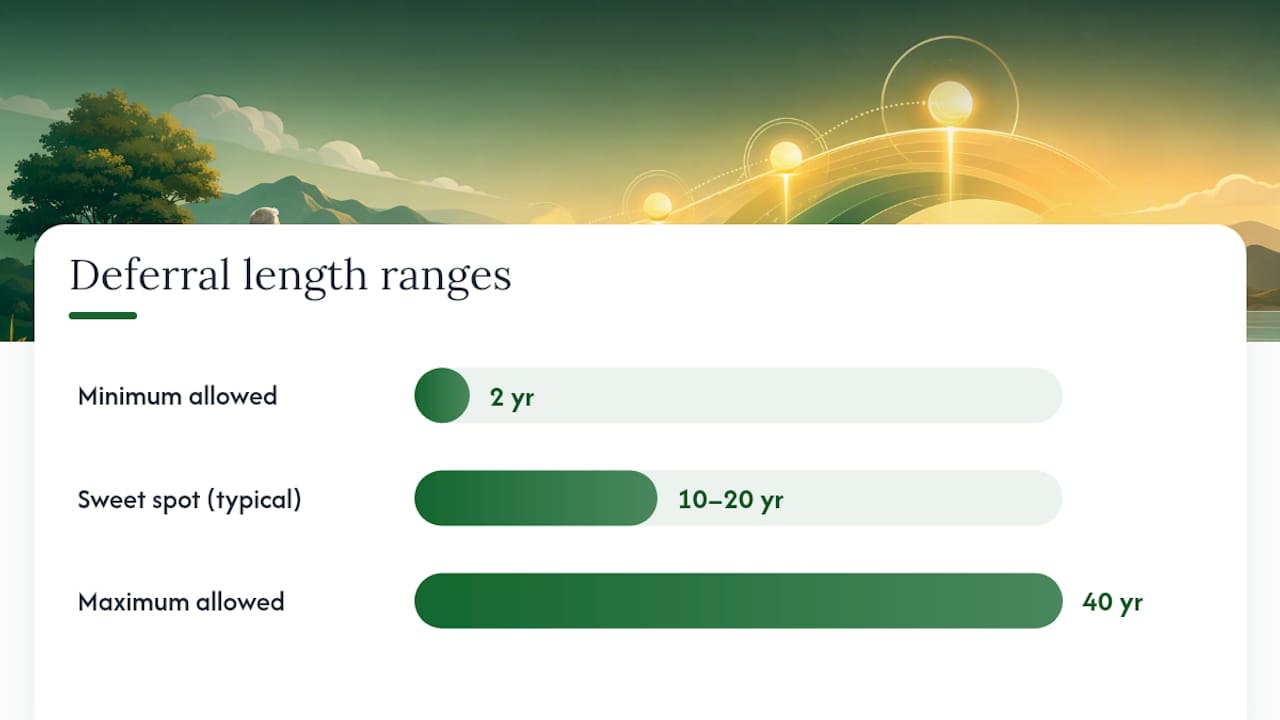
Most insurers let you choose a deferral period anywhere from 2 to 40 years, though the sweet spot for longevity protection tends to run 10 to 20 years. Minimum premiums typically start around $10,000 to $25,000, depending on the carrier.
Once you lock in the contract, here’s what typically happens:
- Purchase: You pay the premium (single lump sum, in most cases) and select your deferral period and payout option.
- Deferral: Your money grows inside the contract at a rate the insurer guarantees upfront; you get no statements showing market swings because there’s no market exposure.
- Income start date: On the date you selected, income begins automatically. There’s no decision to make at that point unless your contract allows a start-date shift.
- Payments: You choose the frequency (monthly is most common) and the payout structure, life-only, life with period certain, or joint-survivor for couples.
Life-only payouts are the highest because the insurer stops paying the moment you die. Period-certain or joint-survivor options pay less per month but protect against the “died right after income started” scenario.
Who Should Consider a Deferred Income Annuity?
A DIA makes sense for one specific worry: running out of money in your 80s or 90s. If that’s not a real concern for you, a DIA probably isn’t the right tool. If it is, this product does something almost nothing else in a retirement plan does, it guarantees income you literally cannot outlive, no matter how long you’re around to collect it.
The typical buyer is age 55 to 70 at purchase, has other liquid assets for near-term spending, and is looking to fill a gap between what Social Security and any pension will cover and what monthly expenses will actually run. FINRA’s guidance on these contracts frames them as a tool for people who want guaranteed income later in life and are comfortable trading liquidity for that certainty.
Before buying, you need three things already in place:
- An emergency fund covering 6 to 12 months of expenses, held somewhere fully liquid.
- Enough other retirement savings to cover the years between now and when DIA income starts.
- A realistic estimate of Social Security timing, since delaying Social Security to age 70 and layering a DIA on top can build a stronger income floor than either move alone.
Pro Tip: Think of a DIA as insurance you buy against living too long, not an investment you buy to grow money. If you’re mentally comparing it to a mutual fund’s return, you’re evaluating it with the wrong yardstick.
Coordinating a DIA with Social Security is where a lot of retirees leave money on the table. Social Security already functions as inflation-adjusted longevity insurance, so some planners suggest maximizing that benefit first (by delaying the claim) before committing another lump sum to a DIA. Others prefer diversifying across both because Social Security’s future benefit levels carry some political risk, while a DIA’s contractual payout doesn’t.
QLACs, RMDs, and the Tax Rules That Actually Matter
If you’re funding a DIA from an IRA or 401(k), you need to know about the Qualifying Longevity Annuity Contract, or QLAC. This is a specific type of DIA that Congress carved out of the required minimum distribution (RMD) rules, and it changes the tax math in a meaningful way.
Normally, the IRS forces you to start taking RMDs from tax-deferred retirement accounts (and paying tax on them) once you hit your RMD age. Money inside a QLAC is excluded from that RMD calculation until income actually starts, which can be as late as age 85. That means a chunk of your IRA can sit outside the RMD math for years, lowering your taxable income during the early stretch of retirement when you might also be managing Medicare premium thresholds.
There’s a statutory cap on how much you can put into a QLAC, and it’s indexed for inflation, so check the current limit with your custodian or a tax professional before assuming a specific dollar figure still applies. The age-85 income start cap is fixed by the QLAC rules themselves, regardless of inflation adjustments to the funding limit.
Why the RMD deferral matters in practice:
- It can reduce your Medicare IRMAA exposure in years when you’d otherwise be pushed into a higher premium bracket.
- It shifts taxable income to later years, which may or may not help depending on your bracket trajectory.
- It doesn’t eliminate tax, it delays it. Once QLAC income starts, it’s taxed as ordinary income, same as any other IRA withdrawal.
Tax treatment diverges sharply depending on where the money came from. A DIA funded with qualified money (IRA, 401(k)) has every dollar of income taxed as ordinary income when it’s paid out, because none of that money was ever taxed going in. A DIA funded with non-qualified money (savings you already paid tax on) uses an exclusion ratio, a formula that treats part of each payment as a tax-free return of your original principal and part as taxable earnings. Over time, once your original principal is fully returned, the entire payment becomes taxable.
Roughly speaking, a non-qualified DIA holder often pays tax on a meaningfully smaller share of each payment than a qualified-account holder does on the exact same payment amount, purely because of how the exclusion ratio works. That single fact changes which account type makes sense to fund a DIA from.
How Much Will a $100,000 Deferred Annuity Pay?
Payout size depends almost entirely on one variable: how long you defer income. The gap between a contract that starts paying immediately and one that waits two decades is not small.
Illustrative figures gathered from annuity payout examples show just how much deferral length moves the number for a $100,000 premium on a single life:
| Deferral length | Illustrative monthly income (single life) |
|---|---|
| Immediate (SPIA, no deferral) | Approximately $490 per month |
| 5-year deferral | Higher than immediate, but notably less than longer deferrals |
| 10-year deferral | Approximately twice the immediate payout in many examples |
| 20-year deferral | Approximately $2,180 per month |
These are illustrative ranges, not quotes, actual payouts depend on your age at purchase, sex, interest rate environment at the time you buy, and the specific insurer’s pricing. Rates move with the broader interest rate environment, so a quote you got two years ago is not a reliable stand in for what you’d get today.
A few rules of thumb worth keeping in mind:
- Each additional 5 years of deferral tends to add a meaningful, though diminishing, percentage boost to your monthly payout.
- Adding a return-of-premium (ROP) or cash-refund rider, which guarantees your heirs get back at least what you paid in if you die early, lowers the monthly payout compared to a life-only option, sometimes noticeably.
- Choosing joint-survivor coverage instead of single life also reduces the monthly number, because the insurer now expects to pay out over two lifetimes instead of one.
- Period-certain guarantees (say, 10 or 20 years of guaranteed payments even if you die early) sit in between, cheaper than ROP in terms of payout reduction, but still less than pure life-only.
When you use a guaranteed-income estimator, tools like Fidelity’s deferred income annuity calculator let you plug in age, premium, and deferral length to see illustrative numbers. The one habit that actually matters when comparing quotes across insurers: hold every input identical, same age, same premium, same start date, same payout option, every single time. Change even one variable and you’re not comparing apples to apples anymore.
What Are the Risks of a Deferred Annuity?
The biggest risk isn’t hidden in fine print, it’s structural. You’re handing over a lump sum in exchange for a promise, and that promise comes with real tradeoffs.
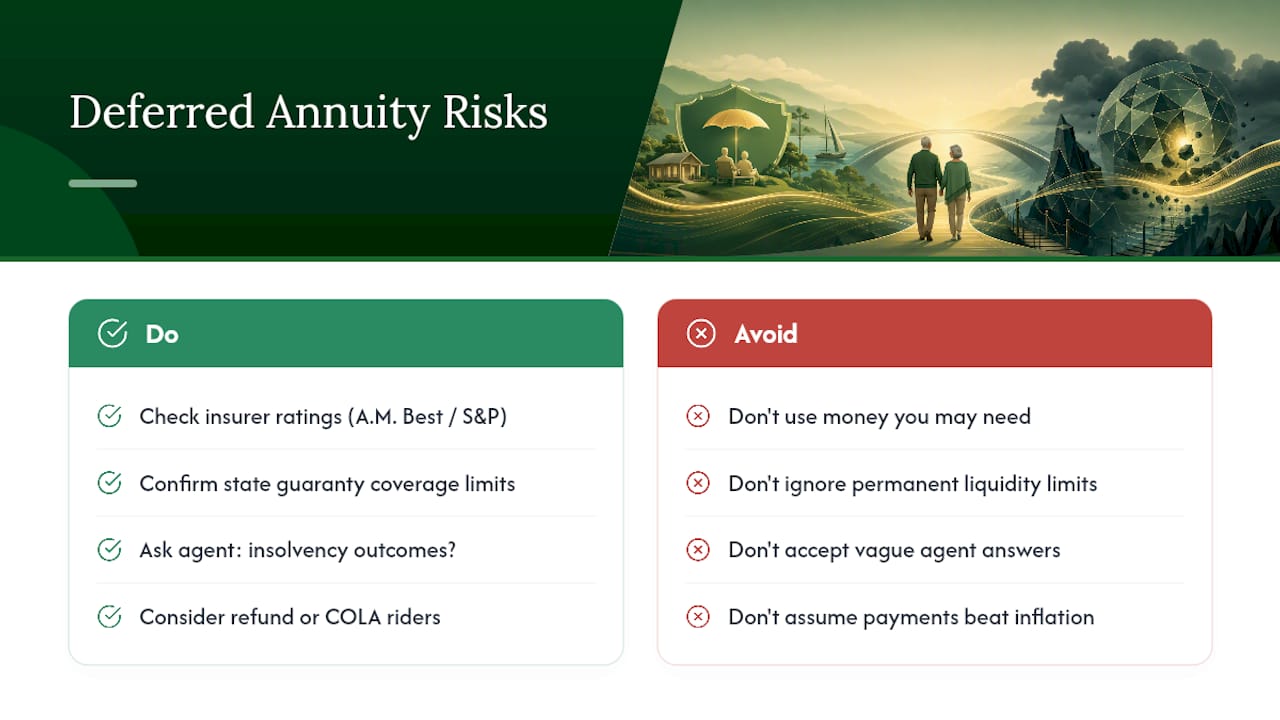
Death before income starts is the one that stops most people cold. If you buy a life-only DIA at 60 with income starting at 80, and you die at 78, the insurer typically keeps the money. That’s what makes mortality credits work for everyone else in the pool, but it’s a hard pill to swallow if it happens to your family. A return-of-premium or cash-refund rider fixes this by guaranteeing your beneficiaries get back at least your original premium, but you pay for that guarantee with a lower monthly income for life.
Liquidity is the second issue, and it’s permanent, not temporary. Once you buy the contract, that money is generally not accessible. Some contracts offer limited commutation or lump-sum withdrawal features, but they’re the exception, not the rule, and they usually come at a cost. This is why FINRA and other consumer-protection resources keep hammering the same point: don’t put money into a DIA that you might need for a medical emergency, a home repair, or anything unplanned.
Insurer credit risk deserves more attention than it gets. Your guarantee is only as good as the insurance company standing behind it. Before signing anything, check the insurer’s financial-strength ratings from agencies like A.M. Best or Standard & Poor’s, and confirm your state’s guaranty association coverage limits through your state insurance department, since those limits and product availability vary by state.
Pro Tip: Ask your agent directly: “What happens to my money if this insurer becomes insolvent?” A confident, specific answer citing state guaranty limits is a good sign. A vague answer is not.
Inflation is the quiet risk. A fixed monthly payment locked in today buys less in year 15 than it does in year one. Some carriers offer inflation-adjustment riders or cost-of-living increases, but they reduce your starting payout in exchange, so weigh that tradeoff carefully against your other inflation-protected income (Social Security has a built-in cost-of-living adjustment; most DIAs don’t unless you pay for one).
How to Shop for and Buy a Deferred Income Annuity
Buying a DIA shouldn’t be a one-call decision. Treat it the way you’d treat a major financial commitment, because it is one.
- Confirm the contract type first. Ask whether the product is a standard DIA or specifically structured as a QLAC, since that determines how it interacts with your RMDs and IRA rules.
- Check income start date flexibility. Some contracts let you shift your start date within a range once the contract is active; others lock it permanently at purchase.
- Ask about riders and what they cost. Get the exact monthly payout with and without a return-of-premium or period-certain rider so you can see the real dollar tradeoff.
- Review surrender and liquidity provisions in writing. Don’t rely on a verbal summary, ask for the specific contract language on withdrawal limits.
- Verify the insurer’s financial-strength rating and ask directly whether your state’s guaranty association would cover this contract, and up to what limit.
- Get multiple quotes using identical inputs. Same age, same premium amount, same deferral period, same payout structure, across at least two or three carriers before deciding.
- Decide where to buy. You can go directly to an insurer, work through a broker network, or use a licensed local agent who can compare multiple carriers on your behalf, which is often the fastest way to get an apples-to-apples comparison without doing the legwork yourself.
An Advisor’s View on Coordinating Annuities with Medicare Planning
When advising retirees, the DIA conversation rarely happens in isolation. It usually comes up alongside Medicare enrollment timing, because shifting income later in retirement can affect IRMAA brackets and premium costs down the road. A DIA tends to make sense for someone who already has Social Security and other guaranteed income mapped out and is specifically trying to close a longevity gap, not as a first move. Every guarantee in this space depends entirely on the issuing insurer’s claims-paying ability, which is why checking financial-strength ratings belongs in every consultation, not as an afterthought.
The Overlooked Trade Most Retirees Get Wrong
The conventional pitch for a DIA leans hard on the payout numbers, look how much more you get by waiting twenty years. That framing skips the actual decision, which isn’t about maximizing a monthly figure. It’s about how much of your retirement you’re willing to insure against a bad outcome you can’t predict: living to 95 with no income floor left.
Most people underweight mortality credits and overweight liquidity anxiety. They walk away from a DIA because “what if I die early and lose it all,” without registering that the insurer is pricing that exact risk into everyone’s payout, including theirs. A return-of-premium rider solves the anxiety, but it also erases much of the reason a DIA outperforms self-directed savings in the first place.
Here’s what I’d prioritize first: figure out your actual longevity gap, the years between when your other income sources likely run thin and your realistic life expectancy, before touching a payout calculator. Fund that gap specifically. Everything else, riders, deferral length, QLAC structuring, is a tuning decision that comes after you know what you’re solving for.
— Zach
Get Help Choosing the Right Annuity for Your Retirement Plan
Comparing deferral lengths, riders, and QLAC rules across multiple insurers is a lot to sort through alone, and the fine print differs from carrier to carrier. Greenins provides an education-first alternative to figuring this out solo or relying on a call center that pushes one carrier’s product. Their planners can walk you through annuity illustrations alongside your Medicare and overall retirement income picture, so you’re not making a longevity-income decision in a vacuum.

Before your consultation, bring your Social Security benefit estimate, a list of other retirement accounts, and your target retirement age. Explore the full range of retirement income planning services Greenins offers, from annuity comparisons to annual coverage reviews, or start at the main Greenins page to schedule a no-pressure conversation about how a deferred income annuity might fit your plan.
Where to Verify Annuity Rules and Insurer Information
For deeper reading on consumer protections, review FINRA’s guidance on deferred income annuities, the Investor, and NAIC’s consumer annuities guidance. Always confirm insurer ratings and your state’s guaranty association limits before signing a contract.
This article is general information, not a substitute for advice from a qualified financial advisor. Consult a qualified financial professional about your own circumstances before acting on anything here.
Sources
FAQ
Who Has the Best Deferred Income Annuity?
There’s no single “best” DIA, the right contract depends on your age, deferral timeline, rider choices, and the specific insurer’s current rates. Compare quotes from multiple carriers using identical inputs, and check each insurer’s financial-strength rating before deciding; a licensed local agent can run these comparisons for you.
What Are the Downsides of a Deferred Annuity?
The main downsides are loss of liquidity (your premium is generally locked up until income starts), the risk of forfeiting your principal if you die before payments begin, and exposure to inflation on a fixed payout. Riders like return-of-premium or period-certain can offset some of these risks, but they lower your monthly income in exchange.
How Much Will a $100,000 Annuity Pay Monthly?
It depends heavily on deferral length. Illustrative examples show a $100,000 immediate annuity paying around $490 per month, while the same premium deferred 20 years can pay roughly $2,180 per month, though actual quotes vary by age, sex, and current interest rates.
What Did Warren Buffett Say About Annuities?
Buffett has generally criticized commission-heavy, complex insurance and investment products for eating into investor returns through high fees, a caution that applies broadly to annuities sold without full fee transparency. That’s exactly why comparing riders, surrender terms, and payout structures in writing before buying matters more than focusing on a single headline payout number.
Is a QLAC the Same Thing as a Deferred Income Annuity?
A QLAC is a specific type of DIA purchased with qualified retirement funds, like an IRA, that gets special treatment under RMD rules. Regular DIAs funded with non-qualified savings don’t get that RMD deferral benefit, but they do offer more flexibility in some contract terms.