

U.S. Retirees: Annuities for Retirement Income That Add 29% to Spending

Annuities can provide reliable retirement income, but only for specific situations: someone in their late 60s or 70s who wants a guaranteed income floor beneath Social Security, or a retiree in their 80s worried about outliving savings and looking for late-life longevity protection. They work best covering essential expenses, not as a place to park emergency cash. Most retirees end up using annuities alongside Social Security, not instead of it, as one piece of a larger retirement paycheck.
TL;DR:
- Annuities are best suited for retirees in their late 60s or 80s seeking guaranteed income for essential expenses or longevity protection.
- Deferred annuities and QLACs can significantly increase payouts by delaying income start to late life, rewarding patience and deferral strategy.
- Fees, including management, riders, and surrender charges, along with inflation risk, can erode value, so partial annuitization and cost-of-living riders are advisable.
- Choosing the right annuity depends on objective, timing, payout options, carrier strength, and comparing multiple quotes with professional guidance.
- Annuities work as a supplement to Social Security or pensions, not as a standalone solution, often paired with flexible assets for liquidity and growth.
Table of Contents
- What Annuities Are and the Main Types That Matter
- How Annuities Turn a Lump Sum Into Steady Retirement Income
- Benefits and Drawbacks: When Annuities Help and Where They Fall Short
- Tax, Retirement Accounts, and Timing: What U.S. Retirees Need to Know
- How to Choose an Annuity Without Getting Burned
- Deferred Income Annuities and QLACs: Using Delay to Your Advantage
- An Agent’s View: What We Actually Ask Clients Before Recommending an Annuity
- Inflation Protection Beyond the Cost-of-Living Rider
- Annuities vs. Systematic Withdrawals and Bond Ladders
- Fees and Expenses: What’s Really Baked Into Your Contract
- What Retirees Get Wrong About Annuities
- How Green Insurance Agency Can Help You Build a Retirement Paycheck
- Sources
- FAQ
What Annuities Are and the Main Types That Matter
An annuity is an insurance contract. You hand an insurance company a lump sum or a series of payments, and in return, the carrier promises to pay you a stream of income, either starting right away or years down the road. That’s the entire concept stripped of marketing language. The Securities and Exchange Commission’s investor education arm frames annuities plainly as contracts issued by insurance companies, and that framing matters because it separates annuities from bank products or securities, a distinction that becomes important later when we talk about counterparty risk.
Not all annuities behave the same way, and the differences change how they fit into retirement income strategies:
- Immediate annuities (SPIAs): You pay a lump sum and payments start within about a year, often within 30 days. This is the simplest structure and the easiest to price and compare across carriers.
- Deferred income annuities (DIAs) and QLACs: You pay now but delay payments, sometimes for decades, to a future date. The longer the deferral, the higher the eventual payout, because the insurer holds and invests your money longer before paying it out.
- Fixed annuities (MYGA): Multi-year guaranteed annuities work like a CD with a locked interest rate for a set term. Predictable, simple, low fees.
- Fixed-indexed annuities (FIA): Returns are linked to a market index like the S&P 500, with a floor that protects against losses and a cap that limits gains. More complex, and the fine print on caps and participation rates matters enormously.
- Variable annuities: Your money goes into subaccounts similar to mutual funds, so your income can rise or fall with market performance. These carry the most fees and the most risk of the group.
- Income riders (GLWB): A guaranteed lifetime withdrawal benefit rider attached to a variable or indexed annuity that guarantees a minimum income stream even if the underlying investments underperform.
People typically buy annuities through licensed insurance agents, financial advisors, or brokerage platforms. Minimum purchase amounts vary widely, from a few thousand dollars for some fixed products to larger sums for certain indexed or variable contracts.
How Annuities Turn a Lump Sum Into Steady Retirement Income
Insurance companies can guarantee lifetime income because of a mechanism called mortality pooling. Picture a large group of retirees, all buying the same annuity contract. Some will live to 100. Others won’t make it past 75. The insurer pools everyone’s premiums together and uses actuarial tables to calculate, on average, how long the group as a whole will live. Retirees who die earlier effectively subsidize the payments made to those who live longer. That’s the actuarial trick that makes lifetime guarantees possible without insurers going broke.
Several factors drive how large your monthly check will be:
- Age at purchase: Older buyers get higher monthly payments because their expected payout period is shorter.
- Payout option: A single-life payout is higher than a joint-life payout covering a spouse, because the insurer expects to pay for a shorter combined lifespan on a single life.
- Period-certain guarantees: Adding a guarantee that payments continue for a minimum number of years (say, 10) even if you die early lowers the monthly amount slightly, since the insurer takes on more obligation.
- Interest-rate environment: When rates are higher, insurers can invest premiums more profitably and offer higher payouts. This is why annuity quotes shift meaningfully year to year.
- Carrier financial strength: Stronger-rated carriers sometimes offer slightly lower payouts because their pricing reflects more conservative investment assumptions.
Here’s an illustrative example to make this concrete. A 65-year-old man putting $100,000 into a single-life immediate annuity might receive roughly $550 to $650 a month, depending on the carrier and current rates. The same $100,000 with a joint-life option covering a 63-year-old spouse would likely pay less, maybe $450 to $550 a month, because the insurer expects to pay out over two lifetimes instead of one. A 75-year-old buying the same single-life product would see a noticeably higher monthly figure, often $700 or more, because the payout period is shorter. These numbers are examples only. Actual quotes vary by carrier, by the day you lock in your rate, and by the specific riders attached.
It’s worth understanding the difference between annuitization and rider activation. Annuitization means you convert your principal irrevocably into a stream of payments. There’s no going back and no lump sum to withdraw later. Activating an income rider on a variable or indexed annuity is different. Your underlying account value still exists, and you’re drawing a guaranteed minimum withdrawal against it, which preserves more flexibility but usually at a lower guaranteed rate than full annuitization.
Benefits and Drawbacks: When Annuities Help and Where They Fall Short
Annuities solve a real problem: nobody knows how long they’ll live, and running out of money at 90 is a genuinely frightening prospect for a lot of retirees. Adding guaranteed lifetime income to a retirement plan can increase annual spending ability by 29% and reduce downside risk by 33%, according to BlackRock’s analysis of retirement income strategies. That’s not a small effect. It reflects a broader finding that once essential expenses are covered by a guaranteed floor, retirees can afford to invest the remainder of their portfolio a bit more aggressively, because they’re not relying on that money for groceries and utility bills.
The core benefits:
- Lifetime income you cannot outlive, regardless of market conditions or how long you live.
- A guaranteed income floor that covers essential expenses, reducing the psychological and financial pressure to time market withdrawals perfectly.
- Reduced exposure to sequence-of-returns risk, since a chunk of your income no longer depends on portfolio performance in any given year.
- Freedom to invest the remainder of your portfolio for growth, since basic needs are already covered.
The core drawbacks:
- Limited liquidity. Annuities are inherently illiquid, and immediate income annuities in particular typically require handing over a lump sum in exchange for an irrevocable income stream you can’t easily undo.
- Surrender charges during the early contract years, often declining over six to ten years, that can eat into your principal if you need to exit early.
- Complexity and layered fees, especially on variable and indexed products with riders attached.
- Inflation risk on fixed payouts, since a $2,000 monthly check today buys noticeably less in twenty years without a cost-of-living adjustment.
- Counterparty risk. Your guarantee is only as solid as the insurance company backing it.
The mitigation for most of these drawbacks is straightforward. Partial annuitization, putting only a portion of your savings into an annuity rather than all of it, keeps flexibility intact. Adding a cost-of-living rider addresses inflation risk, at a cost. And maintaining a separate liquid emergency fund outside the annuity means you’re never forced to tap a surrender-charge period for a car repair or medical bill.
Pro Tip: Never put your entire liquid net worth into an annuity. Keep six to twelve months of expenses in cash or short-term bonds outside the contract, so a surprise expense never forces you into a surrender charge.
Tax, Retirement Accounts, and Timing: What U.S. Retirees Need to Know
Annuities grow tax-deferred, meaning you don’t owe taxes on gains until you take money out. Once distributions begin, the tax treatment depends on how you funded the contract. Money withdrawn from a non-qualified annuity, purchased with after-tax dollars, is taxed under an “exclusion ratio” that splits each payment between tax-free return of principal and taxable earnings. Distributions from a qualified annuity, funded with pre-tax IRA or 401(k) dollars, are fully taxable as ordinary income when withdrawn.
A few points matter specifically for retirement account holders:
- Rolling IRA or 401(k) funds into an annuity doesn’t change the tax character of that money. It’s still subject to required minimum distribution (RMD) rules once you reach the applicable age.
- Qualified Longevity Annuity Contracts, or QLACs, are a specific exception. They allow you to defer income start as late as age 85, and the money used to fund a QLAC is excluded from RMD calculations until payments actually begin.
- This RMD-relief feature makes QLACs a genuinely useful late-life planning tool for retirees worried about longevity, though the deferred dollars are locked away from RMD treatment, not from taxation altogether.
Because the rules around qualified money and annuities get complicated quickly, sit down with a tax professional before rolling retirement account dollars into any annuity contract. A mistake here can trigger unexpected tax bills or penalty exposure.
How to Choose an Annuity Without Getting Burned
Start with your objective, not the product. Are you trying to cover a gap between Social Security and your essential monthly expenses? Protecting against outliving your money past 90? Leaving something for a spouse? The answer changes which product and which payout option make sense. Liquidity needs, your desired start date, inflation protection, survivor benefits, and legacy goals should all get written down before you talk to anyone selling annuities.
Questions worth asking any agent or carrier representative:
- Can you show me a written illustration comparing at least three payout options side by side?
- What are all the fees, including mortality and expense charges, rider costs, and any administrative fees?
- What’s the surrender charge schedule, and how many years until it disappears?
- What is this carrier’s AM Best rating, and has it changed in the past five years?
- What does my state’s guaranty association cover if the carrier becomes insolvent?
Red flags to watch for:
- An agent who pushes one carrier or product without showing comparisons.
- Vague answers about fees or a reluctance to put fee disclosures in writing.
- Pressure to move quickly, especially around “limited time” rate offers.
- Any carrier with a AM Best rating below A- for a large, long-term commitment of your savings.
The recommended purchase flow is simple in concept, even if it takes some legwork. Request quotes from multiple carriers rather than accepting the first one offered. Get a full written illustration, not a verbal summary. Verify carrier ratings independently rather than taking an agent’s word for it. And for any rollover involving a large share of your retirement savings, involve a fee-only advisor who has no commission stake in the sale to review the numbers with you.
Pro Tip: Ask specifically whether the quote you’re seeing includes the highest available payout rate for your exact age and state. Some carriers post lower “book” rates that agents can improve with a specific request.
Deferred Income Annuities and QLACs: Using Delay to Your Advantage
The longer you wait to start annuity payments, the more the insurer pays you each month once payments begin. That’s the entire logic behind deferred income annuities and QLACs. You hand over a lump sum in your early 60s, agree not to touch it for a decade or more, and the insurer rewards that patience with a substantially higher monthly payout when income finally starts, often in your mid-70s or 80s.

This strategy fits a specific kind of retiree: someone who has other income sources, like Social Security and a pension or portfolio withdrawals, to cover their 60s and early 70s, but wants a guaranteed backstop against the risk of living well past 85. Common deferral windows run from five years up to twenty years, and QLACs specifically can push the deferral all the way to age 85, the latest legally allowed start date for that product category.
Some practical timing points:
- Buying at 62 with income starting at 80 produces a much higher payout than buying at 62 with income starting at 65, since the insurer holds and invests the money far longer.
- The dollar amount you commit should reflect what you’d need to cover a genuine “longevity gap,” not your entire retirement nest egg.
- Once the contract terms are locked in, they’re locked. Get every payout figure, start date, and rider term in writing before you sign anything, and compare at least two or three deferred offers before committing.
An Agent’s View: What We Actually Ask Clients Before Recommending an Annuity
At Green Insurance Agency, we treat annuities as one piece of a retirement paycheck, not a standalone solution. Before recommending anything, we walk clients through an essential-expense audit: what does housing, food, insurance, and health care actually cost each month, and how much of that gap is already covered by Social Security or a pension?
The goal isn’t to sell an annuity. It’s to figure out whether a guaranteed income floor actually closes a real gap in a client’s monthly numbers, and if it does, which carrier and structure closes it most efficiently.
Our checklist when shopping carrier quotes includes verifying AM Best financial strength ratings, comparing payout illustrations across at least three carriers, and confirming state guaranty association coverage limits before a client signs anything.
Inflation Protection Beyond the Cost-of-Living Rider
A standard cost-of-living (COLA) rider bumps your annuity payment up by a fixed percentage or an index-linked amount each year. That’s the most common inflation defense, but it’s not the only lever available, and it’s not free.
Purchasing power adjustments work differently from a flat COLA. Instead of a preset annual bump, some contracts tie increases to actual changes in the Consumer Price Index, so your payment rises more in high-inflation years and less in low-inflation years. This tracks real purchasing power more accurately than a fixed percentage rider. But it also means your initial payout starts noticeably lower, since the insurer is pricing in more uncertainty about future increases.
There’s a real tradeoff hiding in these riders. Inflation-protection riders can reduce your initial monthly payout substantially compared to a level payment, and the breakeven point, the year at which the inflation-adjusted total catches up to what you’d have received from a flat payment, can be a decade or more out. That means a COLA rider only pays off if you live long enough to reach and pass that breakeven year.
The practical takeaway: if you’re in your mid-60s with a family history of longevity, an inflation rider probably earns its cost over time. If you’re older or have health concerns that shorten your expected timeline, a level payout without inflation protection may put more money in your pocket over your realistic lifespan. This is exactly the kind of tradeoff worth running past someone who can model both scenarios against your actual life expectancy.
Annuities vs. Systematic Withdrawals and Bond Ladders
Systematic withdrawal strategies, most commonly the “4% rule,” involve pulling a set percentage from an invested portfolio each year and letting the rest ride the market. Bond ladders stagger fixed-income maturities so a portion of your portfolio comes due every year, generating a predictable, though not guaranteed for life, cash flow.
Both alternatives keep your principal fully liquid and under your control, which is their biggest advantage over annuities. If markets crash or you need a lump sum for a medical emergency, that money is accessible. The tradeoff is that neither strategy guarantees income for life. A severe market downturn early in retirement, combined with steady withdrawals, can permanently damage a portfolio’s ability to recover, a risk known as sequence-of-returns risk. A bond ladder eventually runs out unless it’s continually refinanced with new bond purchases, which depends on future rates and reinvestment decisions.
Annuities solve the longevity problem that neither alternative fully addresses. Because of mortality pooling, annuities can deliver more lifetime income per dollar than a self-managed bond ladder in many cases, precisely because the insurer isn’t planning for every policyholder to live to 100. The cost of that efficiency is the loss of access to your principal, which a bond ladder or withdrawal strategy never requires you to give up.
Most experienced planners don’t treat this as an either-or decision. A blended approach, an annuity covering essential expenses with systematic withdrawals or a bond ladder handling discretionary spending, captures the guarantee where it matters most while preserving liquidity everywhere else.
Fees and Expenses: What’s Really Baked Into Your Contract
Surrender charges get most of the attention, but they’re only one line item in a longer list of costs that shape your actual return.
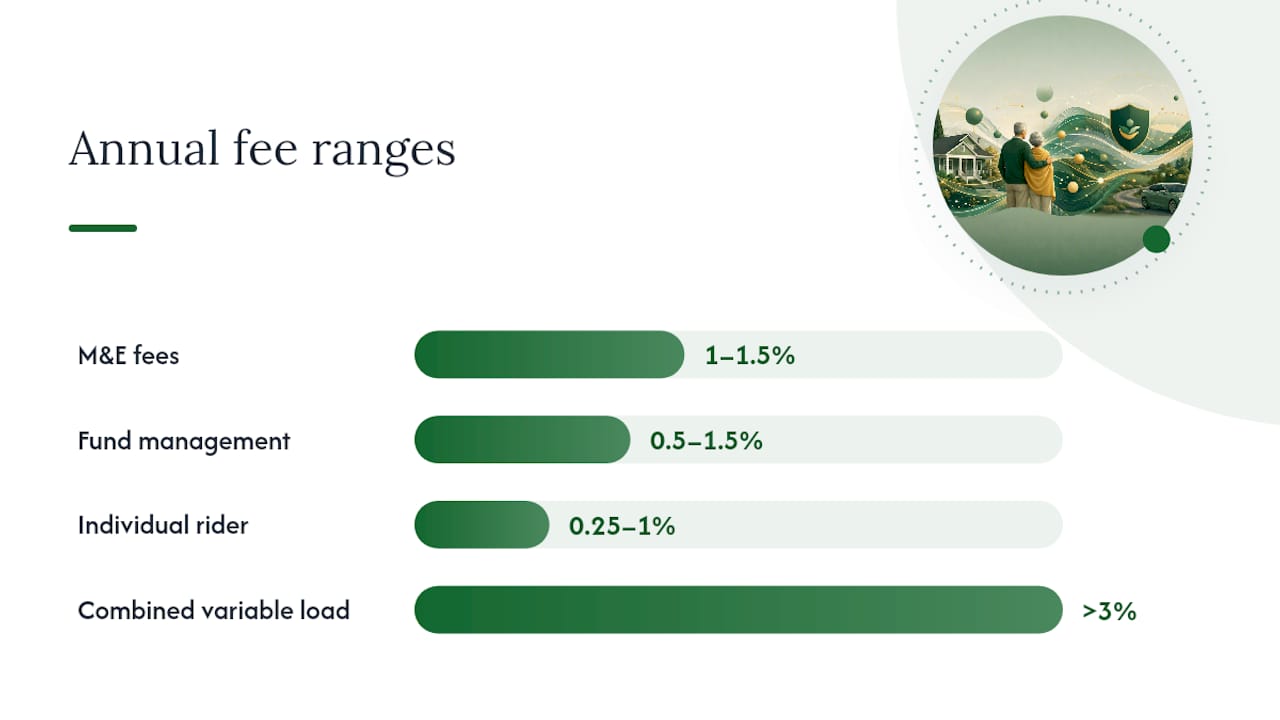
Mortality and expense (M&E) fees apply mainly to variable annuities and typically run between 1% and 1.5% annually. This fee compensates the insurer for the mortality risk it’s taking on and for administrative overhead, and it’s charged whether your subaccounts gain or lose value that year.
Fund management fees apply on top of M&E charges for variable annuities, since the subaccounts holding your money function like mutual funds with their own expense ratios, often another 0.5% to 1.5% depending on the fund lineup.
Rider costs stack on separately. A guaranteed lifetime withdrawal benefit rider, a cost-of-living rider, or an enhanced death benefit rider each typically add somewhere between 0.25% and 1% annually to your total cost. Stack two or three riders on a variable annuity and total annual fees can climb well past 3%, which is a real drag on long-term account growth if the underlying investments aren’t performing strongly.
Fixed annuities and MYGAs largely sidestep this fee structure. The interest rate quoted is usually close to what you’ll actually receive, since there’s no subaccount management and often no rider stack, which is one reason retirees drawn to simplicity gravitate toward fixed products. Fixed-indexed annuities sit in between, generally lower fees than variable contracts but with caps and participation rates that function as a hidden cost of their own. Always ask for the total annual cost in writing, not just the headline rate.
What Retirees Get Wrong About Annuities
The conventional advice on annuities splits into two unhelpful camps. One camp treats them as a scam designed to lock up your money for an insurance salesman’s commission. The other treats them as a magic bullet that solves retirement income anxiety on its own. Neither view survives contact with the actual math.
What the research actually supports is narrower and more useful: annuities work best as a floor, not a foundation. Vanguard’s framing of building predictable income for essentials while investing the remainder for growth is the right mental model, and it’s the one we use with clients. The mistake I see most often isn’t buying an annuity. It’s buying the wrong amount, either too little to matter or so much that liquidity disappears.
The other overlooked point is timing. Retirees fixate on rates and ignore deferral strategy, when a QLAC purchased at 65 with income starting at 82 can outperform a same-size immediate annuity bought at 65 by a wide margin, simply because deferred pricing rewards patience. Prioritize the essential-expense math first, the deferral timeline second, and the carrier comparison third. Rate shopping without that order backwards gets people into contracts that don’t fit their actual gap.
— Zach
How Green Insurance Agency Can Help You Build a Retirement Paycheck
Figuring out whether an annuity belongs in your retirement plan, and which type, carrier, and payout option actually fits your numbers, isn’t something you should sort out alone from a stack of marketing brochures. Our team works with seniors and families in local communities to compare real options, side by side, without the pressure of a call-center script.

A consultation starts with the same essential-expense audit described earlier: what your fixed costs actually are, what Social Security and any pension already cover, and where a genuine income gap exists. From there, we help you compare carrier quotes, walk through payout illustrations, and check financial strength ratings before you commit a dollar. This is the same hands-on, education-first approach that’s built our reputation across hundreds of client reviews in the Orange Park and Fleming Island community.
If you’re weighing an annuity as part of your retirement income plan, request a consultation with Green Insurance Agency and get a straight answer on whether it fits your numbers before you sign anything.
This article is general information, not a substitute for advice from a qualified financial advisor. Consult a qualified financial professional about your own circumstances before acting on anything here.
Sources
- Strategies for optimizing retirement income | BlackRock
- Annuity
- Retirement income security on your terms | Vanguard
- MassMutual RetireEase Review 2026 (AnnuityJournal)
FAQ
How much will a $100,000 annuity pay monthly?
A 65-year-old buying a single-life immediate annuity with $100,000 might see roughly $550 to $650 a month, though the exact figure depends on age, payout option, and current interest rates at the time of purchase.
What did Warren Buffett say about annuities?
Buffett has generally criticized annuities as expensive products that often benefit the salesperson more than the buyer, particularly variable annuities with layered fees, though he has not weighed in specifically on simple fixed or immediate annuities used for guaranteed income.
What is the best type of annuity for retirement income?
There’s no single “best” type. Immediate annuities (SPIAs) suit retirees who need income now, while deferred income annuities and QLACs suit those wanting a late-life longevity hedge; the right choice depends on your age, liquidity needs, and existing income sources.
What does Dave Ramsey say about annuities for retirement?
Ramsey has historically been skeptical of many annuity products, especially variable annuities with high fees, and typically recommends prioritizing low-cost index funds; he’s generally less critical of simple fixed or immediate annuities used narrowly to cover essential expenses.